


The fastest, most reliable way to verify a vacation rental owner is to search county property appraiser or assessor records for the address and match the recorded owner name to the person claiming to be the host. If someone else is listing on the owner’s behalf, we recommend requiring a notarized agent authorization letter and confirming the local short-term rental permit before any money changes hands.
TL;DR:
- Confirm ownership by comparing the county property assessor’s recorded owner name with the host’s identity, as this is the most reliable verification step.
- Request a notarized agent authorization letter and the deed when the property is managed by someone other than the recorded owner, ensuring proper legal authority.
- Verify ownership documents through the county recorder’s office and ensure the deed or property record card matches the rental listing details.
- Check the property’s short-term rental permit status within the jurisdiction, as recent ownership changes may require reapplication and recent deed updates.
- Use secure payment methods like credit cards or platform escrow, and avoid wire transfers or gift cards, especially if documents or identity details do not match county records.
Table of Contents
- Step-by-step verification checklist: records, deed checks, and identity matching
- Documents to collect and how officials validate them
- How local short-term rental permits affect verification
- Red flags, payment safety, and what to do if verification fails
- How Emerald Coast By Owner supports owner verification
- What most verification advice gets wrong
- List your property with verification built in
- FAQ
- Sources
Step-by-step verification checklist: records, deed checks, and identity matching
Ownership verification starts with the property address, not the person’s name. County governments keep free, searchable records that tie every parcel to a legal owner, and that record is the one document a scammer cannot fake without getting caught.
- Look up the address on the county property appraiser or assessor site and note the recorded owner name, parcel ID, and tax mailing address.
- Compare that name to the person or company presenting themselves as the host or owner.
- If the names don’t match, ask who the applicant is and request documentation explaining the relationship (agent, family trust, LLC member).
- Search the county recorder’s office for the most recently recorded deed on that parcel to confirm the chain of title.
- If the owner is a business entity, check the state’s business registry (Florida’s Sunbiz, for example) for the entity’s status and registered agent.
The FTC’s guidance on rental listing scams specifically recommends searching the property address together with the owner or company name in county tax assessment databases. When that search turns up several listings tied to different owner names for the same address, treat it as a warning sign rather than a coincidence.
Reading an assessor record is simple once you know what to look for. The owner name field should match your host. The parcel or assessor ID should match what’s listed in the rental ad, if one is given. The tax mailing address sometimes differs from the rental address, which is normal for absentee owners, but the owner name itself should never be a mystery.
When a property is managed by someone other than the recorded owner, a business card or friendly email isn’t enough. We ask every agent or manager for a notarized agent authorization letter that names the property address, identifies the recorded owner, and explicitly grants permission to advertise and manage short-term rental activity. Our owner communication templates make that request easy to send without sounding accusatory.

Pro Tip: Ask for the deed and the authorization letter in the same message. A legitimate owner or agent will have both ready, since most permitting offices require them anyway.
Documents to collect and how officials validate them
Verifying ownership on paper means collecting a short, specific list of documents, not a stack of guesswork. Some prove ownership outright; others support it when the primary document is unavailable.
- Primary proof: a recorded grant deed or warranty deed, plus a current property record card from the county appraiser.
- Supporting proof: a recent property tax bill, a homestead exemption form, or a mortgage statement where the borrower name matches the claimed owner.
- For entity owners: articles of organization or incorporation, a state business registry extract, and a signed resolution authorizing the listing if the entity requires one.
- For agents and managers: a notarized agent authorization letter naming the owner, the property address, and the specific scope of authority granted.
County recorders and property appraisers maintain the records that let you check whether a deed is genuine. Monroe County’s short-term rental application materials list a current property record card, proof of ownership such as a warranty deed, and notarized agent authorization among the required items for permitting, which gives a useful template for what any owner or manager should be able to produce on request.
| Document | Who provides it | What it confirms |
|---|---|---|
| Recorded grant deed or warranty deed | County recorder’s office | Legal ownership and chain of title |
| Current property record card | County property appraiser | Owner name, parcel ID, assessed details |
| Notarized agent authorization letter | Property owner, notarized | Agent’s legal authority to list and manage |
| State business registry extract | State registry (e.g., Sunbiz) | Entity status and registered agent |
When in doubt, request a certified copy of the deed directly from the county recorder rather than relying on a screenshot the host or agent sends over. Certified copies are accepted by municipalities and carry a traceable public record behind them.
How local short-term rental permits affect verification
Permit requirements depend entirely on jurisdiction, so the first job is figuring out whether the property sits inside city limits or in unincorporated county territory. That distinction decides which office issues the permit and which records you need to check.
- Use the county’s interactive mapping or property search tool to confirm whether the parcel falls under municipal code or unincorporated county rules, since Summit County’s short-term rental portal shows how jurisdiction changes which office handles applications.
- Expect permit applications to require proof of ownership, proof of primary residence where applicable, and notarized consent when the applicant isn’t the owner.
- Check the STR portal for recent renewal dates and current permit status rather than trusting a printed certificate that could be outdated.
- Treat a recently recorded deed as a reason to double-check permit status, since a change in ownership often requires the new owner to reapply under their own name before renting legally.
Municipal registration pages, like the City of Tamarac’s vacation rental registration requirements, commonly spell out that a notarized owner authorization letter is required whenever an agent applies instead of the owner, which backs up what most county permitting offices expect as well.
Red flags, payment safety, and what to do if verification fails
Some warning signs show up before you ever request a document. A listing that’s been posted by several different “owners” for the same address, a host who won’t provide notarized authorization, photos that appear lifted from another site, or a price that’s noticeably below comparable rentals all point toward a problem.
- Pause any booking or payment the moment names, documents, or photos don’t line up.
- Request certified copies of the deed or permit and call the county recorder or assessor’s office directly to confirm they match.
- Document every message, document, and phone call in case you need to report the listing later.
- Report suspected fraud to local law enforcement and file a complaint with the FTC’s rental listing scam reporting process, which also flags hijacked listings where scammers copy real photos and swap in new contact details.
Payment method matters just as much as paperwork. Credit cards and platform escrow give you a way to dispute a charge; wire transfers and gift cards don’t, which is exactly why scammers prefer them.
Pro Tip: Before paying anything, search the property address on the owner’s or management company’s official site. If it isn’t listed there, treat the request with suspicion.
How Emerald Coast By Owner supports owner verification
Our marketplace is built around owner-managed Gulf Coast listings rather than anonymous third-party postings. Our blog includes communication templates and verification guidance aimed at keeping document requests professional, which gives owners and managers a practical starting point instead of a blank page.
What most verification advice gets wrong
Most guidance on this topic treats verification like a one-time checkbox: pull a deed, get a signature, move on. That misses how ownership actually changes. A deed recorded 60 days ago can be entirely legitimate and still leave a county permit in someone else’s name, which is a mismatch worth questioning rather than a scam by default.

The bigger gap is politeness, not paperwork. Owners get defensive when asked for notarized authorization out of nowhere, and managers often don’t carry one because nobody’s asked before. The fix isn’t more documents; it’s asking for the right two, the deed and the authorization letter, in the same message, framed as routine rather than accusatory.
If we had to rank priorities, matching the county assessor record to the host’s name comes first, every time, because it’s free, fast, and the hardest thing to fake. Permits and notarized letters matter, but they’re confirmation, not the first move.
— Tayler
List your property with verification built in
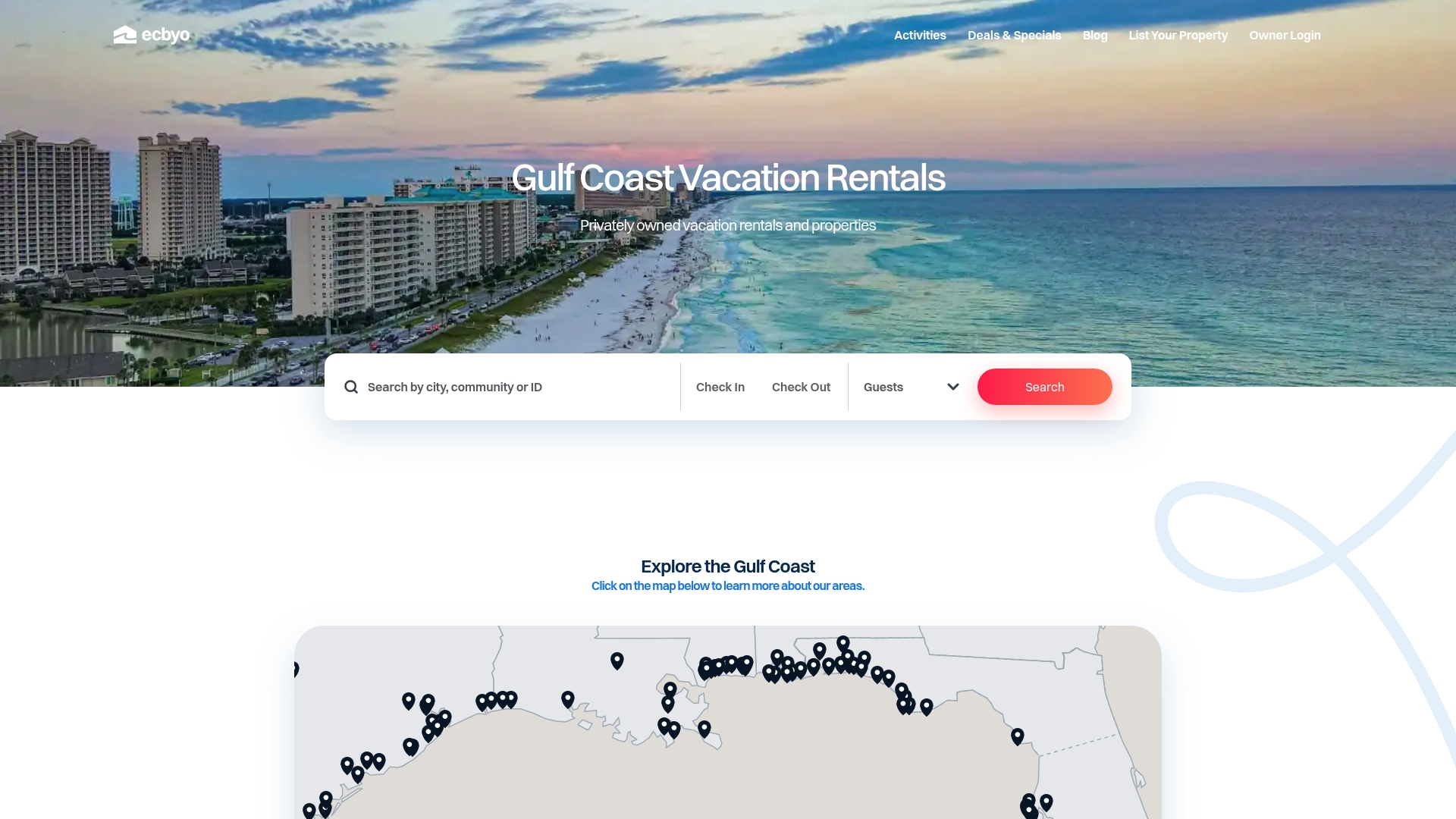
We built our listing process around owner-managed Gulf Coast rentals, so travelers searching our marketplace are already looking at properties tied to a real owner rather than an anonymous ad. When you list your property with a subscription, your listing sits alongside other owner-run rentals across multiple Gulf Coast states, with no traveler booking or service fees.
- Use our owner communication templates to request authorization letters or deed copies without awkward back-and-forth.
- Browse owner-managed rental background for Gulf Coast-specific verification context.
- List directly and reach travelers searching Florida Vacation Rentals, Alabama Vacation Rentals, Louisiana Vacation Rentals, and Texas Vacation Rentals.
Ready to list? Start your ECBYO subscription today.
FAQ
What’s the quickest way to confirm who owns a vacation rental?
Search the property address on the county property appraiser or assessor site and compare the recorded owner name to the person claiming to be the host. The FTC recommends this exact approach as a first check against rental listing scams.
What document proves a property manager has authority to list a rental?
A notarized agent authorization letter naming the property address, the recorded owner, and the specific authority granted is the standard proof. Municipal registration pages, including Tamarac’s vacation rental rules, require this letter whenever an agent applies instead of the owner.
Why would a short-term rental permit be denied even with a valid deed?
Permits are tied to jurisdiction and to the name on file with that specific office, so a recently recorded deed can leave the old owner’s name on the permit until the new owner reapplies. Checking whether the property sits in city limits or unincorporated county territory, as outlined on portals like Summit County’s STR application page, clarifies which office to contact.
What payment methods are safest when booking directly from an owner?
Credit card payments and platform escrow give you dispute options that wire transfers and gift cards don’t. The FTC warns that scammers favor untraceable payment methods precisely because those funds can’t be recovered once sent.
What should I do if the owner’s documents don’t match county records?
Pause the booking, request certified copies of the deed from the county recorder, and call the assessor’s office directly to confirm the details. If the mismatch looks intentional, report it to local law enforcement and file a complaint through the FTC’s rental scam guidance.
Sources
- Rental listing scams | Consumer Advice (FTC)
- Vacation Rental Property Registration (City of Tamarac)
- Monroe County - Vacation Rental initial application (sample materials)
- Summit County - Short term rentals license applications
Recommended
- Avoid Fines and Booking Suspensions: Gulf Coast Rental Agreement
- Verify Ownership: Book Gulf Coast Owner Managed Rentals Direct No Fees
- Avoid Scams: Contact Gulf Coast Rental Owners Safely

About the Author
Tayler Jaeger of the Emerald Coast by Owner Editorial Team creates destination guides, vacation-planning resources, and local travel content focused exclusively on Gulf Coast vacation rentals.
Our team researches beach communities, vacation rental trends, family travel planning, local attractions, and direct-booking best practices across Florida, Alabama, Mississippi, Louisiana, and Texas. Every guide is written to help travelers make more informed booking decisions while avoiding unnecessary third-party guest service fees.
Since launching in 2016, Emerald Coast by Owner has helped connect travelers directly with verified vacation rental hosts across the Gulf Coast.
This article was reviewed for accuracy and updated using local destination research and current vacation rental market insights.


