


TL;DR: Beach Vacation Budget
A one-week beach vacation in 2026 can cost roughly $1,500–$2,500 for a budget-conscious family of four, while midrange trips can reach $5,000 or more. Lodging and food are typically the biggest expenses, so choosing a driveable Gulf Coast destination, booking a vacation rental with a kitchen, and traveling during shoulder season can significantly reduce costs. Travelers can save even more by choosing second-row accommodations, bringing beach gear, splitting a larger rental with another family, and booking directly with property owners. Gulf Shores, Navarre Beach, and South Padre Island are strong options for affordable beach vacations.
A beach vacation budget is the planned total you commit to before you leave, covering lodging, transportation, food, activities, beach extras, gear, and a contingency buffer. For a U.S. trip, that amount varies widely depending on party size, destination, and travel style.
Here’s a quick snapshot of what real beach trips cost for common party sizes and styles:
- Budget (drive + vacation rental with kitchen, minimal paid activities): typical costs for solo travelers and families
- Midrange (flight or beachfront hotel, mix of dining out and cooking): typical costs for couples and families
- Splurge (resort, premium Gulf Coast or California location, guided activities): higher-end costs for families
The two biggest budget drivers, by a wide margin, are lodging and food. Control those two line items and the rest of the budget becomes manageable. For families especially, a vacation rental with a kitchen plus a driveable Gulf Coast destination is the combination that consistently delivers the best value.
Typical budget categories for different party sizes over 5–7 night U.S. beach trips vary widely without fixed numeric ranges. Budget trips generally involve driving and rental kitchens; midrange trips often include flights or hotels with some dining out; splurge trips typically feature resorts or premium destinations with guided activities.

Table of Contents
- What should you include in a beach vacation budget?
- How do you calculate a beach vacation budget?
- What do realistic sample budgets look like by scenario?
- What hidden costs make real beach trips more expensive?
- How can you lower the total cost of a beach vacation?
- Why does booking direct save money on beach rentals?
- When should you book flights, lodging, and activities?
- Key Takeaways
- A Gulf Coast perspective on what budgets actually look like
- Gulf Coast owner-direct rentals that fit your budget
- Useful sources for deeper beach vacation planning
- FAQ
What should you include in a beach vacation budget?
A solid beach trip budget accounts for every category that pulls money from your wallet, not just the headline lodging rate. Here’s the full checklist:
Primary line items:
- Lodging: nightly rate + cleaning fee + platform or service fees + lodging taxes + resort/destination fees + damage waiver
- Transportation: gas or flights + car rental or rideshare + parking at destination
- Food: groceries for in-unit meals + dining out + coffee and snacks
- Activities and attractions: paid tours, water sports, mini-golf, aquariums
- Beach extras: chair and umbrella rentals, parking or beach-access passes, board rentals — these costs vary depending on location and duration.
- Gear and groceries: sunscreen, coolers, beach toys, first-aid basics
- Pre/post-trip costs: pet boarding, house-sitting, airport parking, travel insurance
Sub-items travelers routinely miss:
- Cleaning fees are fixed per stay, so a 2-night booking carries the same fee as a 7-night one. Short stays are disproportionately expensive per night.
- Platform service fees are calculated as a percentage of the booking total and appear only at checkout.
- Resort or destination fees are charged nightly by some properties, separate from the quoted rate.
When planning for a group, calculate a per-person daily cap by dividing your total budget by the number of travelers and the number of nights. That single number makes daily spending decisions fast and clear.
How do you calculate a beach vacation budget?
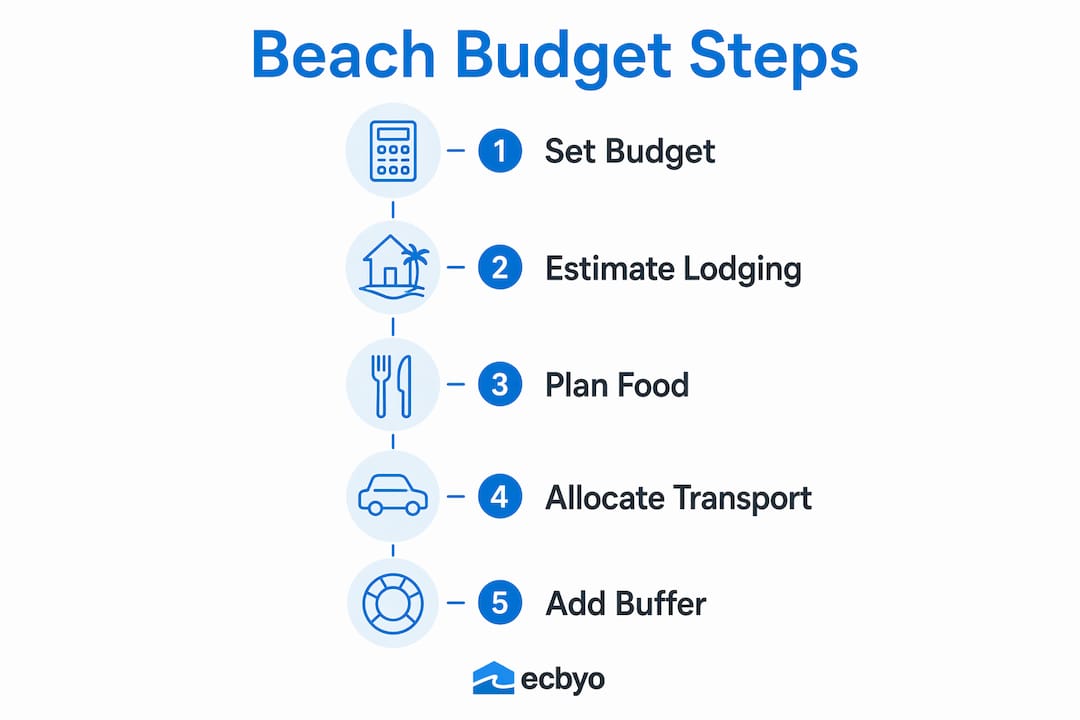
The formula is straightforward: Total = Lodging + Transportation + Food + Activities + Beach Extras + Buffer. A layered budgeting approach that works through each category in sequence is the most reliable way to avoid gaps.
Step-by-step:
- Define your trip: number of travelers, number of nights, destination
- Estimate the full lodging stack: nightly rate × nights + cleaning fee + taxes + all mandatory fees (not just the headline rate)
- Choose your travel method: gas cost for a road trip, or round-trip airfare + car rental for a fly-to destination
- Set a daily food plan: estimate per-person daily food spend, then multiply by nights. Families who cook most meals in a rental kitchen typically save compared with eating every meal out.
- List activities with costs: research admission prices and tour fees before you go
- Add beach extras: chair rentals, parking passes, gear
- Add a 10–20% buffer on top of the subtotal
Converting to per-person or per-day amounts:
- Per-person total = Trip total ÷ number of travelers
- Per-day cap = Trip total ÷ number of nights
- Per-person per day = Trip total ÷ (travelers × nights)
Example: A family of four can expect to spend between $1,500 and $2,500 for a week-long U.S. beach trip by driving and using a rental with a kitchen, which helps keep food costs down.
Pro Tip: Use a percentage buffer around 15% for longer trips to cover daily overruns. For short trips of a few nights, consider a fixed-dollar buffer sufficient to cover typical unexpected expenses.
What do realistic sample budgets look like by scenario?
The three templates below use real U.S. cost ranges. Plug in your own destination and dates to adjust.
Solo traveler, 5 nights, Gulf Coast shoulder season
| Line Item | Estimated Cost |
|---|---|
| Lodging (studio rental, full stack) | $600 |
| Transportation (drive, gas) | $80 |
| Food (mix of cooking + dining out) | $200 |
| Activities | $75 |
| Beach extras | $50 |
| Buffer (15%) | $152 |
Couple, 6 nights, Florida Panhandle midrange
| Line Item | Estimated Cost |
|---|---|
| Lodging (1BR condo, full stack) | $1,200 |
| Transportation (drive) | $120 |
| Food (mix of cooking + dining out) | $480 |
| Activities | $200 |
| Beach extras | $150 |
| Buffer (15%) | $323 |
Family of four, 7 nights, Gulf Shores budget trip
| Line Item | Estimated Cost |
|---|---|
| Lodging (2BR rental, full stack) | $1,400–$2,200 |
| Transportation (drive) | $150 |
| Food (mostly cooking in-unit) | $400 |
| Activities | $150 |
| Beach extras | $200 |
| Buffer (15%) | $345 |
Regional cost notes:
- Gulf Coast (Alabama/Mississippi): Gulf Shores and Orange Beach generally offer more affordable accommodations compared to Destin.
- Florida Panhandle: Pensacola Beach and Navarre Beach tend to be more budget-friendly than Destin.
- California coast: San Diego’s budget costs for families tend to be higher than typical Gulf Coast drive-to trips.
- Airfare impact: Flying typically adds several hundred dollars per person round-trip for domestic summer travel, substantially increasing transportation costs.
Copyable budget template (paste into a spreadsheet or notes app):
- Lodging (full stack): $___
- Transportation: $___
- Food: $___
- Activities: $___
- Beach extras: $___
- Subtotal: $___
- Buffer (15%): $___
- Trip total: $___
- Per-person total: $___
- Per-day cap: $___
What hidden costs make real beach trips more expensive?
The headline nightly rate on most listing sites is only part of what you’ll pay. Mandatory fees can add 40–70% to the listed nightly rate, which means the rate you see first is often just 55–65% of your actual lodging cost.
Common hidden charges to price before you book:
- Cleaning fees (fixed per stay, not per night)
- Platform or service fees (percentage of booking total)
- Lodging and sales taxes (vary by state and county)
- Resort or destination fees (nightly, separate from the quoted rate)
- Damage waivers or security deposits
- Parking passes or beach-access permits
- Equipment rentals (chairs, umbrellas, boards, kayaks)
- Convenience-store and resort-area food markups
Short stays are where hidden fees hit hardest. A $150 cleaning fee spread over 2 nights adds $75 per night to your effective rate. Spread over 7 nights, it adds just $21 per night. Booking at least 5–7 nights is one of the simplest ways to reduce the per-night impact of fixed fees.
Pro Tip: Before booking, ask the owner or manager these four questions: What is the total cost including all fees and taxes? Is there a damage waiver or deposit, and how is it returned? Is parking included or charged separately? Are there any resort or destination fees not shown in the listing? Getting answers upfront prevents checkout-page surprises.
How can you lower the total cost of a beach vacation?
The highest-leverage moves target lodging and food first, since those two categories typically represent 60–70% of total beach trip costs.
- Choose a driveable destination. Removing airfare saves $300–$800+ per person. Gulf Coast destinations like Gulf Shores, Navarre Beach, and South Padre Island are within driving range for a large portion of the U.S. population.
- Book a rental with a kitchen. Cooking most meals saves a family of four $250–$400 per week versus eating every meal out.
- Travel in shoulder season. Accommodation rates drop roughly 30–40% below peak summer prices in early June and September through early October. October on the Gulf Coast is a particularly strong value window: water temperatures stay in the mid-70s°F and crowds thin significantly after Labor Day.
- Book direct with owners or managers. Direct booking avoids platform service fees and can unlock discounts for longer stays or last-minute availability that third-party sites don’t show.
- Choose second-row over Gulf-front. Properties across the street from the beach typically run 30–40% less than Gulf-front units and are still a short walk to the sand.
- Split costs with another family or group. A Gulf-front condo sleeping six at $2,500 per week works out to roughly $60 per person per night, less than most budget hotel rooms.
- Bring your own gear. Renting chairs and umbrellas for a week costs $250–$400. A set of beach chairs and an umbrella purchased before the trip often pays for itself on a single vacation.
For activities, look for free or low-cost options first: Gulf State Park trails ($5 per vehicle), pier fishing (included with park entry), shelling, and dolphin watching from shore are all genuinely enjoyable and cost almost nothing. When you do book a paid activity, budget boat tours for families are often more affordable when booked directly with local operators rather than through hotel concierge desks.
Pro Tip: Evaluate any lodging “deal” by calculating the full lodging stack, not the headline nightly rate. Divide the total checkout price (including all fees and taxes) by the number of nights to get the true effective nightly rate. A $120/night listing with a $200 cleaning fee and $180 in taxes on a 3-night stay has an effective rate of $193/night, not $120.

Why does booking direct save money on beach rentals?
Booking directly with a property owner or local manager typically saves travelers 8–18% compared with third-party platforms because it eliminates traveler service fees calculated as a percentage of the booking total. On a $2,000 Gulf Coast rental, that’s $160–$360 back in your pocket.
Beyond the fee savings, direct booking can unlock discounts that third-party sites simply don’t show: longer-stay rates, off-peak pricing, and last-minute gap discounts when an owner would rather fill an empty week than leave it vacant.
Practical steps for booking direct:
- Search for owner-direct marketplaces like Emeraldcoastbyowner, which connects travelers to Gulf Coast vacation rentals without charging guest service fees
- Contact the owner or manager directly through the listing to ask about total pricing, availability, and any unpublished discounts
- Ask about longer-stay discounts (many owners offer 10–15% off for 10+ night bookings)
- Confirm payment methods: legitimate owners accept credit cards or checks, not wire transfers or gift cards
- Request a written rental agreement before sending any payment
Red flags to watch: requests for payment via wire transfer, no written contract, no verifiable owner profile, or pressure to complete the transaction outside the platform.
Pro Tip: When contacting an owner directly, mention your exact dates and group size and ask: “Do you have any unpublished discounts for this window?” Many owners have flexibility, especially for shoulder-season dates or stays that fill a gap between existing bookings. The worst answer is no.
For a deeper look at owner-direct beach rentals on the Gulf Coast, Emeraldcoastbyowner’s blog covers the full process.
When should you book flights, lodging, and activities?
Timing your bookings correctly can save hundreds of dollars and protect your flexibility if plans change.
Booking windows by category:
- Lodging: Book 8+ weeks before departure for the best price-to-availability balance. Peak summer Gulf Coast rentals in popular areas often fill 3–6 months out; waiting until 2–3 weeks before departure in peak season means paying more for what’s left.
- Flights: Domestic summer fares typically show their best prices 6–12 weeks before departure. Booking earlier than 12 weeks out rarely saves money; booking inside 3 weeks almost always costs more.
- Car rentals: Book as early as possible, then check prices again 2–3 weeks out. Rates fluctuate and re-booking at a lower rate (with free cancellation) is common.
- Activities and tours: Book popular tours (dolphin cruises, snorkeling trips, paddleboard lessons) at least 2–3 weeks ahead in peak season. Many operators offer early-booking discounts. For saving on family boat tours, booking directly with local operators rather than through aggregators often yields the best rate.
- Deposits and cancellation: Most vacation rentals require a deposit (25–50% of total) at booking, with the balance due 30–60 days before arrival. Read cancellation policies carefully before paying; non-refundable deposits are common in peak season.
Flexible dates save money. Shifting arrival by even one or two days can reduce lodging costs noticeably, particularly when a Saturday-to-Saturday rental week carries a premium over a Sunday-to-Friday stay at the same property.
Key Takeaways
A beach vacation budget is the planned total covering lodging, transportation, food, activities, beach extras, and a 10–20% buffer, with lodging and food typically representing 60–70% of the total.
| Point | Details |
|---|---|
| Control lodging and food first | These two categories drive 60–70% of total trip cost; a rental with a kitchen is the single highest-leverage budget move. |
| Always check the full lodging stack | Mandatory fees can add 40–70% to the headline nightly rate; divide total checkout cost by nights to find the true effective rate. |
| Travel shoulder season | Accommodation rates drop roughly 30–40% below peak summer prices in early June and September through early October. |
| Use a 10–20% buffer | Add 15% on top of your subtotal for trips of 5+ nights; use a fixed $200–$300 buffer for short 2–3 night stays. |
| Book direct via Emeraldcoastbyowner | Owner-direct Gulf Coast bookings through Emeraldcoastbyowner avoid guest service fees and can save travelers 8–18% on lodging. |
A Gulf Coast perspective on what budgets actually look like
The most consistent pattern in Gulf Coast vacation rental behavior is that travelers underestimate their lodging costs and overestimate their food savings. They see a $180/night listing, mentally multiply by five nights, and write down $900. The actual checkout total, after cleaning fees, taxes, and platform charges, is often $1,400 or more. That gap, roughly $500 on a single booking, is where most beach trip budgets fall apart before the trip even starts.
The fix is simple but requires a habit change: always request or calculate the full checkout total before comparing properties. Two listings at the same headline rate can have checkout totals that differ by $300–$500 depending on how fees are structured.
On the food side, families consistently overestimate how much they’ll cook. A realistic split for a family of four is two meals per day in the rental and one dinner out. That still saves $250–$400 over the week compared with eating every meal at a restaurant, but it’s a more honest number than “we’ll cook everything.”
The Gulf Coast remains one of the best-value beach regions in the country for families who drive, book direct, and travel in September or October. The water is still warm, the beaches are uncrowded, and the rental rates are genuinely lower. That combination, not any single trick, is what makes a beach vacation feel affordable.
Gulf Coast owner-direct rentals that fit your budget
Lodging is the largest single line item in any beach vacation budget, and it’s also the one where booking strategy makes the biggest difference. Emeraldcoastbyowner connects travelers directly with Gulf Coast property owners across Florida, Alabama, Mississippi, Louisiana, and Texas, with no guest service fees added at checkout.
That fee structure means the price you see when you contact an owner is closer to the price you pay. For a family booking a $2,000 Gulf Coast rental, skipping the platform service fee alone can save $160–$360. Browse Florida vacation rentals or search the full Gulf Coast inventory at Emeraldcoastbyowner.com to compare owner-direct properties by location, size, and amenities. Check the deals and specials page for current owner-listed discounts, particularly for shoulder-season dates where savings stack on top of already-lower rates.
Useful sources for deeper beach vacation planning
These resources back the figures and guidance in this article. Prices and availability change by season, so confirm current rates before booking.
- 8 Budget Family Beach Vacations 2026: From $1,500/Week — destination-specific budget bands and kitchen savings data
- Family Beach Vacation Planning (2026 Guide) — booking windows, food savings, and step-by-step planning
- Real Cost of a Family Beach Vacation | Ardent Workshop — hidden fee breakdowns and full lodging stack analysis
- Beach Vacation Budget Planner for Summer Trips — layered budgeting formula and planner tool
- Gulf Coast on a Budget | Gulf Coast Beach Vibes — destination-by-destination Gulf Coast cost comparisons
- Gulf Coast Vacation Cost Index | Able Airport Shuttle — seasonal pricing data across seven Gulf Coast destinations
- How to Save on Vacation Rentals: Gulf Coast Direct Booking — direct booking savings explained
- Budgeting for the Beach | MilSpouse Money Mission — practical budgeting framework for beach trips
- Emeraldcoastbyowner.com — owner-direct Gulf Coast vacation rental marketplace (no guest service fees)
Prices vary by season, region, and property. Always confirm current rates and total checkout costs directly with the owner or listing before finalizing your budget.
FAQ
How much should you budget for a beach trip?
A budget beach trip for a family of four who drive and use a rental with a kitchen typically costs between $1,500 and $2,500 for a week in 2026, depending on destination and travel style; midrange and splurge trips will cost more.
Is $5,000 enough for a beach vacation?
Yes, a budget around the midrange template costs can cover a comfortable week at many U.S. Gulf Coast destinations for a family of four, including lodging, food, activities, and a buffer. Splurge trip costs vary widely for couples or solo travelers at premium locations.
Where is the most affordable beach vacation in the U.S.?
Gulf Shores, Alabama, and South Padre Island, Texas, are among the most affordable U.S. beach destinations for families, as reflected in the budget template costs. Myrtle Beach, South Carolina, also offers budget options that are more affordable than many Caribbean destinations.
Is $2,000 a lot for a beach vacation?
$2,000 is a realistic total for a couple on a 5–6 night Gulf Coast trip or a small family on a tight budget. It’s not a lot for a family of four flying to a premium Florida destination, where lodging alone can exceed that figure for a week.
Recommended
- Beachfront Access Rentals: What Vacationers Should Know | ECBYO
- Renting Gulf Property for Two Weeks: A Family Guide | ECBYO
- Things to Do on a Destin Florida Vacation: 2026 Guide | ECBYO
- Types of Gulf Coast Beach Rentals: Your 2026 Guide | ECBYO

About the Author
Joe Godar of the Emerald Coast by Owner Editorial Team creates destination guides, vacation-planning resources, and local travel content focused exclusively on Gulf Coast vacation rentals.
Our team researches beach communities, vacation rental trends, family travel planning, local attractions, and direct-booking best practices across Florida, Alabama, Mississippi, Louisiana, and Texas. Every guide is written to help travelers make more informed booking decisions while avoiding unnecessary third-party guest service fees.
Since launching in 2016, Emerald Coast by Owner has helped connect travelers directly with verified vacation rental hosts across the Gulf Coast.
This article was reviewed for accuracy and updated using local destination research and current vacation rental market insights.


