


If you own a Gulf Coast condo or beach house and list it on Vrbo, the commission now takes a bigger bite of every booking. The best response is a mix of three things: price your Vrbo calendar for the new math, track what you actually net per booking, and build a second path that brings guests to you without a percentage attached. A flat-fee listing is the cleanest version of that second path, and it is what we built Emerald Coast By Owner (ECBYO) around.
This guide covers what changed, how the fee is calculated, what it costs on a typical Gulf Coast week, and what to do about it.
TL;DR
- For affected properties, Vrbo charges a flat 12% commission on new bookings made on or after October 29, 2026, calculated on the rental amount plus guest fees such as cleaning and pet fees.
- The traveler service fee stays. The 12% is charged to the host on top of it, so guests still see a higher total than your nightly rate.
- Raising your Vrbo rate by 12% does not cover a 12% commission. You need roughly 13.64% to net the same amount.
- Check each payout statement against your own math, because software and platform billing can differ by small amounts.
- Repeat guests and direct inquiries are the commission-free part of your business. A flat annual listing, like ECBYO’s $499 per year, lets you grow that part.
Table of Contents
- What changed with Vrbo’s commission
- What the 12% is charged on
- What 12% costs on a real Gulf Coast week
- Six things owners can do about it
- Why a flat annual fee suits Gulf Coast owners
- Perspective
- List where Gulf Coast guests already look
- Putting it together: a 30-minute plan
- FAQ
- Sources
What changed with Vrbo’s commission
Vrbo used to give hosts a choice of fee structures. Software providers report that Vrbo announced on September 29, 2026 that those options merge into one flat 12% commission, effective October 29, 2026. Owners still on the older annual subscription move to the pay-per-booking model at the same rate.
The pay-per-booking model was previously much cheaper for many owners. The same report puts the old pay-per-booking cost at about 8%, made up of a 5% commission plus 3% payment processing. The 12% figure replaces that. According to Guesty’s channel commission guide, the 12% for U.S. partners previously paying less includes the 3% payment processing fee. So the jump is from about 8% all in to 12% all in, not from 5% to 12% plus processing.
Two things did not change:
- The traveler service fee. It is charged to guests and is separate from your commission. Our own breakdown of it is in what the Vrbo service fee costs.
- Your control over your nightly rate. You set the price. What you can’t control is how much of it is left after the platform takes its share.
The exact terms can differ by property, account type and software connection, so confirm yours in your Vrbo owner account before you change anything.
What the 12% is charged on
This is where owners get surprised. The commission is not on your nightly rate alone. Vrbo calculates it on the rental amount and applicable guest fees, such as cleaning and pet fees. Guesty’s guide adds that the charge covers accommodation fare, cleaning and other mandatory fees, but not taxes, refundable damage deposits or fees collected during the stay. It also says the commission is refunded if a cancellation occurs after the fee is charged.
| Charge on the reservation | Included in the 12%? |
|---|---|
| Nightly rent for the stay | Yes |
| Cleaning fee | Yes |
| Pet fee and other mandatory fees | Yes |
| Taxes | No |
| Refundable damage deposit | No |
| Fees collected during the stay | No |
The practical lesson: a cleaning fee is not a pass-through. If you charge $200 to cover your cleaner, Vrbo takes $24 of it, and your cleaner still needs $200.
What 12% costs on a real Gulf Coast week
Take a one-week stay at a Destin or Gulf Shores condo with $2,800 in rent and a $200 cleaning fee. The commissionable amount is $3,000. These figures are our own arithmetic, shown to illustrate the math.
| At about 8% (old pay-per-booking) | At 12% | |
|---|---|---|
| Commissionable amount | $3,000 | $3,000 |
| Commission and processing | $240 | $360 |
| What you keep before cleaning and taxes | $2,760 | $2,640 |
| Difference per booking | $120 less |
Now scale it. Ten of those weeks a year is $1,200 more in commission. Thirty weeks is $3,600. Owners with a short peak season, such as a Midwest-driven summer on Orange Beach, feel it in a few high-value bookings. Owners of year-round properties feel it across dozens of smaller ones.
For comparison, the whole ECBYO subscription is $499 per year. The 12% on a single $3,000 week is $360. Two such bookings through a percentage platform cost more than a year of a flat listing.

Six things owners can do about it
1. Raise your Vrbo rates by the right amount
The obvious fix is to add 12% to your Vrbo rate. It falls short. Because the commission is charged on the higher amount, a 12% increase leaves you under target. OwnerRez explains that you would need to raise rent and surcharges by about 13.64%. Its example: a $100 nightly rate becomes $113.64, which leaves about $100 after the 12% commission.
The formula is simple: divide your target amount by 0.88. A $3,000 target becomes $3,409.09 on the platform, and 12% of that is $409.09.
2. Raise rates on that channel only
If you use a property management system or channel manager, look for a per-channel rate adjustment. It lets you raise prices on one platform without changing what you charge on your own website or elsewhere. OwnerRez notes that this tool exists but will not apply the increase automatically, so you have to set it.
This matters for the guest. A traveler who compares a platform price against a direct price should see the direct one lower. That is a fair reflection of the lower cost behind it.
3. Decide how much to absorb
You do not have to pass on the full amount. Some owners raise rates by half the difference and accept a smaller margin on high-demand dates, while passing on the full amount on weeks that already sell out. Peak weeks such as spring break and the Fourth of July on the Emerald Coast are good candidates for a full increase. Shoulder-season weeks, where a higher price might leave the calendar empty, are better to hold.
Ask three questions for each season:
- Does this week usually book without a discount?
- Does a competing listing nearby cost less on the same platform?
- Would an empty night cost me more than the commission I would save?
4. Audit your payouts
At the end of each month, match each payout to the reservation. Check that:
- the commission is applied only to rent and mandatory fees, not taxes or refundable deposits;
- cancelled stays show the commission refunded, as Guesty’s guide describes;
- the figure in your property management system matches the platform payout.
Small gaps can appear. According to Guesty, Vrbo does not send per-reservation commission information to it, so its own calculation and the platform’s billing can differ slightly. A spreadsheet with four columns (booking total, commissionable amount, commission, payout) is enough to spot a pattern.
5. Compare net revenue by channel, not gross
A booking at $3,409 gross on one platform and $3,000 on another may leave you with the same money, or not. Add the commission, any payment processing, the guest’s extra fees that make your listing look more expensive, and the time each booking takes. Only net revenue per available night tells you which channel earns its place.
| Channel | Gross price | Platform cost | Net to you |
|---|---|---|---|
| Percentage platform at 12% | $3,409.09 | $409.09 | $3,000 |
| Direct inquiry at a flat listing price | $3,000 | $0 per booking | $3,000 |
The second line has no per-booking commission, but it does need a way to be found. That is step six.
6. Build the part of your calendar the commission cannot touch
Every guest who books you directly is a booking with no percentage taken. That includes your returning guests, referrals, and travelers who find you on a marketplace where you pay one price per year instead of per stay. Our guide on capturing contacts to win direct bookings covers how owners with fewer than 30 units can do this without a big budget. Low-cost tactics for the first 90 days and direct-booking search optimization go deeper on the how.
A few moves that work for owners on the Gulf:
- Put a note in your welcome book and checkout message inviting guests to rebook directly for next year.
- Collect a guest email with permission at booking or check-in.
- Keep a clear owner profile with real photos and a plain description of the house, the beach access and the neighborhood.
- List where travelers already search specifically for Gulf Coast stays.
Why a flat annual fee suits Gulf Coast owners
Percentage fees punish success. The more your property earns, the more the platform takes. A beachfront house in Miramar Beach that books at $4,500 a week pays three times what a $1,500 Galveston cottage pays, for the same listing and the same service.
A flat fee reverses that. The $499 annual subscription is the same whether you book three weeks or thirty. For luxury owners, the math improves with each premium week. For budget owners, it keeps small bookings from being eaten by percentages.

Travelers benefit too. ECBYO charges guests no service fees, and its owners communicate directly with guests. A traveler comparing a total with a platform service fee against a direct quote from an owner sees the difference right away. That helps your listing stay competitive without lowering your rate.
Perspective
Since we started in November 2016 with 350 listings, our idea has not changed: guests and owners should be able to find each other without a toll booth in between. When a platform moves from about 8% to 12%, owners tell the same story. The number looks small in a percentage and large on a July statement.
Our view is that no single channel should decide your margin. Keep a presence wherever guests search, but make sure part of your calendar comes from a place where you pay one clear price and talk straight to the traveler. Our whole focus is the Gulf Coast, from Florida to Alabama, Mississippi, Louisiana and Texas, so the guests who see your listing are already looking for a beach trip here.
Owners who treat direct bookings as a long-term asset, not a backup, are the ones who feel least pressure when any platform changes its fees.
Tayler
List where Gulf Coast guests already look
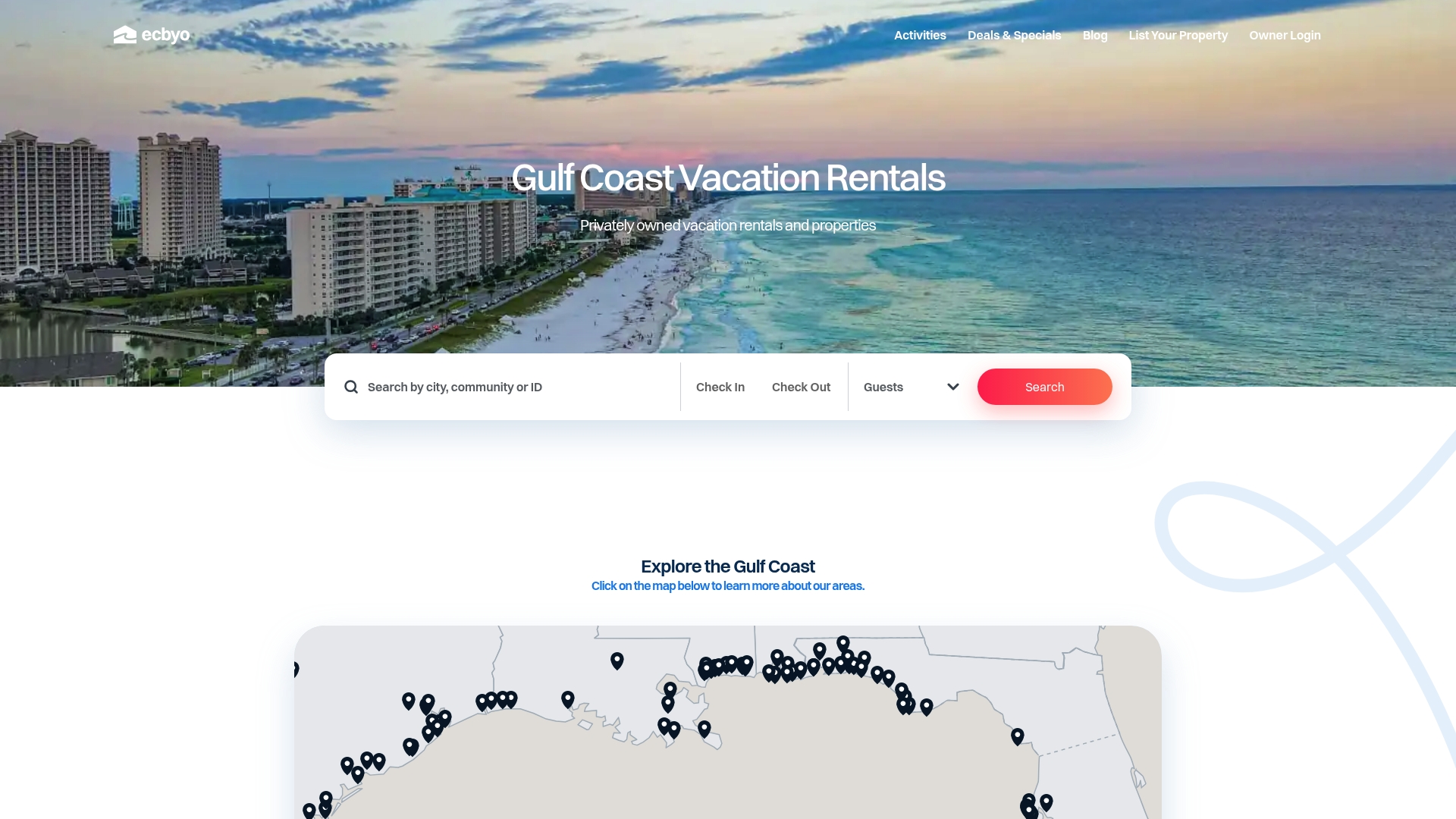
ECBYO is an online marketplace where travelers search and book vacation homes, condos, villas, cottages and resorts directly from owners. Guests use map-based search, owner profiles and detailed listings, and they can contact you directly. Listings can be seen across Florida, Alabama, Mississippi, Louisiana and Texas, with filters for pet-friendly, beachfront, luxury and budget stays.
The owner subscription is $499 per year. You can see how it works and start on the list your property page.
Putting it together: a 30-minute plan
- Open your last 10 Vrbo payouts and calculate the effective commission on each.
- Set a channel-specific rate using the divide-by-0.88 formula for your peak weeks.
- Decide your shoulder-season stance: absorb, split or pass on.
- Add a rebook note to your guest messages.
- Create or update a second listing on a flat-fee marketplace, with the same photos and an honest description.
- Review in 90 days: compare net revenue per booked night by channel.
FAQ
When did Vrbo’s 12% commission start?
For affected properties, it applies to new bookings made on or after October 29, 2026, according to OwnerRez’s summary. Bookings made before that date stay under the earlier terms. Check your Vrbo owner account for the details on your property.
Does the 12% apply to cleaning fees and taxes?
It applies to cleaning, pet and other mandatory guest fees along with the rent. Per Guesty’s guide, it does not apply to taxes, refundable damage deposits or fees collected during the stay. Because cleaning is included, your cleaning fee needs to cover the commission on itself.
Can I raise my Vrbo price without changing my other listings?
If your property management system supports per-channel rate adjustments, yes. You raise rates only for that channel and leave your own site and other listings alone. To net the same amount, increase by about 13.64%, not 12%.
Is the traveler service fee gone?
No. Vrbo’s traveler service fee is not going away, and the 12% is charged to the host in addition to it. Guests pay their fee and you pay your commission. Our guide on how the traveler fee is calculated explains the guest side.
Sources
- OwnerRez: Vrbo is changing its commission fee to 12%
- Smoobu: Vrbo host fees 2026, the new 12% commission
- Guesty Help Center: Configuring channel commissions
Recommended

About the Author
Tayler Jaeger of the Emerald Coast by Owner Editorial Team creates destination guides, vacation-planning resources, and local travel content focused exclusively on Gulf Coast vacation rentals.
Our team researches beach communities, vacation rental trends, family travel planning, local attractions, and direct-booking best practices across Florida, Alabama, Mississippi, Louisiana, and Texas. Every guide is written to help travelers make more informed booking decisions while avoiding unnecessary third-party guest service fees.
Since launching in 2016, Emerald Coast by Owner has helped connect travelers directly with verified vacation rental hosts across the Gulf Coast.
This article was reviewed for accuracy and updated using local destination research and current vacation rental market insights.


