


If a rip current pulls you off the sandbar, don’t fight it. Stay calm, float, swim parallel to shore until the pull releases you, then angle back in with the breaking waves. Wave an arm and yell for help if you can’t make progress.
- Stay calm; a rip does not pull you under, only out
- Float on your back to save energy
- Swim parallel to the beach, not toward it
- Once free, angle back to shore with the waves
- Raise an arm and call out if you need a rescuer
Check the National Weather Service’s local surf zone forecast before you swim, and stay within sight of a lifeguard stand.
Pro Tip: Waves are your ride home. Once you’re out of the current, let each incoming wave push you a little closer to the sand instead of fighting straight through them.
Key Takeaways
Rip current survival depends on floating instead of fighting, swimming parallel to shore to escape the channel, and choosing lifeguarded beaches whenever possible.
| Point | Details |
|---|---|
| Never swim against the current | Rips can move up to 8 feet per second, faster than an Olympic swimmer, so fighting it causes exhaustion. |
| Swim parallel, then angle in | This gets you out of the narrow channel before you try heading back to the beach. |
| Choose lifeguarded beaches | Over 80 percent of surf rescues involve rip currents, and guards spot them faster than untrained eyes. |
| Scan before you swim | Watch the water from an elevated spot for a few minutes to catch persistent foam lines or dark channels. |
| Never enter the water to rescue someone | Throw a flotation device and call 911 or a lifeguard instead of swimming out untrained. |
Table of Contents
- Rip Current Safety Starts Before You Leave the House
- What Should You Do When You First Reach the Sand?
- How Can You Spot a Rip Current Before Getting In?
- What Do You Do If You’re Caught in a Rip Current?
- How Should You Help Someone Else Caught in a Rip?
- When Are Rip Currents Most Likely to Form?
- Are Rip Currents and Undertows the Same Thing?
- How Do Lifeguards Actually Rescue Rip Current Victims?
- What Are Beach Authorities Doing to Prevent Rip Drownings?
- How Many People Do Rip Currents Actually Injure or Kill?
- What Our Gulf Coast Community Wants You to Know
- Where to Find Official Rip Current Resources
- Sources
- FAQ
Rip Current Safety Starts Before You Leave the House
The best rip current safety habit costs nothing and takes thirty seconds: check the surf zone forecast. The National Weather Service issues a rip current outlook rated low, moderate, or high risk for beaches with active surf, updated daily. A “high” rating on a bluebird sky day is not a suggestion to skip it.
Pick a beach with lifeguard towers whenever you can. The red-and-yellow flag system marks the patrolled swim zone, and NOAA is blunt about why it matters: education helps you recognize danger, but a trained lifeguard is the one who can act on it in seconds.
Before you head out, pack for the possibility, not just the picnic:
- A flotation device (a pool noodle or boogie board works)
- A whistle or bright towel to signal for help
- Your phone sealed in a waterproof pouch
- A buddy who knows your swim plan
Over 80 percent of lifeguard rescues in the U.S. tie back to rip currents. That single number is why “check before you swim” belongs on every packing list, right next to sunscreen.
What Should You Do When You First Reach the Sand?
Resist the urge to sprint straight into the water; instead, take a moment to find an elevated spot for better vantage before swimming, as suggested by todolist’s Michigan sand dunes travel tips. Stand on the dune line, a boardwalk, or any raised spot and watch the surf for a few minutes before anyone in your group gets wet. Rip channels often reveal themselves only after you’ve watched several wave sets roll through.
Swim between the lifeguard flags, always with a buddy, and follow any posted warning signs without arguing about them. Jetties, piers, and any spot where the waves visibly stop breaking are common rip zones; give them a wide swim.
- Watch the water for at least two to three minutes from an elevated vantage point
- Stay within the flagged, lifeguarded zone with a buddy
- Avoid swimming near jetties, piers, or gaps in the breaking waves
- Keep a flotation device within arm’s reach at all times
Pro Tip: Polarized sunglasses cut glare off the surface and make it far easier to spot the darker, choppier water that signals a rip channel.
How Can You Spot a Rip Current Before Getting In?
Rip currents leave visual fingerprints, and once you know them, you’ll see them everywhere. Look for a narrow gap of water that looks calmer or darker than the surf around it, a streak of foam, seaweed, or sand churning and moving steadily out to sea, or a choppy, turbulent channel cutting through otherwise smooth breakers.
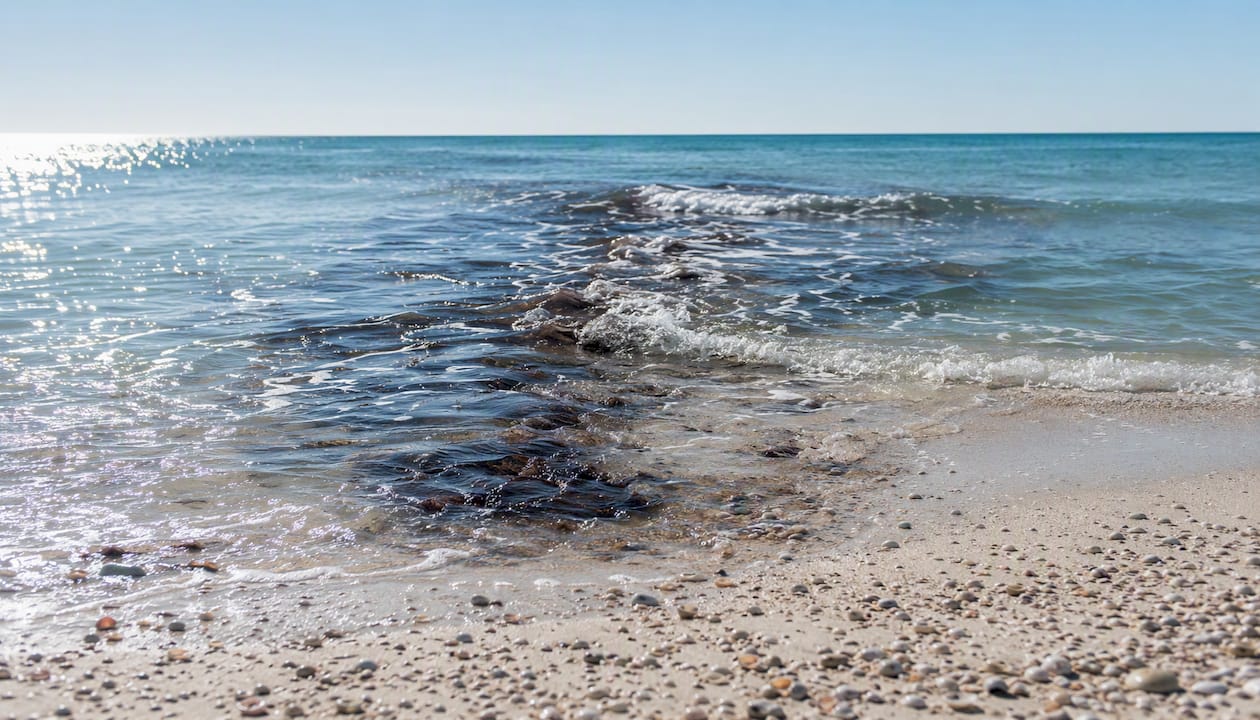
Structures make this easier to predict. Jetties and piers interrupt the natural flow of water, and a rip often sets up right alongside them. That “calm-looking gap” between areas of whitewater is deceptive. It looks like the safest place to swim precisely because it’s the rip itself, not a break from the waves.
Your scanning routine matters as much as the signs themselves. Climb to an elevated spot (a dune, a pier, a balcony), watch for several minutes, and note any feature that stays in the same place as wave sets come and go. A single glance won’t cut it. Coastal scientists studying rip behavior stress that spotting a rip is a skill built through repeated observation, not a one-time glance.
- Narrow gap of darker or calmer water between breaking waves
- Foam, sand, or debris moving steadily seaward
- Choppy or turbulent channel cutting through the surf
- Persistent calm patch near a jetty or pier
Pro Tip: Pick a landmark, like a lifeguard tower, and mentally mark where you last saw calm, unbroken water. If that same “calm” gap is still there five minutes later, treat it as a rip, not a shortcut.
What Do You Do If You’re Caught in a Rip Current?
Panic is what turns a rip current from a scare into a tragedy. The current itself won’t pull you under. It pulls you out and along the shore, and it eventually weakens once you’re past the breaking waves.
- Stay calm and float. Fighting the pull burns energy you’ll need later.
- Try to stand. Some rips are shallow enough that you can simply walk out sideways.
- Swim parallel to the shoreline. This is the move that actually gets you out of the narrow rip channel, which is usually only 10 to 30 feet wide.
- Angle back to shore. Once you feel the pull release, use the breaking waves to carry you in at a diagonal.
- If you can’t escape, float and signal. Tread water, face the beach, wave an arm, and yell. A lifeguard or bystander watching for exactly this signal is your fastest route to safety.
Here’s why step three beats swimming straight in: rip currents typically move 1 to 2 feet per second, but have clocked speeds up to 8 feet per second, which is faster than an Olympic swimmer’s sprint pace. Trying to outswim that head-on is a losing bet that ends in exhaustion, not progress. The National Hurricane Center compares it to a car hydroplaning: relax, redirect, don’t slam the brakes.
Pro Tip: If you grabbed a flotation device before swimming, keep it tucked under your chest or between you and the incoming waves. It does double duty as a rest point and a visibility marker for anyone trying to spot you from shore.
How Should You Help Someone Else Caught in a Rip?
The instinct to jump in after a struggling swimmer is exactly what turns one victim into two. NOAA is direct on this point: untrained rescuers drown at alarming rates trying to save someone from a rip they didn’t understand.
- Yell for a lifeguard or call 911 immediately
- Throw anything that floats, a cooler lid, boogie board, or ring buoy
- Shout instructions: “Swim parallel to the beach!”
- Only enter the water yourself if you’re a trained lifeguard with rescue equipment
Pro Tip: If you’re with a group, split the job. One person calls 911 and flags a lifeguard while another starts throwing floatable items and keeping eyes locked on the swimmer’s position.
When Are Rip Currents Most Likely to Form?
Certain conditions stack the odds against you. Low tide exposes sandbars and narrows the channels water uses to rush back out, which strengthens rip flow. Wave heights of 2 to 3 feet or more push more water toward shore, and that water has to return somewhere.
- Low tide, especially combined with a pronounced sandbar
- Wave heights of 2 feet or higher
- Proximity to jetties, piers, or breakwaters
- Distant storms or hurricanes churning up swell, even under clear local skies
Rip strength also pulses in bursts tied to wave groups, so a channel that looked mild ten minutes ago can suddenly intensify. That’s part of why distant tropical systems create hazardous surf on otherwise calm, sunny days along the coast.
Are Rip Currents and Undertows the Same Thing?
No, and this mix-up leads to bad decisions. A rip current is a horizontal jet of water moving away from shore through a narrow channel. An undertow, or backwash, is the water sliding back down the sloped sand under an incoming wave, tugging at your ankles for a second before the next wave arrives.
| Feature | Rip Current | Undertow/Backwash |
|---|---|---|
| Direction of pull | Seaward, through a narrow channel | Downward and back, close to shore |
| Duration | Can persist for minutes, pulses stronger with wave sets | Momentary, tied to each individual wave |
| Danger | Carries swimmers away from shore, causing panic and exhaustion | Can cause a stumble or knockdown in shallow water |
| Visual signs | Foam or debris line, darker channel, gap in breaking waves | Usually invisible, felt rather than seen |
| Correct response | Float, swim parallel, then angle to shore | Regain footing, lean into the next wave |
The confusion matters because the survival response is different. Fighting an undertow by planting your feet works fine. Fighting a rip current the same way wastes the energy you need to swim parallel and escape the channel. Rip currents will never pull you under the surface. That myth alone has cost lives when swimmers panicked and gulped water while trying to keep their head above a current that was only ever pulling them sideways and out, never down.
How Do Lifeguards Actually Rescue Rip Current Victims?
Trained lifeguards don’t swim straight at a struggling victim. They read the same visual cues covered earlier, the foam lines and channel gaps, then approach from an angle that uses the rip’s own flow to reach the swimmer faster while conserving their own energy.
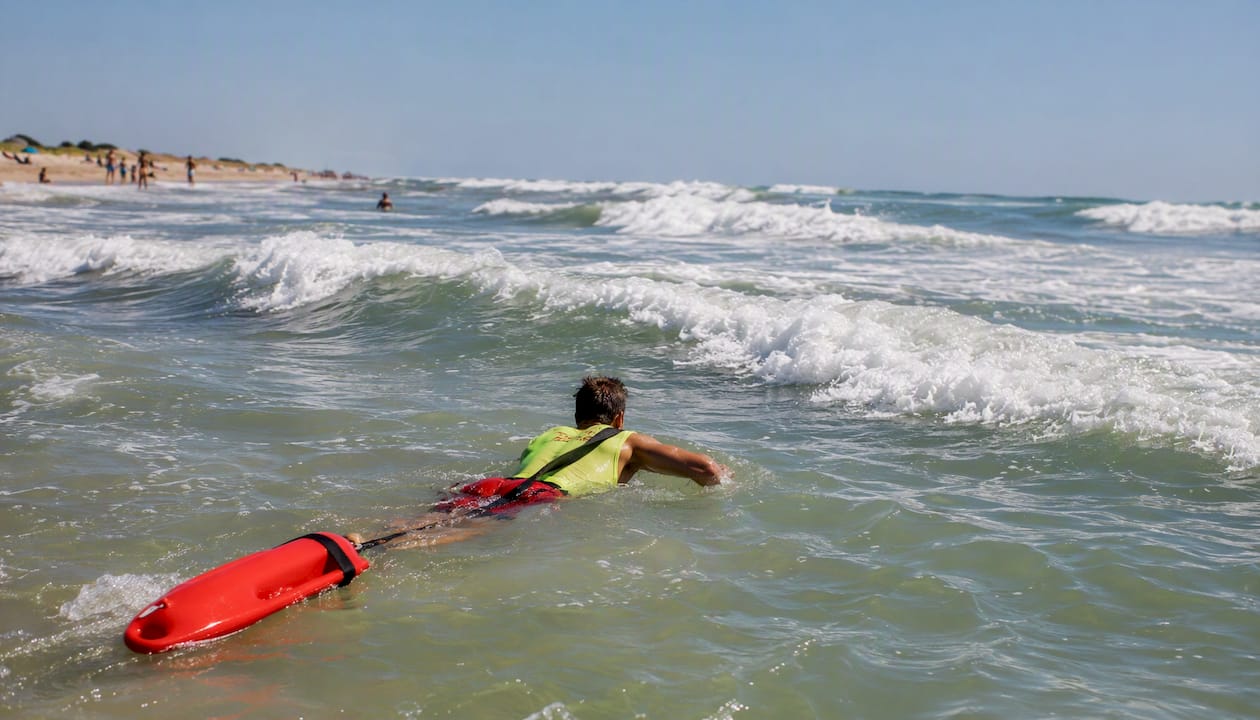
Standard rescue equipment includes a rescue tube or buoy clipped to a strap the lifeguard tows through the surf. Once they reach the victim, the tube goes between the guard and the swimmer, giving both of them flotation for the swim back. Some agencies also deploy rescue boards or jet skis for faster response on wide, exposed beaches where the swim distance to open water is longer.
Communication matters as much as the physical rescue. Lifeguards are trained to shout instructions before they ever reach the water, telling a struggling swimmer to relax, float, and stop fighting the current. That verbal calm-down can prevent the swimmer from swallowing water or going into full panic before help arrives.
The U.S. Lifesaving Association trains and certifies lifeguards across the country specifically on rip current recognition and rescue protocol, and USLA-affiliated beaches report far lower drowning rates than unguarded stretches of coastline. That gap is the single strongest argument for picking a beach with a staffed tower, even if it means walking a few extra minutes from your rental.
What Are Beach Authorities Doing to Prevent Rip Drownings?
Coastal cities and park services lean on a mix of warning systems and physical design to cut down rip current incidents before anyone gets in the water. The flag system is the most visible piece: red-and-yellow flags mark a lifeguarded zone, while a single red or double-red flag signals dangerous surf, sometimes closing the water entirely.
Signage at beach access points typically illustrates what a rip channel looks like from shore, paired with the “don’t fight it, swim parallel” instruction in simple graphics that don’t rely on reading ability alone. Some high-traffic beaches have added QR codes linking directly to real-time surf forecasts.
Physical interventions include groins and breakwaters designed to reduce the sandbar breaks that spawn rips in the first place, though these engineering fixes are expensive and only used at a handful of chronic hot spots. More commonly, authorities focus on staffing: adding lifeguard towers at known trouble zones near jetties and piers, and rotating patrols during the summer months and any period when the surf forecast shows moderate to high rip risk.
None of these measures replace personal judgment. Signs and flags only work if beachgoers actually read and respect them, and that responsibility sits with every swimmer who walks past the warning post.
How Many People Do Rip Currents Actually Injure or Kill?
The scale of the problem is easy to underestimate on a calm beach day. Rip currents account for more than 80 percent of all lifeguard rescues nationwide, making them the single most common reason a lifeguard enters the water outside of routine patrol.
That statistic holds steady across coastlines, from the Gulf Coast to both ocean seaboards, because the physics behind rip formation, sandbars, wave setup, and structures like jetties, shows up wherever surf breaks against a sloped shore. Fatalities cluster heavily around unguarded beaches, where nobody is watching the water for the visual cues covered earlier and nobody is trained to respond in the first ninety seconds after someone starts struggling.
The pattern in the data is consistent: most rip drownings involve people who never intended to swim in a rip current at all. They entered the water at what looked like a calm, inviting gap, the exact visual signature of a channel described earlier, without realizing that “calm” and “safe” are not the same thing in the surf zone. That single misunderstanding, more than any lack of swimming ability, drives the majority of rip current tragedies each year.
What Our Gulf Coast Community Wants You to Know
Emeraldcoastbyowner has spent years connecting travelers to Gulf Coast rentals, and that means we’ve heard from plenty of owners and guests about which stretches of beach have strong lifeguard coverage and which don’t. When you’re booking a stay, ask the owner about proximity to a guarded beach, not just the view.
Our beach and travel blog covers planning details for a safer coastal trip, and pairing that with your own rip current knowledge is how you protect your whole group, not just yourself.
Where to Find Official Rip Current Resources
| Resource | What It Offers | Link |
|---|---|---|
| National Weather Service | Daily surf zone and rip current forecasts | Weather |
| NOAA | Rip current safety guidance and visual identification tips | Noaa |
| National Hurricane Center | Step-by-step survival instructions | Nhc |
Sources
- Rip Current Safety - National Weather Service
- Rip Current Safety | National Oceanic and Atmospheric Administration
- Survive a Rip Current | National Hurricane Center (NOAA)
- What causes a rip current—and how can you spot one? | National Geographic
FAQ
What Are the Odds of Surviving a Rip Current?
Survival odds are high when you avoid panic: rip currents don’t pull you under, only out to sea, and floating while signaling for help is a reliable way to stay safe until you can swim parallel to shore or a lifeguard reaches you.
Has Anyone Survived a Rip Current?
Yes, the overwhelming majority of people caught in rip currents survive, especially those who follow the float and swim parallel technique instead of exhausting themselves swimming straight against the pull.
Is It Safe to Swim in a Rip Current?
Being caught in a rip current is not inherently fatal, but it is dangerous if you panic or try to swim directly against it; staying calm and swimming parallel to shore is the safest response.
What Is the Best Way to Survive a Rip Current?
Stay calm, float to conserve energy, swim parallel to the shoreline until you’re out of the current’s pull, then angle back toward the beach using the breaking waves, and signal for help if you can’t make it in on your own.
Recommended
- Find Beachfront Rental with Pool: Family Guide 2026 | ECBYO
- Best Vacation Rentals with Private Pools: 2026 Guide | ECBYO
- Finding Accessible Beach Vacation Rentals on the Gulf Coast | ECBYO
- Seaside Florida: What Every Traveler Should Know | ECBYO

About the Author
Joe Godar of the Emerald Coast by Owner Editorial Team creates destination guides, vacation-planning resources, and local travel content focused exclusively on Gulf Coast vacation rentals.
Our team researches beach communities, vacation rental trends, family travel planning, local attractions, and direct-booking best practices across Florida, Alabama, Mississippi, Louisiana, and Texas. Every guide is written to help travelers make more informed booking decisions while avoiding unnecessary third-party guest service fees.
Since launching in 2016, Emerald Coast by Owner has helped connect travelers directly with verified vacation rental hosts across the Gulf Coast.
This article was reviewed for accuracy and updated using local destination research and current vacation rental market insights.


