


Response rate is the percentage of guest inquiries you answer within a platform's set window, and response time is how fast those answers land. Hit those numbers and you convert more inquiries into bookings while ranking higher in search results.
TL;DR:
- Responding within one hour can increase conversion rates by 25%, and raising response rates from 89% to 100% can boost bookings by up to 116%.
- Airbnb requires a response rate of 90% within 24 hours for Superhost status, but most top hosts aim for 95% to 100%, with response times under 15 minutes during active hours.
- Using saved replies, notification stacking, and scheduled messages can dramatically improve response speed without additional software, especially when managing multiple listings.
- Centralized inbox tools and careful automation, including AI drafting with human oversight, are essential for hosts managing multiple channels and properties to maintain high response metrics.
- Focusing on recent response behavior over a 30 to 90-day window is crucial for recovering from slumps, with rapid replies within 15 minutes during campaigns providing the fastest improvement.
Table of Contents
- Why Response Rate and Speed Move the Needle on Bookings
- Platform Benchmarks: What Airbnb and VRBO Actually Measure
- A Prioritized Playbook to Improve Response Rate Fast
- Choosing the Right Tools Without Breaking What Works
- Tracking Your Numbers and Recovering From a Slump
- The Marketplace View on Response Metrics
- List Your Property Where Direct Bookings Skip the Middleman
- Sources
- FAQ
Why Response Rate and Speed Move the Needle on Bookings
The math here is not subtle. Vacation rentals that answer within one hour see 25% higher conversion rates than slower responders, and hosts who raise their response rate from 89% to a full 100% can see instant bookings jump by as much as 116%. That is not a rounding error. That is the difference between a listing that fills its calendar and one that watches guests scroll past it toward a competitor who answered first.
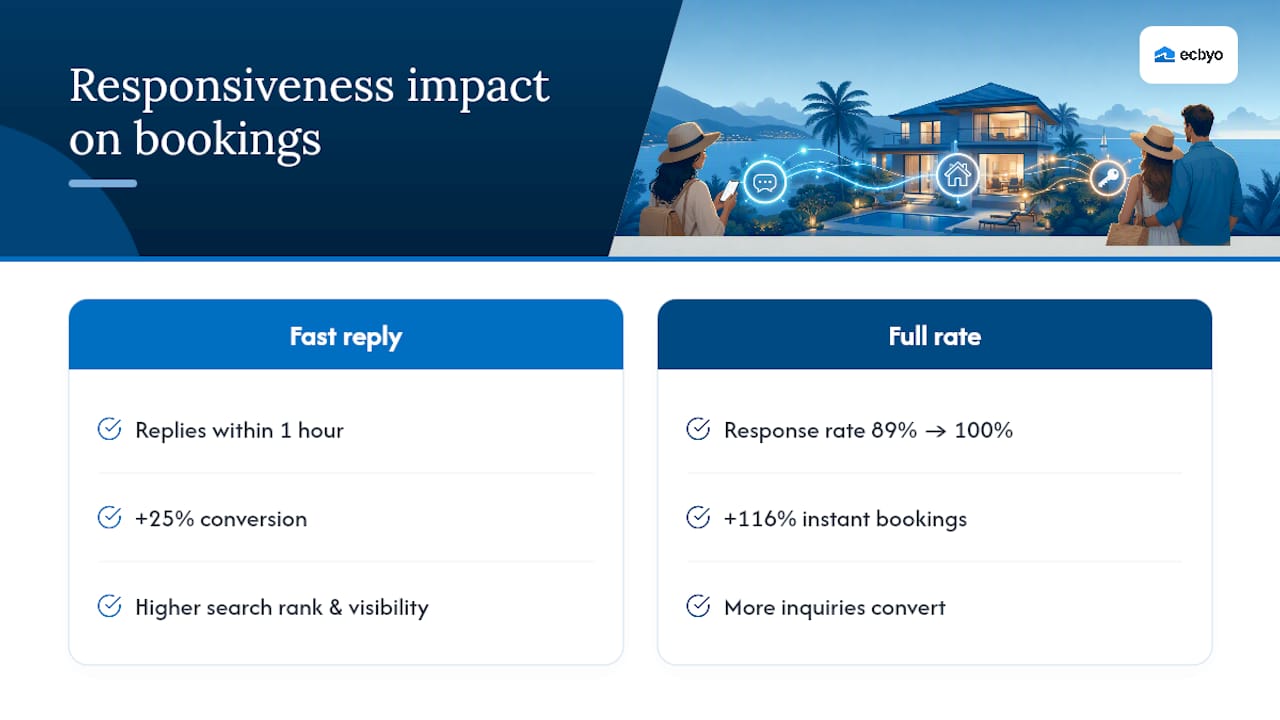
Airbnb and other platforms treat responsiveness as a ranking signal, not just a courtesy metric. A host who replies fast and consistently tends to surface higher in search results, because the platform's algorithm reads slow response as a risk to the guest experience. That ranking boost compounds: more visibility means more inquiries, and a habit of fast replies means more of those inquiries convert.
Guest expectations have also shifted. Industry data shows most travelers now expect a reply within a few hours at most, and luxury-tier hosts commit to far shorter windows as a competitive differentiator. Guests who get a quick, helpful answer are more likely to leave a five-star review mentioning communication, and those reviews feed directly into future bookings. Slow responders, by contrast, tend to accumulate the kind of vague negative feedback that quietly erodes conversion over months.
Platform Benchmarks: What Airbnb and VRBO Actually Measure
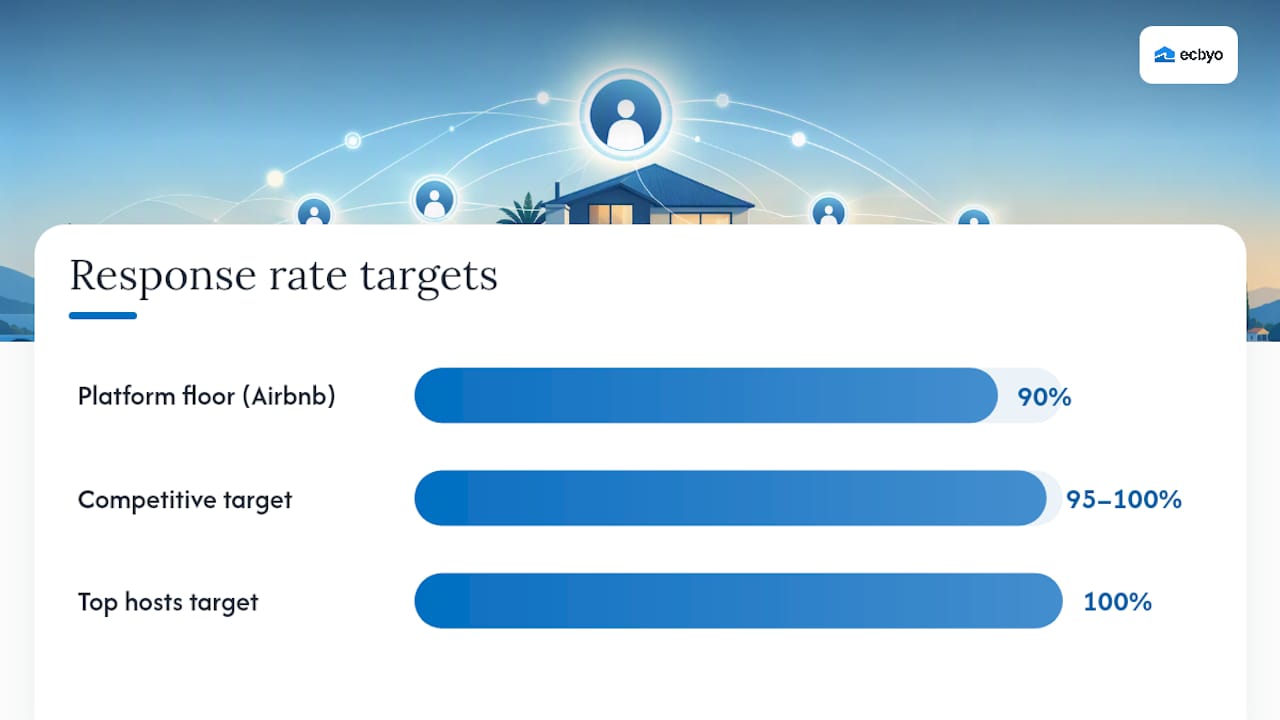
Airbnb calculates response rate as the percentage of new inquiries and reservation requests you answer within 24 hours, tracked on a trailing 365-day window. Superhost status requires keeping that number at 90% or above, and Airbnb reviews eligibility every quarter, not continuously, so a bad month can linger in your stats far longer than you would like.
VRBO takes a different approach. It factors acceptance rate and response behavior into its ranking metrics using its own rolling calculation, which means a slip on VRBO does not always recover on the same timeline as a slip on Airbnb.
The gap between platform minimums and what top hosts actually target is wide:
- Platform floor: 90% response rate within 24 hours (Airbnb's Superhost threshold)
- Competitive target: 95% to 100% response rate
- Speed target during active hours: under 15 minutes, with the fastest hosts aiming under 5 minutes
- After-hours acceptable window: a few hours, provided the reply still lands inside the 24-hour rule
Treat the 24-hour rule as the line you never cross, not the pace you aim for.
A Prioritized Playbook to Improve Response Rate Fast
Most hosts do not need new software to fix a sagging response rate. They need a sharper process. Start here, in order.
- Turn on saved replies for your top ten questions. Check-in time, Wi-Fi password, parking, and pet policy account for most inbound messages. A saved reply cuts your reply time from minutes to seconds.
- Stack your notifications. Push alerts on your phone, email, and a secondary device close the gap when one channel fails. A missed notification is the single most common cause of a blown response window.
- Send a fast, honest holding reply before a perfect one. "Got it, I'll confirm in 10 minutes" protects your response rate just as well as a fully detailed answer sent late, and it keeps the guest from feeling ignored.
- Use scheduled messages to deflect repeat questions. A check-in instruction sent 24 hours ahead answers the question before it's asked, though it's worth remembering that scheduled messages don't count as a reply to a guest-initiated inquiry, so they reduce volume rather than boost your rate directly.
- Turn on Instant Book for standard reservations. This alone can cut pre-booking inquiry volume by 20% to 35%, which shrinks the pool of messages that could count against you in the first place.
- Set up an on-call rotation if you manage more than one property. One person cannot watch every inbox around the clock. A rotation with clear escalation rules (who answers after 10 p.m., who covers weekends) keeps your average reply time steady instead of spiking on your day off.
- Triage by urgency, not by order received. A locked-out guest outranks a general pricing question every time. Build a simple mental filter: is someone standing outside a door right now, or can this wait 20 minutes?
Pro Tip: Draft your five most common replies once, save them as templates, and review them every season. A saved reply written for spring break rarely fits a guest asking about hurricane season.
Owners who need a policy reference to link into their saved replies can point guests toward a clear rental agreement, and check-in questions get easier to template when your self-check-in process is documented in one place.
Choosing the Right Tools Without Breaking What Works
A single-property host answering a handful of messages a day rarely needs software beyond saved replies and phone notifications. The math changes once you're running three or more listings, or once you're fielding inquiries across Airbnb, VRBO, and direct email at the same time. At that volume, a unified inbox that pulls every channel into one screen becomes the highest-leverage purchase you can make, since centralizing communication into one dashboard is widely considered the single most effective change a multi-property host can make to median reply time.
Before you buy anything, confirm the tool covers:
- Every channel you actually use, not just Airbnb, since a gap in coverage recreates the exact problem you're solving
- Mobile push notifications that work without a delay, tested on your actual phone before you commit
- Template management that lets you update one saved reply across every property at once
- An audit log, so you can see who answered what and when across a team
AI drafting tools deserve a specific caution. They work best when trained on a property-specific knowledge base and set to review mode, where a human approves the message before it sends, rather than auto-send mode, which can produce a confidently wrong answer about your specific cancellation policy or parking rules. Hosts who consolidate channels and add smart auto-replies often see a 60% to 80% improvement in response time almost immediately, but that gain holds only if the automation is checked, not left to run unsupervised. For teams weighing broader operational workflow changes alongside messaging, a hospitality efficiency framework can help map where automation fits against staffing.
Tracking Your Numbers and Recovering From a Slump
Watch three numbers weekly: your count of unanswered threads older than a few hours, your median reply time, and your rolling response rate over the last 30, 90, and 365 days. The 365-day window is the trap most hosts miss. Because Airbnb averages your performance over a full year, a bad week does not disappear quickly. It gets diluted slowly.
The fastest practical fix is to concentrate on the most recent 30 to 90 days and eliminate every missed first reply going forward, since recent behavior carries disproportionate weight in pulling a rolling average back up.
- Run a focused 30-day campaign where every single inquiry gets a reply within 15 minutes, no exceptions
- Bring in temporary coverage, even a family member or virtual assistant, ahead of a Superhost quarterly review or a seasonal booking surge
- Prioritize speed over polish during recovery. A quick "got it, checking now" beats a perfect answer sent two hours later
The Marketplace View on Response Metrics
Response metrics matter differently once a host controls the guest relationship directly. Since 2016, Emeraldcoastbyowner has watched Gulf Coast owners grow from a few hundred listings into a much larger direct-booking community, and one pattern holds: hosts who own the conversation, rather than routing every message through an OTA's rules, tend to set clearer expectations with guests from the first message. Cutting OTA dependency doesn't lower the bar for responsiveness, but it does simplify the workflow behind it, a shift worth exploring in our direct-booking playbook.
— Tayler
List Your Property Where Direct Bookings Skip the Middleman
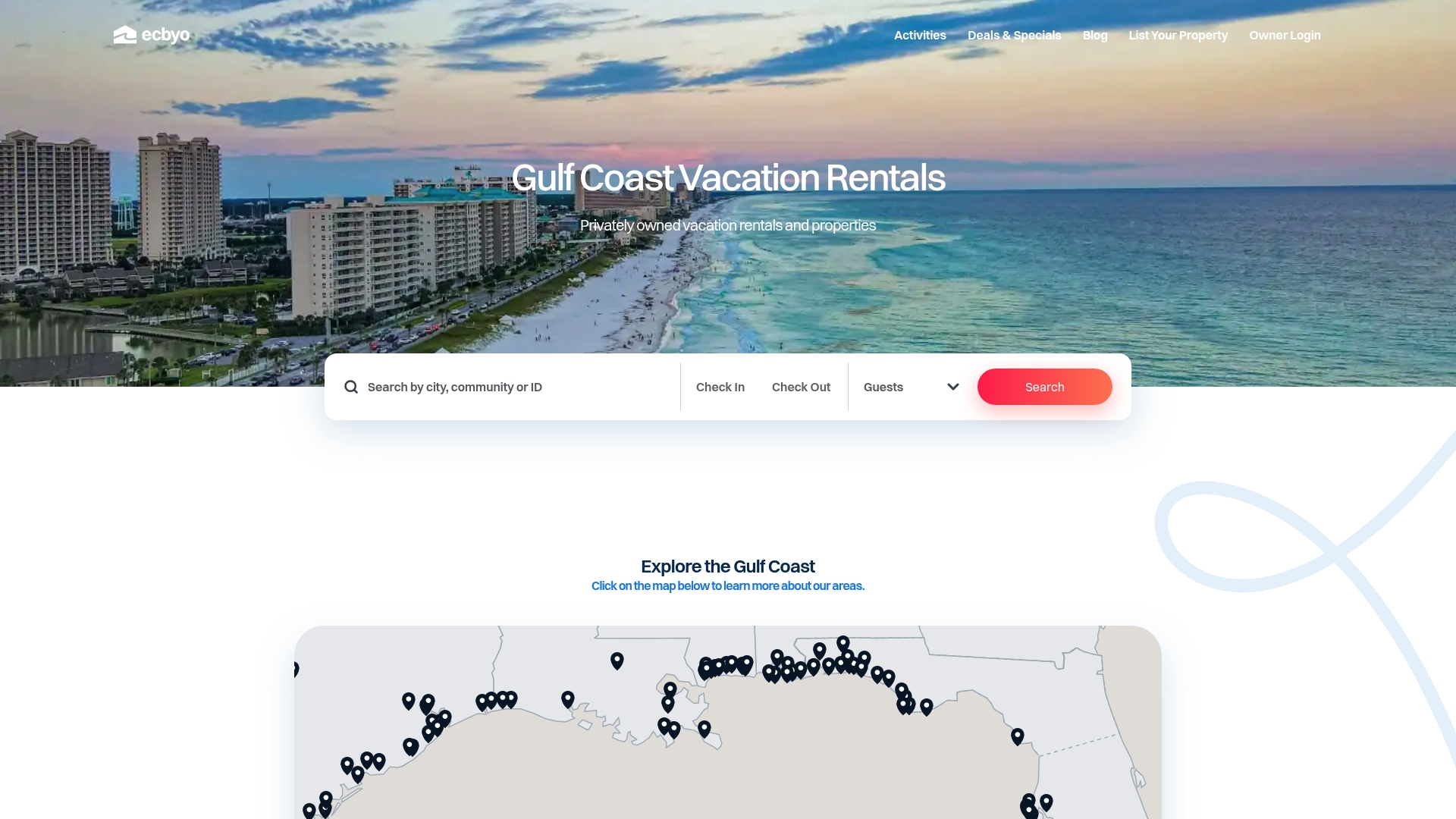
This platform offers an alternative to paying per-booking traveler fees on major OTAs: you list once, guests message you directly, and there's no third-party fee eating into every reservation you confirm. That direct line to the guest is exactly what makes fast, personal responses easier to sustain, since you're not juggling a platform's rules on top of your own.
Here's what that looks like in practice for owners managing their own response workflow:
| What you get | Why it matters for response rate |
|---|---|
| Direct guest messaging, no OTA relay delay | Faster first replies, fewer dropped notifications |
| No guest service fees | More competitive pricing without cutting your margin |
| Region-specific listing pages | Guests searching your exact market find you faster |
| Owner-to-owner community | Practical workflow habits shared across many listings |
If you manage property along the Gulf Coast, browse the Florida vacation rental listings to see how a direct listing is structured, or check regional pages for Texas and Louisiana if that's your market. Ready to list your own property and start managing guest messages on your own terms? Visit Emeraldcoastbyowner to get your listing live.
Sources
- Response Times in Hospitality: A Guide for Vacation Rental Professionals
- How to Improve Airbnb Response Rate Across Multiple Properties — Hostrexa Blog
- How Important is Response Time as an Airbnb Host? - HostGenix Blog
FAQ
What Is the 80/20 Rule for Airbnb Hosts?
It generally refers to the idea that roughly 20% of guest inquiries or maintenance issues consume 80% of a host's time, which is why saved replies and scheduled messages matter so much for protecting response rate on the small number of repeat questions that dominate an inbox.
What Is a Good VRBO Acceptance Rate?
VRBO factors acceptance and response behavior into its own ranking metrics using a rolling calculation, so hosts should treat a consistently high acceptance rate, alongside fast replies, as core to staying visible in VRBO search results.
Is Owning a Vacation Rental Still Profitable?
Profitability depends heavily on occupancy and cost control, but responsiveness is a direct lever on both: faster replies convert more inquiries into bookings, and platforms like Emeraldcoastbyowner let owners keep more of each booking by skipping guest service fees altogether.
Recommended

About the Author
Tayler Jaeger of the Emerald Coast by Owner Editorial Team creates destination guides, vacation-planning resources, and local travel content focused exclusively on Gulf Coast vacation rentals.
Our team researches beach communities, vacation rental trends, family travel planning, local attractions, and direct-booking best practices across Florida, Alabama, Mississippi, Louisiana, and Texas. Every guide is written to help travelers make more informed booking decisions while avoiding unnecessary third-party guest service fees.
Since launching in 2016, Emerald Coast by Owner has helped connect travelers directly with verified vacation rental hosts across the Gulf Coast.
This article was reviewed for accuracy and updated using local destination research and current vacation rental market insights.


