


TL;DR:
- Book direct: Travelers can rent Gulf Coast cottages directly from property owners without using a traditional travel agent.
- Save on fees: Owner-direct marketplaces can eliminate third-party guest service fees.
- Verify before paying: Confirm the host, property details, rental agreement, cancellation policy, and payment recipient.
- Use a credit card: Credit cards generally provide stronger consumer dispute protections than irreversible payment methods.
- Compare total costs: Include rent, taxes, cleaning, pet, and other property-specific fees.
- Use ECBYO: Emerald Coast By Owner connects travelers directly with Gulf Coast vacation rental hosts.
You can rent a Gulf Coast cottage directly from an owner without a travel agent, and you can do it safely. Emeraldcoastbyowner is a fee-free Gulf specialist marketplace built for exactly this, covering Florida, Alabama, Mississippi, Louisiana, and Texas. Renting a gulf cottage without a travel agent is straightforward when you know where to search, how to verify, and how to pay.
Three fastest steps to get started:
- Search a Gulf-specialist marketplace. Start with Emeraldcoastbyowner for fee-free, owner-direct listings across the entire Gulf Coast.
- Verify before you pay. Run a reverse-image search on listing photos, check the address on Google Maps Street View, and ask the owner for a short video walkthrough.
- Pay by credit card only. Never wire money or use a P2P app like Zelle or Venmo for a vacation rental deposit. Credit cards give you chargeback rights if something goes wrong.
Use the checklist in Section 6 before sending any payment.
Key Takeaways
Booking a Gulf cottage directly from an owner is safe and cost-effective when you follow a clear verification sequence, pay by credit card, and use a Gulf-specialist marketplace like Emeraldcoastbyowner.
| Point | Details |
|---|---|
| Verify before paying | Run a reverse-image search, check the address on Street View, and request a video walkthrough before sending any money. |
| Credit card only | Pay by credit card to keep chargeback rights; avoid wire transfers, Zelle, Venmo, and gift cards entirely. |
| Direct booking saves fees | Booking direct typically avoids OTA guest service fees, which can reach 14% of the booking total. |
| Local permits matter | Ask owners for their short-term rental permit or license number and verify it with the issuing authority before booking. |
| Emeraldcoastbyowner | A fee-free Gulf-specialist marketplace covering all five Gulf Coast states with no guest service fees for travelers. |
Table of Contents
- Where can you find Gulf cottages listed directly by owners?
- How do you verify a direct-owner Gulf listing is legitimate?
- How should you pay, and what do you do if something goes wrong?
- What does a Gulf cottage rental actually cost, and when should you book?
- What should you ask owners before booking?
- Is booking direct better than using an OTA or travel agent?
- How Emeraldcoastbyowner makes direct Gulf cottage booking work
- What local regulations apply to Gulf Coast cottage rentals?
- How to handle disputes when booking directly with owners
- A direct booking perspective worth considering
- Start searching Gulf Coast cottages on Emeraldcoastbyowner
- Sources
- FAQ
Where can you find Gulf cottages listed directly by owners?
Several channels connect travelers with Gulf Coast owners, and each one involves a different trade-off between fees, owner access, and built-in protections.
- Emeraldcoastbyowner (ECBYO). A Gulf-specialist, fee-free marketplace covering Florida, Louisiana, Texas, Mississippi, and Alabama. Listings are placed by owners, and travelers pay no guest service fees. The map-based search and owner profiles make it easy to compare properties and message owners directly before committing.
- Houfy. A fee-free owner marketplace where hosts list properties and guests book without platform service charges. Coverage is national, so Gulf listings are mixed in with properties from other regions. Worth checking for owners who list there alongside ECBYO.
- Airbnb and Vrbo. Both platforms carry owner-hosted Gulf Coast listings, but they add guest service fees that can reach 14% or more of the booking total. They do offer platform-mediated dispute resolution, which is a real trade-off. Some travelers use these platforms to find a property and then contact the owner directly to arrange a future stay outside the platform. Be aware that most platforms prohibit this in their terms of service, and it removes their protections.
- Local Facebook groups and community boards. Gulf Coast towns like Destin, Gulf Shores, and Port Aransas have active rental groups where owners post availability. These can surface deals, but listings carry no verification layer at all. Treat them as leads, not confirmed bookings, and apply the full verification checklist before paying anything.
- Town and destination websites. Some Gulf Coast municipalities and local tourism boards maintain owner-listing directories. Quality varies, but these are generally low-scam-risk because listings are tied to local business registrations.
The same cottage can appear on ECBYO, Vrbo, and a local Facebook group simultaneously, sometimes at different prices. Comparing listings across channels is worth the 15 minutes it takes. Scammers sometimes repost stolen photos with inconsistent prices across platforms, so a price that looks dramatically lower on one channel than another is a signal worth investigating before you proceed.
Pro Tip: When you find a property on a major OTA, search the address directly on ECBYO or Houfy. The owner may have a fee-free listing there, which means the same cottage at a lower total cost.
How do you verify a direct-owner Gulf listing is legitimate?
Follow this sequence in order before sending any payment. Skipping steps is where most rental fraud begins.
- Run a reverse-image search on every listing photo. Upload the main photos to Google Images or TinEye. If the same photos appear under a different address or property name, the listing is likely fraudulent. Scam guides consistently identify stolen photos as the most common fake-listing tactic.
- Check the address on Google Maps Street View. Confirm the property exists at the stated address, that it looks like the listing photos, and that it is a residential property, not a vacant lot or commercial building.
- Review the listing’s review history. Look at the dates. A cluster of five-star reviews posted within a few days of each other, or a brand-new listing with no reviews, warrants extra caution. Legitimate owners typically have a review trail spanning multiple seasons.
- Cross-check the listing on at least one other platform. Search the address or owner name on a second site. Inconsistent prices, different owner names, or missing reviews on one platform are red flags.
- Ask for a short video walkthrough. Request a live or recorded video of the interior and exterior, including the view from the front door. A legitimate owner will agree without hesitation. Refusal is a clear signal to walk away.
- Verify the owner’s phone number and identity. A quick Google search of the phone number and owner name can surface complaints or confirm a real local presence. Ask for the owner’s full name and confirm it matches the property records you can find through the county property appraiser’s website (most Gulf Coast counties publish these online for free).
- Check for a local short-term rental permit or license number. Many Gulf Coast municipalities require owners to display a permit number in their listing. TravelAwaits recommends checking local rules and license numbers as a standard verification step, particularly for private rentals.
Trust signal: A Consumers’ Checkbook investigation found widespread fake listings and documented cases where major platforms treated themselves as forums rather than guarantors, leaving defrauded guests to pursue refunds on their own. This means the verification burden falls on you, regardless of which platform you use.
Pro Tip: On a video call with an owner, ask them to open a specific interior door or show you the view from a specific window. A scammer working from stolen photos cannot do this in real time.
How should you pay, and what do you do if something goes wrong?
Always pay by credit card. This is the single most protective payment choice for a direct Gulf cottage booking. Credit cards give you chargeback rights under the Fair Credit Billing Act, meaning you can dispute a charge with your card issuer if the property does not exist or the owner refuses to refund a canceled booking. Travelers who paid by debit card or bank transfer often had little recourse after fraud, according to Consumers’ Checkbook reporting.
Safe vs. unsafe payment methods:
- Credit card through a platform or payment processor. Safest option. Reversible via chargeback. Fraud protection built in.
- PayPal (Goods & Services). Acceptable. Offers buyer protection when you select the correct payment type. Do not use PayPal Friends & Family for a rental payment.
- Personal check. Lower risk than wire transfer, but slow to recover if disputed. Use only with a well-reviewed owner you have thoroughly verified.
- Wire transfer. Avoid. Irreversible once sent. No fraud protection.
- Zelle, Venmo, Cash App. Avoid for rental deposits. These are designed for personal transfers between people who know each other, not for commercial transactions. Recovery after fraud is extremely difficult.
- Gift cards or cryptocurrency. Never. Any owner requesting these as payment is running a scam.
| Payment Method | Reversible? | Fraud Protection | Scam Risk |
|---|---|---|---|
| Credit card | Yes, via chargeback | High | Low |
| PayPal (Goods & Services) | Yes, via dispute | Medium | Low to medium |
| Personal check | Partial (stop payment) | Low | Medium |
| Wire transfer | No | None | High |
| Zelle / Venmo | No | None | High |
| Gift cards / crypto | No | None | Very high |
The off-platform payment pivot is the highest-frequency scam tactic: a scammer contacts you through a legitimate-looking listing and then asks you to pay outside the platform via wire or P2P app. Once you leave the platform’s payment system, all protections disappear.
If something goes wrong:
- Contact the owner in writing and request a refund with a clear deadline (48 hours is reasonable).
- If you booked through a platform, escalate to the platform’s resolution center immediately. Document everything with screenshots.
- File a credit card chargeback with your card issuer. Do this promptly; most issuers have a 60-day window from the statement date.
- File a complaint with the FTC at ReportFraud.ftc.gov and with your state’s attorney general consumer protection office.
What does a Gulf cottage rental actually cost, and when should you book?
Booking direct commonly avoids guest service fees, but the total cost still includes several components. Setting accurate expectations before you search saves time and prevents surprises at checkout.
Typical cost components:
- Nightly base rate. The core rental price, set by the owner. This is the figure most directly negotiable when booking direct, especially for longer stays or shoulder-season dates.
- Cleaning fee. Standard on almost all Gulf Coast rentals. Ranges from modest for a small cottage to significant for a larger property. Not typically negotiable, but worth confirming upfront.
- Security deposit. Usually $200–$500 for a cottage, held and returned after checkout if no damage is reported. Some owners use damage protection insurance instead.
- State and local taxes. Florida charges a 6% state sales tax plus a county tourist development tax that varies by county (typically 2%–5%). Texas, Louisiana, Alabama, and Mississippi each have their own short-term rental tax structures. These are non-negotiable and legally required.
- Optional extras. Pet fees, parking fees, early check-in or late checkout fees, and linen packages are common. Confirm all of these before booking.
Illustrative price comparison (3-bedroom Gulf cottage, 7 nights):
Note: These are illustrative examples only, not quoted rates.
| Cost Component | High Season (June–July) | Shoulder Season (April–May) |
|---|---|---|
| Nightly base rate | $350 per night | $200/night |
| 7-night subtotal | $2,450 | $1,400 |
| Cleaning fee | $200 | $200 |
| Security deposit | $300 | $300 |
| Taxes (est. 10%) | $245 | $140 |
| OTA service fee (est. 14%) | $343 | $196 |
| Direct booking total | $3,195 | $2,040 |
| OTA booking total | $3,538 | $2,236 |
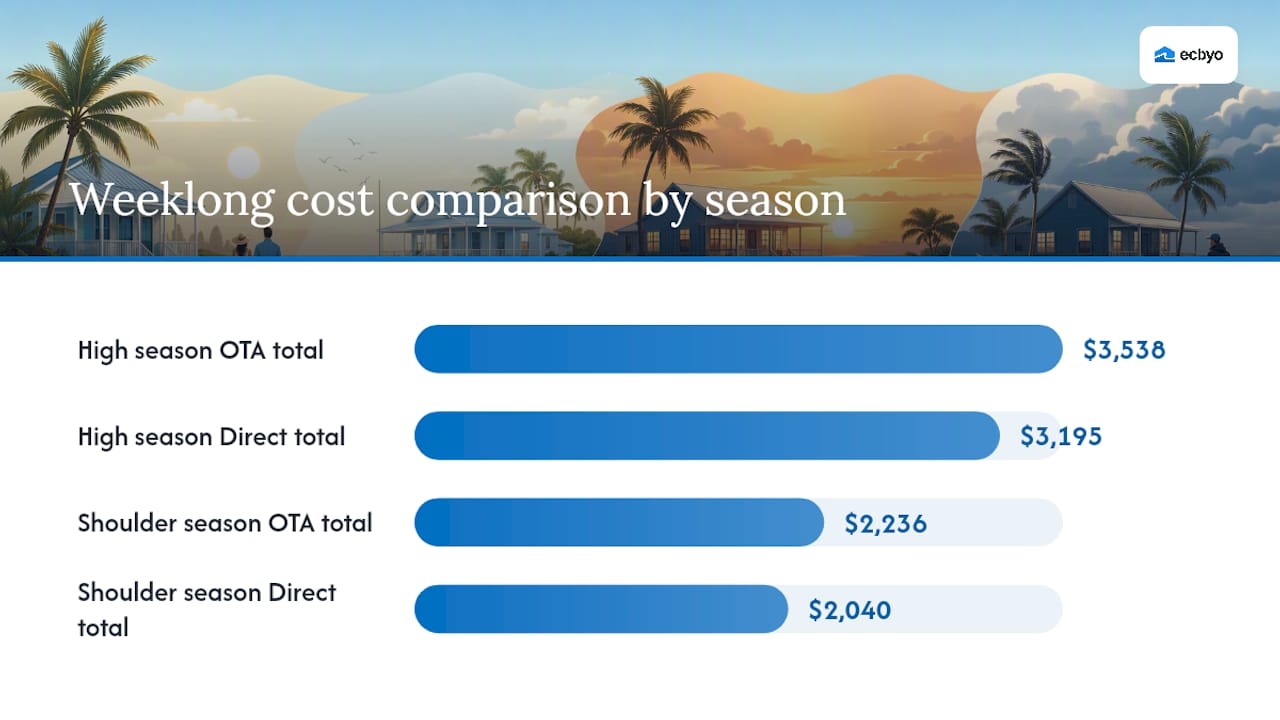
Booking direct skips the OTA service fee entirely, which on a high-season week can represent a meaningful saving. Check current deals and specials on Emeraldcoastbyowner for owners who have discounted rates or last-minute availability.
Timing guidance:
- Summer (June–August): Book 4–6 months in advance. Gulf Coast peak season fills fast, and owners rarely discount during this window.
- Spring break (March–April): Book 3–4 months ahead. Destin, Gulf Shores, and South Padre Island are especially competitive.
- Shoulder season (April–May, September–October): Book 6–8 weeks out. Owners are more open to negotiating a lower nightly rate or waiving small fees for longer stays.
- Off-season (November–February, excluding holidays): Book 2–4 weeks out. The best window for direct negotiation, particularly for stays of 7 nights or more.
What should you ask owners before booking?
Confirming these details before you pay protects you from surprises at check-in and gives you a paper trail if a dispute arises later. Use the checklist below as a guide, then adapt the message template to your situation.
Pre-booking checklist:
- Maximum occupancy and whether it includes children
- Total price broken down by component (base rate, cleaning, deposit, taxes, extras)
- Deposit amount, due date, and refund conditions
- Full cancellation policy (deadline for full refund, partial refund window, no-refund cutoff)
- Check-in and check-out times, and who to contact on arrival
- Parking availability and any associated fees
- Pet policy and pet fee if applicable
- Wi-Fi availability and reliability (especially important for remote workers)
- Local short-term rental permit or license number
- Preferred payment method and whether credit card is accepted
Copy-paste message template for initial owner contact:
Keep the tone friendly and direct. Owners who respond quickly, answer all questions clearly, and accept credit card payment are the ones worth booking with. Evasive answers or pressure to pay immediately are signals to step back.
Pro Tip: When asking for a video walkthrough, phrase it as a preference rather than a demand: “Would you be able to do a quick video call or send a short walkthrough video? We just like to see the space before we commit.” Legitimate owners almost always say yes.
Is booking direct better than using an OTA or travel agent?
The honest answer: it depends on what you value most. Here is a clear breakdown.
Advantages of booking direct:
- No guest service fees (saves 10%–14% on most OTA bookings)
- Direct communication with the owner, which means faster answers and more flexibility
- Easier to negotiate on price, especially for longer stays or off-season dates
- Owners often offer loyalty discounts or better rates to repeat guests
Disadvantages of booking direct:
- No platform-mediated dispute resolution if something goes wrong
- Verification is entirely your responsibility
- Less standardized cancellation policies; each owner sets their own terms
- No built-in review system unless you use a marketplace like ECBYO or Houfy
When a travel agent or OTA makes sense:
- Complex multi-destination itineraries where coordination adds real value
- Large group bookings where a single point of contact simplifies logistics
- Corporate or incentive travel where receipts, insurance, and liability documentation are required
- First-time renters who are not comfortable with the verification process
Rule of thumb: If you are booking a single Gulf Coast cottage for a family vacation and you are willing to spend 30 minutes on verification, booking direct is almost always the better financial choice. If you are coordinating a multi-property group trip or need guaranteed dispute resolution, a platform’s protections may be worth the fee.
For a deeper look at how Gulf Coast marketplace options compare, the differences in coverage and fee structures are worth reviewing before you decide.
How Emeraldcoastbyowner makes direct Gulf cottage booking work
Emeraldcoastbyowner is a Gulf-specialist, fee-free marketplace built specifically for travelers who want to book directly with owners and avoid agent fees. It covers the full Gulf Coast: Florida, Alabama, Mississippi, Louisiana, and Texas, with thousands of listings ranging from beachfront cottages to budget-friendly inland homes.
Features that reduce risk and friction:
- Owner profiles with contact details. Every listing includes an owner profile so you can message directly, ask questions, and request verification materials before committing.
- Map-based search. Find cottages by exact location, whether you want to be steps from the water in Mexico Beach, Florida or on the quieter shores of Holly Beach, Louisiana.
- Detailed property listings. Photos, amenity lists, occupancy limits, and pricing details are all displayed upfront, so you can compare properties without back-and-forth messaging.
- No guest service fees. Travelers pay nothing to Emeraldcoastbyowner. The price you see is the price you negotiate with the owner.
- Regional coverage. Whether you are searching Florida Gulf Coast rentals, Texas beach cottages, or Louisiana Gulf properties, ECBYO covers all five Gulf states in one search.
How to use ECBYO in your verification flow:
- Search by destination and dates on Emeraldcoastbyowner.
- Shortlist 2–3 properties and compare amenities, photos, and owner response history.
- Message owners directly through the platform to request a video walkthrough and full price breakdown.
- Once verified, pay by credit card and confirm the cancellation policy in writing before finalizing.
Pro Tip: Use ECBYO’s map view to check the property’s exact distance from the beach. “Gulf views” and “beachfront” mean different things to different owners. The map removes the ambiguity.
What local regulations apply to Gulf Coast cottage rentals?
Short-term rental laws on the Gulf Coast vary significantly by state and municipality, and they affect both owners and guests. Knowing the basics helps you avoid booking an unlicensed property that could be shut down mid-stay.

Florida. Florida preempts local governments from banning short-term rentals outright, but counties and cities can regulate them through licensing, inspection requirements, and occupancy limits. Many popular destinations, including Destin, Panama City Beach, and Fort Walton Beach, require owners to hold a valid vacation rental license issued by the Florida Department of Business and Professional Regulation (DBPR). Ask owners for their DBPR license number and verify it at the state’s online portal before booking.
Alabama. Gulf Shores and Orange Beach both require short-term rental permits. Orange Beach additionally requires a business license. Owners in these markets should be able to provide permit numbers on request.
Mississippi. Short-term rental regulation in Mississippi is primarily handled at the local level. Gulf Coast cities like Biloxi and Ocean Springs have their own ordinance frameworks. Regulation is less uniform here than in Florida, so direct verification with the owner about local compliance is especially important.
Louisiana. New Orleans has strict short-term rental regulations, but Gulf Coast communities like Holly Beach and Grand Isle operate under different, generally less restrictive frameworks. Confirm local permit status directly with the owner.
Texas. Texas does not have a statewide short-term rental licensing requirement, but cities like Galveston, Port Aransas, and South Padre Island have their own permit and registration systems. Galveston, for example, requires a short-term rental certificate of occupancy.
As a guest, the practical step is simple: ask for the permit or license number, then verify it with the issuing authority. TravelAwaits notes that unlicensed listings carry real risk, including the possibility of a property being shut down by local authorities during your stay. A legitimate owner will have no hesitation sharing their permit details.
How to handle disputes when booking directly with owners
Most direct bookings go smoothly. When they do not, having a clear plan matters.
Step 1: Document everything in writing. From the first message, keep a written record of all communications, the agreed price, the cancellation policy, and any promises the owner made. Screenshots of listing pages are useful because listings can be edited or removed after a booking.
Step 2: Contact the owner directly and calmly. Most disputes, such as a missing amenity or a cleaning issue, are resolved at this stage. State the problem clearly, reference the listing description, and propose a specific resolution (a partial refund, a replacement item, a cleaning visit).

Step 3: Escalate through the platform if you used one. If you booked through Emeraldcoastbyowner, Houfy, or another marketplace, contact their support team with your documentation. Platform resolution processes vary, but having a paper trail strengthens your position significantly.
Step 4: File a credit card chargeback. If the property did not exist, was materially misrepresented, or the owner refuses a legitimate refund, contact your credit card issuer. Provide all documentation: booking confirmation, communications, photos of the property condition. Most issuers have a 60-day window from the statement date, so act quickly.
Step 5: File a consumer complaint. Report fraud or significant misrepresentation to the FTC at ReportFraud.ftc.gov, your state attorney general’s consumer protection office, and, if applicable, the Better Business Bureau. These filings create a record that can support other victims and prompt regulatory action.
The Elliott recommends treating direct bookings with the same due diligence as any large purchase. That framing is useful: you would not wire $2,000 to a stranger for a car without verification. The same standard applies here.
A direct booking perspective worth considering
The conventional wisdom says booking through a major OTA is safer because of platform protections. That framing deserves some scrutiny. A Consumers’ Checkbook investigation found that some of the largest platforms in the industry treated themselves as forums rather than guarantors, leaving defrauded guests to fight for refunds on their own. Platform protection is real, but it is not unconditional.
What actually protects you is the combination of verification steps and payment method, not the platform logo on the booking page. A traveler who pays by credit card, runs a reverse-image search, verifies the address on Street View, and asks for a video walkthrough is better protected than one who books through a major OTA, pays by debit card, and skips verification entirely.
Direct booking with a Gulf-specialist marketplace like Emeraldcoastbyowner gives you owner access, no service fees, and a Gulf-focused listing pool. The verification work is yours to do, but it takes less than an hour and the savings on a peak-season week can easily exceed $300. That is a reasonable trade for anyone willing to follow a checklist.
For families planning a longer Gulf stay, the two-week Gulf rental guide covers additional planning considerations worth reading before you search.
Start searching Gulf Coast cottages on Emeraldcoastbyowner
Skip the agent fees and search thousands of owner-listed Gulf Coast cottages directly on Emeraldcoastbyowner. The platform covers Florida, Alabama, Mississippi, Louisiana, and Texas with no guest service fees, so the price you see is the price you pay the owner.
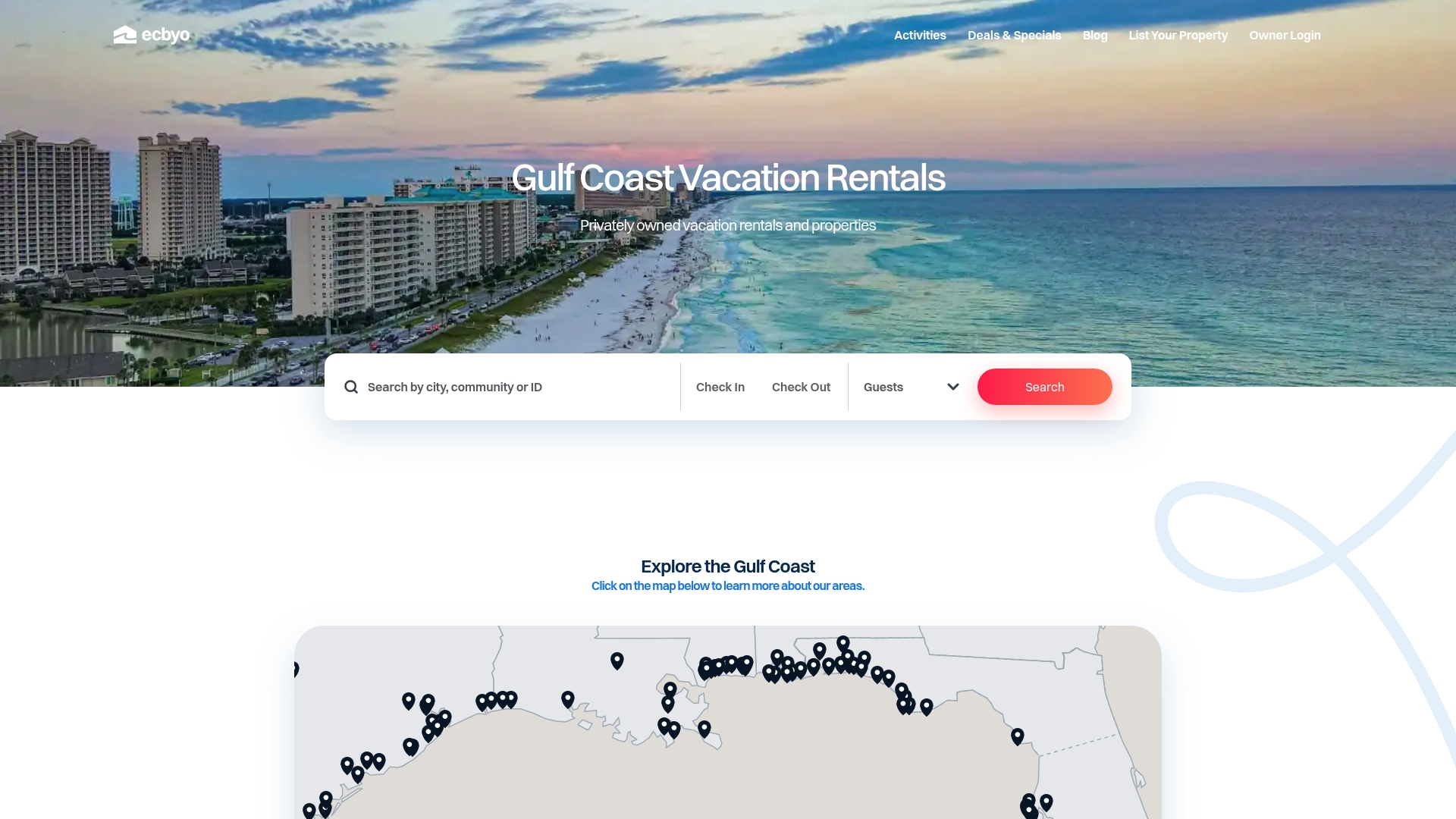
Browse Gulf Coast vacation rentals by owner and filter by destination, dates, and property type to find the right cottage for your trip. Check the deals and specials page for owners offering discounted rates on available dates. Before you book, run through the verification checklist in Section 3 and confirm payment by credit card with the owner.
Sources
- Vacation Rental Industry Plagued by Problems - National
- Vacation rental scams are surging: Here’s how summer travelers can protect themselves
- The Vacation Rental Scam Playbook: How To Spot Fake Listings Before You Wire Money - Making Sense Of Security
- How to rent a vacation home: the ultimate guide
- Hidden risks when booking private rentals in other countries
FAQ
Is Emeraldcoastbyowner a legitimate booking platform?
Yes. Emeraldcoastbyowner is a Gulf Coast vacation rental marketplace that connects travelers directly with property owners across Florida, Alabama, Mississippi, Louisiana, and Texas, with no guest service fees charged to travelers.
Are there Gulf Shores oceanfront rentals by owner with no fees?
Owner-direct listings in Gulf Shores are available on fee-free marketplaces like Emeraldcoastbyowner, where travelers pay no platform service fees. You still pay the owner’s cleaning fee, security deposit, and applicable state and local taxes.
Which is safer for vacation rentals: Airbnb or Vrbo?
Both platforms offer dispute resolution, but a Consumers’ Checkbook investigation found that major platforms sometimes act as forums rather than guarantors, meaning protection is not guaranteed. Your safest move on either platform is to pay by credit card and complete the verification checklist regardless of which site you use.
How do you avoid Vrbo service fees?
The most direct way is to book through a fee-free owner marketplace like Emeraldcoastbyowner, where no guest service fee is added. Some owners list the same property on multiple platforms, so searching ECBYO for the same address can surface a direct-booking option at a lower total cost.
What payment methods should you avoid for direct vacation rentals?
Avoid wire transfers, Zelle, Venmo, Cash App, and gift cards. These payment methods are irreversible and carry no fraud protection. Always pay by credit card so you retain chargeback rights if the booking falls through.
Recommended
- Beach Time! An ECBYO blog about all things Gulf Coast
- Renting Gulf Property for Two Weeks: A Family Guide | ECBYO

About the Author
Joe Godar of the Emerald Coast by Owner Editorial Team creates destination guides, vacation-planning resources, and local travel content focused exclusively on Gulf Coast vacation rentals.
Our team researches beach communities, vacation rental trends, family travel planning, local attractions, and direct-booking best practices across Florida, Alabama, Mississippi, Louisiana, and Texas. Every guide is written to help travelers make more informed booking decisions while avoiding unnecessary third-party guest service fees.
Since launching in 2016, Emerald Coast by Owner has helped connect travelers directly with verified vacation rental hosts across the Gulf Coast.
This article was reviewed for accuracy and updated using local destination research and current vacation rental market insights.


