


Private beach access is the right to use a specific beach entrance or area controlled by a property owner, homeowners association, or resort, while the shoreline itself often remains legally public. For vacationers planning a Gulf Coast trip, understanding this distinction prevents trespassing risks and sets realistic expectations about what “private beach access” actually delivers. The rules vary significantly by state, and what sounds like an exclusive perk can mean anything from a gated parking lot to a staffed beach club. Getting this right before you book makes the difference between a relaxing vacation and a frustrating one.
What is private beach access explained in simple terms?
Private beach access refers to controlled entry to a beach area, not necessarily ownership of the entire beach. The legal term most relevant here is the mean high-water line (MHWL), a survey-based tidal boundary that separates public and private land. Ownership typically splits at the MHWL, with state-owned submerged land seaward of this line and private upland dry sand landward. Vacationers standing on wet sand near the water are almost always on public tidelands, even if the dry sand behind them is privately owned.
The public trust doctrine grants everyone the right to walk, swim, and fish below the MHWL. That right does not extend to sunbathing or setting up chairs on private dry sand without permission. This creates a situation where the beach looks open but the upper sand is legally off-limits.
Access paths and entrances matter as much as ownership because even public tidelands become unreachable if all pathways are blocked by private property. A “private beach access” listing in a vacation rental typically means the property provides a legal, controlled path to the shore, not that the guests own the beach.
What is the difference between private beach ownership and private beach access?
Private beach ownership and private beach access are two different things, and confusing them leads to real problems on vacation.
Private beach ownership means a person or entity holds title to the dry sand upland above the MHWL. That owner can restrict others from using that sand. However, they cannot own the wet sand or water below the MHWL, which belongs to the state under sovereign land principles.
Private beach access typically means controlling the logistics of getting to the beach. This includes:
- Gated or coded entry points to beach walkovers
- Reserved parking areas for residents or guests
- Membership or key card systems at beach club entrances
- Staffed checkpoints at resort beach areas
Private beach access often means controlling entry logistics such as parking, walkovers, and membership checks, rather than owning the shoreline outright. Travelers risk trespass when they leave controlled access paths and wander onto private dry sand.
The MHWL itself is not marked with a visible line on the ground. It is a survey-based tidal datum subject to interpretation, which makes the exact boundary ambiguous in practice. After beach nourishment projects, erosion control lines may fix boundaries for trespassing purposes under Florida law, adding another layer of complexity.
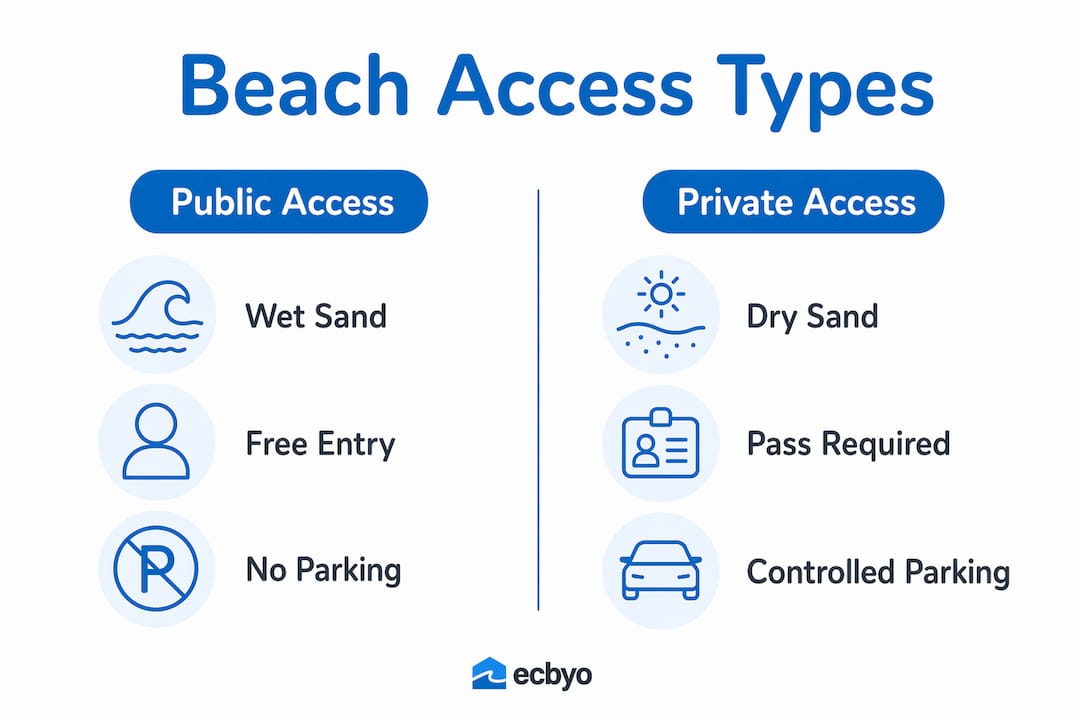
Pro Tip: When in doubt about whether you are on private dry sand, move toward the wet sand near the water. That zone is almost always public under the public trust doctrine.
How do beach access rights vary across popular U.S. beach destinations?
Beach access laws are patchwork across states and can be counterintuitive. What is legal in California may be trespassing in Florida. The table below summarizes key differences across four major beach destinations.
| Destination | Public access rule | Private dry sand rights | Key law or doctrine |
|---|---|---|---|
| Florida | Public rights below MHWL; access depends on legal pathways | Owners can restrict dry sand above MHWL | Florida Statute 810.09 |
| New Jersey | Public access at mean high water line | Private control above MHWL; beach badges required at many towns | Public trust doctrine |
| California | Public use below MHWL guaranteed | Private upland restricted; Coastal Commission regulates access | California Coastal Act |
| 30A, Florida | Public shoreline trust applies; private entrances common | HOAs and resorts control walkovers and parking | Florida public trust + local HOA rules |
Florida Statute 810.09 prohibits trespassing on privately owned dry sand above the MHWL once notice is given. Violations can rise to a first-degree misdemeanor. Knowing this boundary protects vacationers from unintentional legal trouble.
In Florida’s 30A corridor, private beach access often reserves entrances and amenities for homeowners or guests, while the shoreline public trust continues to apply. Visitors to communities like Rosemary Beach, WaterColor, and Alys Beach encounter gated walkovers and community-only parking, but the wet sand remains open to anyone who reaches it. 30A vacation rentals often include access passes or parking credentials that make navigating these systems straightforward.
California’s Coastal Act is among the strongest public access protections in the country. The state requires coastal development permits to include public access provisions, meaning private landowners cannot legally block the path to the shoreline. New Jersey takes a middle ground, with many beach towns charging access fees through badge systems while still honoring public rights at the water’s edge.
What amenities and privileges typically come with private beach access?
Private beach access areas offer a noticeably different experience from crowded public beaches. The amenities vary by property type, but most fall into predictable categories.
- Controlled entrances. Gated walkovers or coded access points keep non-guests off the beach path. This alone reduces foot traffic significantly.
- Reserved parking. Dedicated lots or passes eliminate the hunt for street parking during peak season, which is a real advantage on busy summer weekends.
- Beach furniture. Many resort and HOA-managed beaches provide chairs, umbrellas, and sometimes cabanas at no extra charge for guests.
- Lifeguard coverage. Some private access beaches staff lifeguards during peak hours, a service rarely available at public access points.
- Maintained facilities. Restrooms, rinse stations, and trash collection are typically better maintained in private access areas because usage is controlled.
These amenities are operated by HOAs, resorts, or beach clubs, not by the property owner of the individual rental. Verifying access rights before booking means confirming both the legal pathway and the operational rules, including guest passes, parking credentials, and hours of access.
Pro Tip: Ask the property owner or host specifically whether beach access passes are included, how many passes come with the rental, and whether there are restricted hours. Some communities limit beach access to residents only after a certain time.
The amenities do not change the ownership status of the beach itself. A resort may offer lounge chairs on the dry sand it owns, but the wet sand at the water’s edge remains public. Understanding this helps vacationers set accurate expectations and avoid assuming the entire beach is theirs exclusively.
How does private beach access work in international destinations?
International beach access rules differ sharply from U.S. law, and Mexico is the clearest example for Gulf Coast travelers considering cross-border trips.
Mexico’s legal framework for beach access includes several key points:
- Mexico’s Federal Zone covers 20 meters from the high tide line and cannot be privately owned by any individual or company.
- Property owners and businesses can apply for government concessions that grant temporary usage rights within this zone.
- Foreign nationals must go through a Mexican bank trust (fideicomiso) to hold concession rights near the coast.
- Blocking public access to the Federal Zone is illegal and subject to penalties under Mexican federal law.
- Resorts that appear to have “private beaches” are operating under concessions, not ownership, and those concessions can be revoked.
This contrasts with the U.S. public trust doctrine, where states hold sovereign land below the MHWL permanently. In Mexico, the federal government retains control of the entire coastal zone and grants temporary permits rather than transferring any ownership rights. Travelers booking beachfront properties in destinations like Cancun, Los Cabos, or the Riviera Maya should understand that the resort’s beach setup depends on an active government concession, not a deed.
Consulting legal and travel resources before booking international beachfront properties is worth the time. The practical experience of a “private beach” at a Mexican resort is often excellent, but the legal foundation is entirely different from what U.S. travelers expect.
What practical steps should vacationers take to confirm private beach access?
Confirming beach access before arrival prevents the most common vacation disruptions. Follow these steps when booking any property advertised with private or exclusive beach access.
- Read the rental agreement carefully. Look for specific language about beach access, including whether it is deeded, HOA-controlled, or resort-managed. Vague terms like “beach nearby” are not the same as confirmed private access.
- Ask for the access mechanism. Request details on parking passes, key cards, gate codes, or wristbands. Confirm how many passes come with the rental and whether extras are available.
- Check county and local maps. Most Florida counties publish public beach access point maps online. Cross-referencing these with your rental location clarifies what is public and what requires a pass.
- Know the MHWL rule. If you are unsure whether you are on private dry sand, move toward the wet sand. Public access points are the main legal entryways to beaches with privately owned dry sand, and no right to cross private property without easements exists.
- Consider boat access. For a genuinely uncrowded experience, boating waterways offer a different set of access rights. Anchoring offshore and swimming to the beach is legal in most Gulf Coast areas and bypasses dry sand access issues entirely.
- Respect posted signage. Private property signs on dry sand above the MHWL carry legal weight in Florida and most other states. Ignoring them creates trespass liability.
Vacationers should verify both the legal public access and the operational rules, including passes and parking, when booking private or exclusive beach-access properties. Skipping this step is the most common reason beach vacations start with frustration rather than relaxation.
Key takeaways
Private beach access means controlled entry to a beach area, not ownership of the shoreline, and understanding this distinction protects vacationers from trespassing risks and unmet expectations.
| Point | Details |
|---|---|
| MHWL is the key boundary | Public rights apply below the mean high-water line; private ownership covers dry sand above it. |
| Access differs from ownership | Private beach access controls entry logistics like parking and walkovers, not the shoreline itself. |
| State rules vary widely | Florida, New Jersey, and California each apply different laws to dry sand and public access rights. |
| Amenities require verification | Confirm passes, parking, and hours before arrival to avoid access disruptions during your stay. |
| International rules differ | Mexico’s Federal Zone cannot be privately owned; resort beaches operate under government concessions. |
What I’ve learned from watching travelers get beach access wrong
Most beach access confusion comes from one mistake: taking the phrase “private beach” at face value. Travelers assume it means they have an exclusive stretch of sand all to themselves. In reality, it almost always means a controlled path to a beach where the wet sand is still public.
The 30A corridor in Florida is a perfect example. Communities like Rosemary Beach and WaterColor have beautiful, well-maintained beach walkovers reserved for residents and guests. The experience feels exclusive. But walk to the water’s edge and you are on public tidelands, the same as any other Florida beach. The value is in the amenities and the reduced crowds, not in legal ownership of the sand.
The other mistake I see regularly is travelers who skip the verification step entirely. They book a property, assume the beach access is sorted, and arrive to find the HOA pass was not included or the parking lot requires a separate sticker. A five-minute conversation with the host before booking eliminates that problem completely.
Beach access laws are genuinely complicated, and even local residents sometimes misunderstand them. The MHWL is invisible, the rules differ by state, and private property signs do not always tell the full story. The best approach is to research the specific destination, ask direct questions of the host or property manager, and know that the wet sand near the water is almost always a safe place to be.
— Joe
Gulf Coast rentals with clear beach access from Emeraldcoastbyowner
Finding a vacation rental with confirmed private beach access should not require a law degree. Emeraldcoastbyowner lists thousands of Gulf Coast properties where owners specify exactly what beach access is included, from gated walkovers to resort beach clubs with chairs and umbrellas.
Emeraldcoastbyowner connects travelers directly with property owners across Florida, Texas, and Louisiana, so access details come straight from the source. Browse Florida vacation rentals with clear beach access descriptions and book directly without traveler fees. Whether you want a quiet stretch near Mexico Beach or a community with full resort amenities, the listings include the access specifics you need to plan with confidence.
FAQ
What does private beach access mean for vacation rentals?
Private beach access in a vacation rental means the property provides a controlled pathway or pass to reach the beach, often through a gated walkover, HOA system, or resort entrance. It does not mean the guests own the beach or that the shoreline is legally private.
Can anyone walk on a private beach in Florida?
Anyone can walk on the wet sand below the mean high-water line in Florida, as that area is public under the public trust doctrine. Walking on private dry sand above the MHWL without permission can be a trespass violation under Florida Statute 810.09.
What is the mean high-water line and why does it matter?
The mean high-water line is the legal boundary separating public tidelands from private upland dry sand. It is not visibly marked on the beach, making it an ambiguous boundary that vacationers and property owners alike can misread.
How do I confirm a rental has real private beach access?
Ask the host for the specific access mechanism, including passes, parking credentials, gate codes, and hours. Cross-check with county public access maps and read the rental agreement for explicit beach access language before booking.
Is private beach access different in Mexico than in the U.S.?
Yes. Mexico’s Federal Zone covers 20 meters from the high tide line and cannot be privately owned. Resorts operate under government concessions rather than ownership, meaning the beach experience may feel private but the legal structure is entirely different from U.S. beach ownership rules.
Recommended
- Jamaica Beach Texas Vacation Rentals | ECBYO
- Panama City Beach Vacation Rentals | Beach Houses & Condos
- St. Pete Beach Florida Vacation Rentals | ECBYO
- 30A Vacation Rentals and beaches in South Walton, Florida | ECBYO
About the Author
The Emerald Coast by Owner Editorial Team creates destination guides, vacation planning resources, and local travel content focused exclusively on Gulf Coast vacation rentals.
Our team researches beach communities, vacation rental trends, family travel planning, local attractions, and direct-booking best practices across Florida, Alabama, Mississippi, Louisiana, Texas, and Southwest Florida. Every guide is written to help travelers make more informed booking decisions while avoiding unnecessary third-party guest service fees.
Since launching in 2016, ECBYO has helped connect travelers directly with verified vacation rental hosts across the Gulf Coast.
This article was reviewed for accuracy and updated using local destination research and current vacation rental market insights.


