


Owner-managed rentals are a solid option when you take a few minutes to verify who you are actually dealing with. The lower visible cost and direct owner communication are real advantages, but the trade-off is that you carry more of the verification work yourself. Your next move: search verified owner-direct listings on a trusted owner marketplace, and confirm ownership before you send a dollar.
TL;DR:
- Owner-managed rentals often have lower overall costs and more negotiation flexibility but require tenants to handle verification and maintenance requests themselves.
- Using specialized owner marketplaces or local classified sites improves the chances of finding verified, direct-owner listings with clearer documentation and safer payment options.
- Confirm ownership through deeds or recent utility bills, and avoid full payments before in-person or live video walkthroughs to prevent scams and disputes.
- Owners may offer less formal lease terms and variable maintenance responses, so tenants should request written agreements covering deposits, pet policies, and renewal conditions upfront.
- Comparing multiple options benefits from building a custom table of costs, lease details, and response history rather than relying solely on advertised rent or standard listing information.
Table of Contents
- What Are Owner-Managed Rentals, and What Are the Trade-Offs?
- Where Should You Search for Owner-Managed Rentals?
- How Do You Verify an Owner-Managed Listing Before You Pay?
- Owner-Managed vs. Property-Managed: Cost and Service Trade-Offs
- Contacting Owners: Best Practices and Etiquette
- Negotiation Strategies Specifically for Owner-Managed Rentals
- How Do You Compare Multiple Owner-Managed Rental Options?
- Understanding Lease Terms Unique to Owner-Managed Properties
- How Do You Ensure Secure and Legitimate Payments to Owners?
- Why ECBYO Focuses on Owner-Managed Listings
- Find Your Next Gulf Coast Stay Direct From the Owner
- Sources
- FAQ
What Are Owner-Managed Rentals, and What Are the Trade-Offs?
An owner-managed rental, often labeled FRBO (“for rent by owner”), is a property where the person who owns it also handles the listing, tenant screening, lease, and day-to-day communication. No property management company sits between you and the decision-maker. You will see the term applied to both long-term leases and vacation stays, where it is sometimes called vacation rental by owner or owner-direct rentals.
The appeal is straightforward: you are negotiating with the person who actually sets the price and can say yes on the spot.
Where owner-managed rentals tend to win:
- Lower total cost in many cases, since there is no management company markup baked into the rent.
- Room to negotiate rent, move-in dates, or lease length directly with the decision-maker.
- Faster, more personal communication. No call center, no ticket number.
- More flexibility on pet policies, short-term arrangements, or custom lease terms some corporate landlords will not touch.
Where they can create headaches:
- Paperwork is often less formal, and some owners skip a written lease entirely unless you ask.
- Maintenance response time varies wildly. A responsive owner is a gift; a slow one is a real inconvenience.
- Payment and deposit handling is less standardized, which raises the risk of disputes if something goes wrong.
- Tenant protections that a professional management company would build into a lease by default (documented inspections, formal notice procedures) may need to be requested rather than assumed.
Budget-conscious renters, flexible travelers, and anyone comfortable doing their own due diligence tend to benefit most from this model. If you want a fully standardized process with predictable service levels regardless of who owns the building, an owner-managed rental will ask more of you upfront in exchange for a better price later.
Where Should You Search for Owner-Managed Rentals?
Not every channel delivers the same quality of listing, and knowing which one to try first saves real time.
- Specialized owner marketplaces. Platforms built specifically around direct owner-to-renter connections, like Emerald Coast By Owner, filter out agencies by design and typically include owner profiles, direct messaging, and detailed property pages. For Gulf Coast vacation stays, this is usually your fastest route to a verified listing.
- Local classified sites. Good for hyperlocal, long-term rental finds, especially in smaller towns where owners still post informally. Expect less structure and fewer built-in safeguards.
- Neighborhood social groups. Community boards and local group pages can surface listings before they hit bigger platforms, particularly for month-to-month or short-notice openings.
- University and community bulletin boards. Useful if you are renting near a campus or in a smaller college town, where individual landlords still post directly.
- “Owner” filters on general listing sites. Some larger platforms let you filter out agency-managed properties, though the filter’s accuracy depends on how sellers tag their own listings.
When you search, use the terms owners actually use: “FRBO,” “owner managed,” “by owner,” or “no agency.” Filter for listings with direct contact information rather than a generic inquiry form, and compare posting history. A listing that has been reposted five times in three months with shifting details is worth a second look before a first call.
A focused owner marketplace is generally the better choice when you want vetted listings and built-in payment options. Classifieds still win for hyperlocal or unusual finds a marketplace might not carry. Either way, on first contact, ask a basic verification question, never wire money before seeing documentation, and insist on a written lease before you pay anything.
How Do You Verify an Owner-Managed Listing Before You Pay?
Verification is the one step renters skip when they are excited about a property, and it is the one step that actually protects your money.
Confirm ownership first.
- Ask for a deed or title snapshot, a recent utility bill in the owner’s name, or a lease already signed by the owner that matches their ID.
- Cross-check the name on any document against the person you are messaging.
Protect your payment.
- Favor platform payments, credit cards, or escrow-style arrangements over a one-way personal wire transfer or cash handoff.
- Always get a receipt or digital payment record, even for a small deposit.
Nail down the lease and deposit terms.
- Get a written lease, not a verbal agreement or a text message summary.
- Check the deposit amount against your state’s security deposit rules, and request an itemized move-in condition report before you hand over keys.
Set communication expectations early.
- Ask for written confirmation of move-in dates, notice periods, and how maintenance requests get handled.
Watch for these red flags:
- Rent that is noticeably below market with no clear explanation.
- Pressure to pay a deposit or first month immediately, often “before someone else takes it.”
- Listing details that shift between the ad, the email, and the phone call.
- An owner who refuses an in-person or video showing, or won’t verify identity.
Pro Tip: Ask the owner to send one document with their name on it and one photo of the property taken that same week, timestamped. Scammers reusing old listing photos rarely bother with either.
For a deeper look at what a solid rental agreement should include for vacation properties specifically, this Gulf Coast rental agreement guide breaks down the clauses worth checking twice.
Owner-Managed vs. Property-Managed: Cost and Service Trade-Offs
Renters rarely see a property manager’s invoice, but it shapes the rent and the service they get either way, so it is worth understanding what is baked in.
Professional property management typically charges owners 8% to 12% of monthly rent, but that headline number often understates the real cost. Leasing fees, renewal fees, and maintenance markups can push the effective all-in cost well above the advertised rate. Owners paying those fees frequently pass at least part of the cost through in the rent they set, which is one reason owner-managed units can sometimes be priced lower.
| Factor | Owner-managed rental | Property-managed rental |
|---|---|---|
| Visible cost to renter | Often lower, no management markup passed through | Can include indirect costs from management fees |
| Communication | Direct with decision-maker, response time varies | Standardized, often slower, routed through staff |
| Maintenance consistency | Depends entirely on the individual owner | Generally more predictable, backed by vendor contracts |
| Negotiation room | Higher, owner can approve changes on the spot | Lower, staff often follow fixed company policy |
| Paperwork formality | Varies, sometimes informal unless requested | Usually standardized lease and deposit procedures |
Self-managing owners who replace a management company with the right systems can cut costs meaningfully while keeping time investment to a few hours per unit each month once things are set up. That efficiency, when it exists, is one reason well-run owner-managed properties can compete on both price and service.
A quick decision checklist:
- Choose owner-managed if you can verify the listing and you value negotiation room and a lower price over standardized process.
- Choose a manager-handled property if you want predictable service and are less comfortable doing your own verification legwork.
Contacting Owners: Best Practices and Etiquette
Your first message sets the tone for the entire relationship, and owners notice the difference between a generic inquiry and a serious one.
Lead with specifics: the exact dates you need, how many people, and any relevant details about your situation (pets, length of stay, move-in flexibility). Owners fielding a dozen inquiries a day tend to answer the ones that show you actually read the listing.
Keep initial contact in writing, whether that is a marketplace message system, email, or text. A phone call is fine for follow-up questions, but a written trail protects both sides if a dispute ever comes up over what was promised.
Respect response windows. Owners managing their own properties often have full-time jobs, so a reply within 24 to 48 hours is normal, not a red flag. Following up once after two or three days is reasonable; messaging five times in a day is not.
Be direct about your budget and timeline early rather than after several rounds of back-and-forth. Owners appreciate renters who do not waste their time, and clarity upfront tends to earn a faster, more favorable response.
Finally, treat the showing, virtual or in person, as a two-way interview. Ask about maintenance turnaround, how deposits are handled at move-out, and whether the owner lives locally. Their answers tell you as much about fit as the property itself.
Negotiation Strategies Specifically for Owner-Managed Rentals
Owner-managed rentals give you a negotiation advantage that corporate-managed units rarely offer: you are talking to the person who can say yes immediately, without checking with a regional manager or a pricing algorithm.
Start with information, not a lowball number. Check how long the listing has been posted. A property sitting unrented for a month or more gives you real leverage; a listing posted yesterday does not.
Negotiate more than rent. Owners often have flexibility on move-in date, whether a security deposit can be split into two payments, minor repairs before move-in, or including utilities. If the rent itself is firm, one of these terms usually is not.
For vacation rentals, ask about shoulder-season flexibility or multi-night discounts directly. Owners without a booking algorithm setting their price often have more room to adjust than a listing on a large OTA platform ever would.
Always put the agreed terms in writing before you pay anything. A verbal negotiation that never makes it into the lease is not a negotiation at all. It is a conversation you cannot enforce.
One more tactic worth trying: ask directly whether the rate reflects the fact that there is no traveler service fee involved, since many owner-direct listings are already priced without one baked in. That framing shows the owner you understand how their pricing works, which tends to earn a more candid answer.
How Do You Compare Multiple Owner-Managed Rental Options?
Comparing three or four owner-managed listings side by side is where most renters get sloppy, because each owner presents information differently and there is no standardized format forcing consistency.
Build your own comparison instead of relying on memory. A simple table works better than scrolling back through saved listings.
| What to compare | Why it matters |
|---|---|
| Total move-in cost (deposit plus first month) | Owners quote this differently; some bundle fees, others don’t |
| Lease length and renewal terms | Short leases can mean flexibility or instability, depending on the owner |
| Response time to your first message | A strong early signal of how responsive they’ll be after you move in |
| Documentation offered without asking | Owners who volunteer a written lease tend to run a tighter operation |
| Condition of photos and posting consistency | Recent, consistent photos across platforms suggest an active, honest listing |
Weight these factors based on what actually matters to you. A renter prioritizing cost should rank total move-in cost and lease length highest. A renter who has been burned by a slow landlord before should weight response time and documentation more heavily.
Do not compare listings purely on advertised rent. Two properties at the same price can carry very different total costs once deposits, utilities, and lease length differences are factored in. The owner who answers your questions clearly and quickly is often, though not always, the one who will be easiest to deal with for the length of your stay.
Understanding Lease Terms Unique to Owner-Managed Properties
Owner-managed leases do not follow a single template, which means you need to read every line rather than assume it matches what a property management company would include.
Security deposit terms vary more here than almost anywhere else. Some owners follow their state’s statutory limits and return timelines precisely. Others improvise, which is exactly why you should ask about the deposit return process and timeline before signing, not after you move out.
Maintenance responsibility clauses deserve particular attention. A property-managed lease usually spells out exactly who fixes what and how fast. An owner-managed lease might say almost nothing, leaving you to assume the owner will handle repairs promptly. Get that commitment in writing, including a rough response-time expectation.
Renewal and notice terms can be more flexible, which cuts both ways. An owner might offer you a month-to-month arrangement after the first year, which is great for flexibility but offers less long-term security than a fixed multi-year lease.
Pet policies, subletting rules, and guest limits are often negotiated individually rather than pulled from a standard clause library. If any of these matter to your living situation, do not assume the lease covers them. Ask directly and get the answer written into the document itself.
How Do You Ensure Secure and Legitimate Payments to Owners?
Payment is where verification either pays off or where a scam actually costs you money, so treat this step with more caution than any other part of the process.
Favor payment methods that leave a trail and offer some recourse: credit cards, marketplace-integrated payment systems, or checks that clear through a traceable bank account. Avoid one-way wire transfers, gift cards, or cryptocurrency for any rental transaction. Legitimate owners rarely insist on these, and a request for one is one of the strongest scam signals you will encounter.
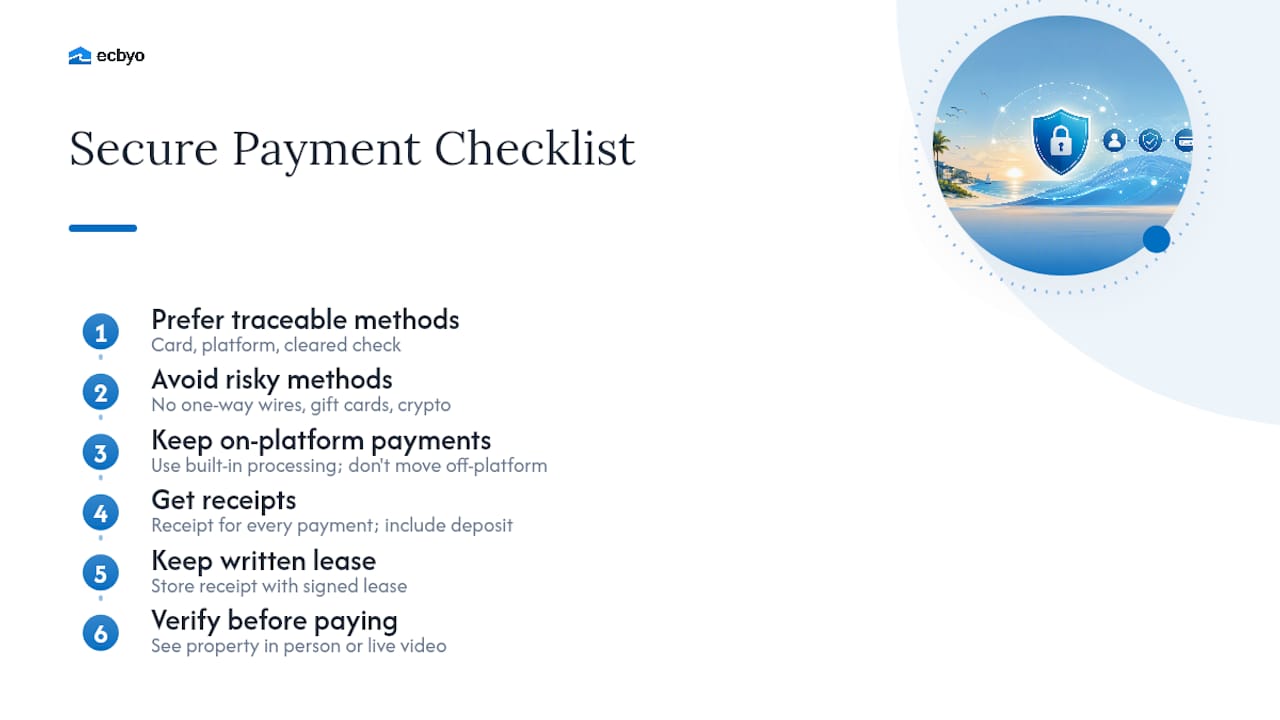
Request a receipt for every payment, including the security deposit, and keep it alongside your written lease. If the owner uses a platform with built-in payment processing, use it rather than moving the transaction off-platform, even if the owner suggests it “saves a processing fee.” Off-platform payment requests are a common tactic once initial trust is established.
Never pay a full deposit or first month’s rent before seeing the property, either in person or via a live video walkthrough with the owner present. Photos alone, no matter how convincing, are not verification.
If a deal feels rushed, that is information. Legitimate owners generally are not in such a hurry that they cannot wait for you to complete basic verification.
Why ECBYO Focuses on Owner-Managed Listings
Emerald Coast By Owner exists because renters deserve a straight line to the person who actually owns the property, not a chain of intermediaries adding cost along the way. The whole model is built around connecting guests directly with Gulf Coast owners, without charging travelers a service fee for the privilege.
That direct-contact structure is the practical advantage worth naming here: you are messaging the decision-maker from the first inquiry, on a marketplace built specifically for Gulf Coast rentals rather than a general nationwide listing site. It is a narrower focus by design, and it is exactly why verification steps like the ones covered in this guide still matter, even on a trusted marketplace.
— Gail
Find Your Next Gulf Coast Stay Direct From the Owner
This platform is built for exactly the situation this guide walks through: connecting you with Gulf Coast property owners directly, without additional traveler booking or service fees. Instead of digging through classifieds hoping a listing checks out, you get owner profiles, direct messaging, and detailed property listings designed to help with verification.
Search by destination to see what is available right now, whether you are looking in Florida, Alabama, Mississippi, Louisiana, or Texas. If you are a property owner rather than a renter, listing costs $499 per year through the list your property page, which gets your rental in front of travelers actively searching for owner-direct stays on the Gulf Coast. Either way, the next step is the same: pick a destination page and start comparing verified owner listings today.
Sources
The 1% and 2% screening rules referenced here come from SmartAsset and BiggerPockets. Property management cost comparisons draw on Leasebase and rents.ai.
- Property Manager vs. Self-Managing: The Real Cost Comparison – Leasebase
- Rents
- Self-employment tax overview – OnPay
FAQ
What Is the 2% Rule for Rentals?
If monthly rent equals roughly 2% of the purchase price, the deal clears an initial screen worth a closer look, though SmartAsset and BiggerPockets both note it rarely holds up in most U.S. markets and ignores real operating costs.
Is Renting by Owner Cheaper?
Renting by owner is often cheaper because there is no property management markup built into the rent, and owner-managed listings on platforms like Emerald Coast By Owner carry no traveler service fees. The savings are not guaranteed on every listing, so comparing total move-in cost across a few options remains worthwhile.
Can I Pay Myself to Manage My Own Rental Property?
Yes, but paying yourself a management fee has real tax consequences worth understanding before you set one up. OnPay’s guidance on self-employment tax notes this is not a simple way to shift profit and should be treated cautiously rather than as a guaranteed savings strategy.
What Is the 7% Rule for Rental Properties?
Renters and owners researching rental math are better served sticking to the documented 1%/2% heuristics and a full expense-based analysis rather than an undefined figure.
Recommended
- Save 8–18%: Find Gulf Coast Rentals Direct From Owners Safely
- How to Find Owner Direct Beach Rentals on the Gulf Coast
- Save 12–18% When You Book Direct Gulf Coast Rentals Safely
- Avoid Fines and Booking Suspensions: Gulf Coast Rental Agreement
 |
About the AuthorGail Greiner of the Emerald Coast by Owner Editorial Team creates destination guides, vacation-planning resources, and local travel content focused exclusively on Gulf Coast vacation rentals. Our team researches beach communities, vacation rental trends, family travel planning, local attractions, and direct-booking best practices across Florida, Alabama, Mississippi, Louisiana, and Texas. Every guide is written to help travelers make more informed booking decisions while avoiding unnecessary third-party guest service fees. Since launching in 2016, Emerald Coast by Owner has helped connect travelers directly with verified vacation rental hosts across the Gulf Coast. This article was reviewed for accuracy and updated using local destination research and current vacation rental market insights. |


