


Reviewed for 2026 rules.
TL;DR:
- Standard golf carts generally cannot drive on public 30A roads.
- Street-legal LSVs may operate on eligible roads posted at 35 mph or less, subject to local restrictions.
- LSVs require proper registration, insurance, safety equipment, and a license plate.
- U.S. 98, sidewalks, and the Timpoochee Trail are not legal LSV travel routes.
- Community rules vary: Rosemary Beach, Alys Beach, and other 30A communities may impose additional restrictions.
- Before renting: Verify the VIN, registration, insurance, equipment, passenger limits, and permitted driving areas.
Standard golf carts cannot legally be driven on 30A’s public roads. Only a Florida-compliant low-speed vehicle (LSV), one that meets the equipment and registration requirements spelled out in Florida Statute 316.2122, may operate on streets posted at 35 mph or less, and only where Walton County ordinance permits it. The definitions matter more than they sound: Florida Statute 320.01 draws a hard legal line between a golf cart and an LSV, and the Walton County Sheriff’s Office enforces that line under Chapter 20, Article VI of the county code.
If you’re renting one for your trip, don’t take the golf cart company’s word for it. Confirm this before you climb in:
- Ask for the vehicle’s registration and license plate, not just a rental receipt.
- Request proof of insurance covering that specific vehicle.
- Check the VIN plate matches the paperwork you’re handed.
- Look for headlights, turn signals, mirrors, a windshield, and seat belts. Missing any of these usually means it isn’t street-legal.
Pro Tip: If the rental company hesitates or can’t produce a registration card on the spot, walk away. An unregistered “golf cart” driven on a public 30A street is the fastest way to turn a beach vacation into a conversation with a deputy.
Key Takeaways
Only a registered, insured low-speed vehicle meeting Florida’s equipment standards may legally operate on 30A’s public roads, and Walton County actively enforces that line.
| Point | Details |
|---|---|
| Golf carts stay off public roads | Only compliant LSVs meeting F.S. 316.2122 may drive on streets posted 35 mph or less. |
| Verify before you drive | Check registration, insurance, and VIN against the vehicle before renting or accepting one. |
| Local rules add restrictions | Rosemary Beach, Alys Beach, and other communities can impose stricter boundaries and hours. |
| Fines and towing are real | Sidewalk or Timpoochee Trail violations start at $161; US Highway 98 use risks towing. |
| Confirm details before booking | Emeraldcoastbyowner listings let you message owners directly about vehicle compliance and rules. |
Table of Contents
- Golf Cart Rules 30A: The Legal Difference Between a Cart and an LSV
- Where LSVs Can and Cannot Drive on 30A
- Equipment, Registration, and Who Can Drive
- How Rosemary Beach, Alys Beach, and Other Communities Add Their Own Rules
- A Renter’s Checklist Before You Drive Away
- What Happens If You Get It Wrong
- Common Myths About Golf Carts on 30A
- Book Smarter on 30A With Clear Answers Upfront
- Sources
- FAQ
Golf Cart Rules 30A: The Legal Difference Between a Cart and an LSV
The word “golf cart” gets used loosely all over South Walton, but Florida law treats two categories of vehicle very differently, and only one of them belongs on a public street. Under Florida Statute 320.01, a golf cart is defined as a vehicle designed for use on a golf course that cannot exceed 20 mph. An LSV, by contrast, must be capable of speeds greater than 20 mph but no more than 25 mph, and it has to meet the federal safety standard set out in 49 C.F.R. 571.500. That standard is why LSVs come with windshields, seat belts, and turn signals: a golf cart, by design, has none of that built in.

This distinction is the whole ballgame for 30A driving rules. A true golf cart, the kind with no doors, no seat belts, and a top speed under 20 mph, has no legal path onto a public road in Walton County. An LSV does, but only under specific conditions. Florida Statute 316.2122 authorizes LSV operation on any street with a posted speed limit of 35 mph or less, and it lists the equipment, registration, and insurance requirements that make that legal. Walton County then layers its own rules on top through Ordinance 2025-03, which added Article VI to Chapter 20 of the county code and introduced a mandatory safety-sticker program for LSVs operating locally.
| Category | Golf Cart (F.S. 320.01) | Low-Speed Vehicle (F.S. 320.01, 316.2122) |
|---|---|---|
| Top speed | Cannot exceed 20 mph | Must reach 20 to 25 mph |
| Federal safety standard | Not required | Must meet 49 C.F.R. 571.500 |
| Registration/title | Not required | Required |
| Insurance | Not required | Required |
| Where it can drive | Golf courses, private property only | Streets posted 35 mph or less |
| County safety sticker | Not applicable | Required under Walton County ordinance |
Pro Tip: When in doubt, read the source text yourself rather than trust a rental flyer. The full ordinance is posted as a PDF on the Walton County site, and it takes about five minutes to confirm the current boundaries and sticker rules for yourself.
Where LSVs Can and Cannot Drive on 30A
Even a fully compliant LSV doesn’t have free rein across South Walton. The rule of thumb is simple: LSVs are allowed on public streets with a posted speed limit of 35 mph or less, but Walton County has carved out explicit no-go zones that catch a lot of visitors off guard.
- Permitted: neighborhood streets and connector roads posted at 35 mph or under throughout South Walton communities.
- Permitted with caution: crossings and intersections where an LSV route meets a higher-speed road, provided the crossing itself is legal and marked.
- Prohibited outright: US Highway 98, a 45+ mph corridor that runs through the heart of South Walton and is off-limits to LSVs entirely.
- Prohibited: sidewalks and the Timpoochee Trail, the paved multi-use path that runs along Scenic Highway 30A.
- Prohibited: other multimodal and multi-use paths, which the county treats as separate from the public road system and reserves largely for pedestrians and cyclists, with a 15 mph cap where any vehicle use is posted at all, per the county’s multimodal facility rules.
One detail trips up a lot of first-time renters: fines for illegal sidewalk or path use start at a specified civil infraction amount, and a vehicle caught on US Highway 98 can be towed on the spot, according to WCSO guidance. The Timpoochee Trail in particular looks like an obvious shortcut between beach access points, and it is exactly the kind of route where deputies watch for violations. Before you plan a route, check the county’s beach access and driving resources for current maps, since boundary lines shift as new development comes online.
Equipment, Registration, and Who Can Drive
An LSV isn’t street-legal just because it has a windshield bolted on. Florida law requires a specific list of equipment, and Walton County checks for it through the safety-sticker program tied to Ordinance 2025-03. Here’s the baseline under F.S. 316.2122:
| Requirement | Detail |
|---|---|
| Headlamps | Required, functioning |
| Turn signals | Required, front and rear |
| Taillamps | Required |
| Reflex reflectors | Required on rear |
| Parking brake | Required |
| Rearview mirror | Required |
| Windshield | Required |
| Seat belts | Required for all seating positions |
| VIN | Required, visible on manufacturer plate |
| License plate | Required, vehicle must be registered |
| Insurance | Required, valid policy on file |
| Title | Required through FLHSMV |
Operators need a valid driver’s license to get behind the wheel of an LSV on a public road. FLHSMV guidance also notes that, as of October 1, 2023, anyone under 18 operating a golf cart on a public roadway must hold a learner’s permit or license, and adults must carry government-issued photo ID whenever they’re operating one on public streets. That rule was aimed squarely at the kind of casual, unlicensed teen driving that used to be common in beach towns before the law tightened.
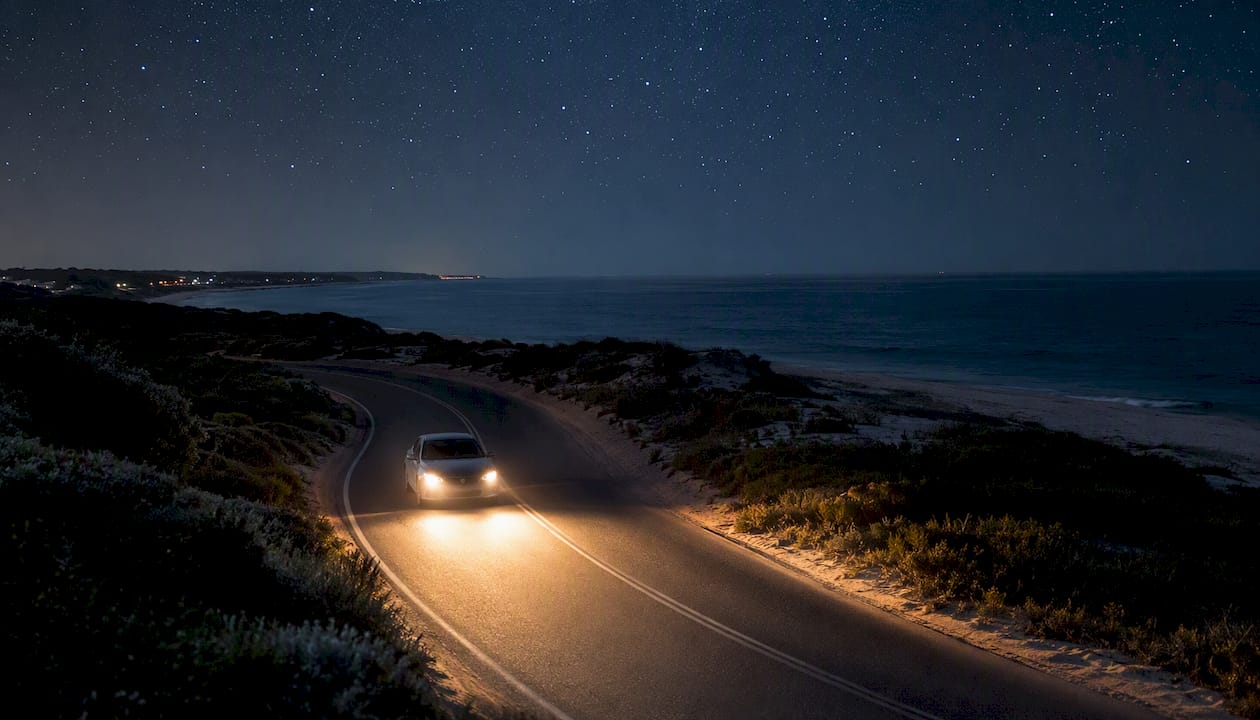
Night driving adds another layer of risk. Headlamps and taillamps aren’t optional accessories; they’re the difference between being visible to a car doing 35 mph and being invisible until it’s too late. If you’re renting after dark, confirm the lights actually work before you leave the lot, not after you’re three blocks from the rental office.
How Rosemary Beach, Alys Beach, and Other Communities Add Their Own Rules
Walton County sets the floor, not the ceiling. Individual 30A communities can, and often do, layer stricter rules on top of the state and county baseline, which means a vehicle that’s technically legal under Florida Statute 316.2122 might still be restricted inside a specific neighborhood.
- Rosemary Beach and Alys Beach are both known for tightly managed, pedestrian-first streetscapes, and each community can impose its own boundaries on where LSVs may travel within town limits.
- Some communities restrict LSV use to certain hours, limiting evening or late-night operation even when county rules would otherwise allow it.
- HOA-governed neighborhoods frequently add mapped boundaries, designating specific entry and exit points for LSVs rather than allowing free movement throughout the community.
- Special events, festivals, and peak-season weekends can trigger temporary road closures that suspend LSV access on streets that are normally open.
None of this replaces the county-wide requirements. A community can add restrictions, but it can’t waive the equipment, registration, or insurance rules that Walton County and the state require. If you’re staying inside Rosemary Beach, Alys Beach, or a similar planned community, check that town’s own posted rules or ask your property host directly before you assume the county baseline is all that applies.
A Renter’s Checklist Before You Drive Away
Rental operators up and down 30A move fast during peak season, and paperwork sometimes gets treated as an afterthought. Protect yourself with a short verification routine before any money changes hands.
- Ask directly: “Is this vehicle registered as an LSV?” A real registration means a plate, a title on file with FLHSMV, and a VIN that matches the paperwork.
- Request the insurance card. No policy number, no coverage, no drive.
- Confirm it meets 49 C.F.R. 571.500. This is the federal safety standard that separates a real LSV from a dressed-up golf cart, and a legitimate operator should know the term.
- Match the VIN plate to the paperwork in hand, not to a photo on the company’s website.
- Ask about passenger limits, parking rules, and operating hours the rental company enforces, since some cap seating below the vehicle’s physical capacity for liability reasons.
Pro Tip: Insist on seeing the VIN and the county safety sticker before you hand over payment. As local guidance from Visit South Walton points out, plenty of vehicles that look like ordinary golf carts around South Walton are actually configured as LSVs, and the only way to know for certain is the paperwork, not the paint job.
What Happens If You Get It Wrong
Walton County doesn’t treat LSV violations as a minor tourist inconvenience. The Walton County Sheriff’s Office enforces these rules as it would any other traffic law, because an LSV on the road is legally a motor vehicle, not a novelty.
- Operating an unregistered or non-compliant vehicle on a public road can draw a citation on the spot.
- Illegal use of a sidewalk, bike path, or the Timpoochee Trail carries a civil infraction with fines starting at a specified civil infraction amount.
- Driving on US Highway 98, where LSVs are prohibited outright, can result in the vehicle being towed.
- Because LSVs are classified as motor vehicles for traffic purposes, operators are expected to obey the same rules of the road as any car: stop signs, right-of-way, and posted speed limits all apply.
The underlying reason enforcement stays strict isn’t bureaucratic box-checking. An LSV without working brakes, mirrors, or headlights is a hazard to everyone else on a 30A road, especially at dusk when bike and pedestrian traffic peaks along Scenic Highway 30A. WCSO’s approach leans on education first, through the safety-sticker program and mapped boundaries, but citations follow when vehicles clearly don’t meet the standard.
Common Myths About Golf Carts on 30A
A surprising amount of bad information circulates among renters every summer, usually passed along by word of mouth rather than checked against the actual rule.
- Myth: “If it has lights and a windshield, it’s street-legal.” Reality: visual cues don’t replace paperwork. Registration, insurance, and a VIN on file are what actually make a vehicle legal, not how it looks.
- Myth: “There’s a ‘90-day rule’ that lets visiting golf carts operate without registration.” Reality: no such provision exists in Florida Statute 316.2122 or Walton County’s ordinance. Registration and insurance requirements apply from the first mile driven on a public road.
- Myth: “Rosemary Beach and Alys Beach let any golf cart through since they’re private-feeling communities.” Reality: both communities sit within Walton County and are still subject to county and state LSV rules, on top of whatever internal restrictions they add.
- Myth: “The rental company handles all the legal stuff, so it’s not my problem.” Reality: as the operator, you’re the one who gets the citation if the vehicle isn’t compliant, regardless of who rented it to you.
When a situation feels ambiguous, go to the source rather than guessing. The WCSO’s LSV page and the county ordinance text are both written in plain enough language to answer most borderline questions in a few minutes.
A Local Marketplace’s View on Golf Cart Compliance
Booking a 30A rental should never come with legal guesswork attached, and that’s a responsibility Emeraldcoastbyowner takes seriously on the host side of the marketplace. When a property listing mentions golf cart or LSV access, that detail should come with real specifics: whether the vehicle is registered, whether insurance is current, and where it’s actually permitted to go within the community. A vague mention of “golf cart included” tells a guest nothing useful, and it can set them up for a fine they never saw coming.
Hosts who list on Emeraldcoastbyowner and offer an LSV as part of the stay are in a strong position to add that documentation directly into the listing, along with a simple boundary map showing where guests can and can’t drive. Guests booking a 30A property should ask the same three questions every time: is the vehicle registered, is it insured, and where specifically does the owner allow it to be driven? A quick message before arrival saves a headache after check-in.
Book Smarter on 30A With Clear Answers Upfront
Emeraldcoastbyowner connects you directly with the property owner, not a call center, which means questions about golf carts, parking, and local vehicle rules get answered by someone who actually knows the property and the neighborhood.
Before you book, look for listing notes that spell out whether a golf cart or LSV comes with the property, whether it’s registered and insured, and where the owner allows it to be driven. If a listing is vague on those details, message the owner directly and ask before you commit. That direct line to the owner is exactly what sets Emeraldcoastbyowner apart from booking through a faceless portal: real answers, from the person who actually owns the vehicle and the property. Ready to find a 30A stay with the details already spelled out? Browse Florida vacation rentals and start messaging owners about their local vehicle policies today.
Sources
- Chapter 316 Section 2122 - 2025 Florida Statutes - The Florida Senate
- Low Speed Vehicle Laws | Walton County Sheriff’s Office, FL
- Ordinance 2025-03 — Walton County (LSV standards and Article VI)
Consult the statute or ordinance text directly for borderline cases. Local rules can change between seasons, and the primary source always outranks secondhand summaries, including this one.
FAQ
Can You Drive Golf Carts on 30A in Florida?
Standard golf carts, capable of no more than 20 mph, are not permitted on public 30A roads. Only low-speed vehicles that meet Florida Statute 316.2122’s equipment and registration requirements may operate on streets posted 35 mph or less.
Are Golf Carts Allowed in Rosemary Beach?
Rosemary Beach sits within Walton County and follows the same state and county LSV rules as the rest of 30A, plus any additional community-specific restrictions on hours or boundaries. Confirm current local rules directly with the community before driving.
What Is the New Law for Golf Carts in Florida?
As of October 1, 2023, FLHSMV rules require anyone under 18 operating a golf cart on a public road to hold a learner’s permit or license, and adults must carry government-issued photo ID while operating one.
What Is the 90 Rule for Golf Carts?
There is no “90-day rule” or similar provision in Florida law or Walton County’s ordinance that exempts visiting golf carts from registration and insurance requirements. Every LSV driven on a public 30A road needs current registration and insurance regardless of how long the driver is visiting.
How Do I Confirm a Rental Golf Cart Is Street-Legal?
Ask the rental company to show the registration, insurance card, and VIN plate, and confirm they match. If Emeraldcoastbyowner-listed hosts, this can be as simple as messaging the owner directly through the platform before arrival.
Recommended
- 30A Vacation Rentals and beaches in South Walton, Florida | ECBYO
- Top 4 30A Vacation Rentals Marketplace 2026 | ECBYO
- Beachfront Access Rentals: What Vacationers Should Know | ECBYO
- Renting Gulf Property for Two Weeks: A Family Guide | ECBYO

About the Author
Joe Godar of the Emerald Coast by Owner Editorial Team creates destination guides, vacation-planning resources, and local travel content focused exclusively on Gulf Coast vacation rentals.
Our team researches beach communities, vacation rental trends, family travel planning, local attractions, and direct-booking best practices across Florida, Alabama, Mississippi, Louisiana, and Texas. Every guide is written to help travelers make more informed booking decisions while avoiding unnecessary third-party guest service fees.
Since launching in 2016, Emerald Coast by Owner has helped connect travelers directly with verified vacation rental hosts across the Gulf Coast.
This article was reviewed for accuracy and updated using local destination research and current vacation rental market insights.


