


Yes, plenty of U.S. beach towns actively welcome golf carts and build their whole vacation culture around them. The Emerald Coast along 30A, the Outer Banks, Hilton Head Island, Gulf Shores and Orange Beach, Panama City Beach, Galveston, and a handful of others are the best places to plan a cart-friendly trip. Every one of these spots sets its own permit, registration, and route rules. Confirm the details with your property manager and the local municipal page before you book or climb behind the wheel.
TL;DR:
- Confirm the specific town and neighborhood rules, as cart access varies widely due to local ordinances and HOA restrictions.
- Know the difference between golf carts and LSVs, and ensure proper registration, insurance, and safety equipment for street-legal use.
- Rent your cart and property simultaneously to avoid availability issues, and verify HOA permissions and parking passes before booking.
- Follow local safety and parking regulations, especially avoiding highways, driving at night, and respecting designated cart zones to prevent fines.
- Use platforms like Emerald Coast By Owner to find direct-owner listings that specify cart-friendly properties with no extra booking fees.
Table of Contents
- Top golf cart friendly beach towns and what makes each one work
- How golf cart rules work: LSVs, registration, and age limits
- Renting versus bringing your own: costs and the pre-drive checklist
- Why HOA and community rules can override a cart-friendly town
- Staying safe and avoiding fines on cart-friendly streets
- How Emerald Coast By Owner helps you find cart-friendly rentals
- What carts actually change about a beach vacation
- Book cart-friendly Gulf Coast rentals through Emerald Coast By Owner
- FAQ
- Sources
Top golf cart friendly beach towns and what makes each one work
Some beach towns tolerate golf carts. Others are practically built around them, with wide cart lanes, dedicated parking, and rental shops on every corner. Here are ten of the best, with the details that matter before you pack your sunscreen.
- 30A (Rosemary Beach, Seaside, and neighboring communities): This stretch of Florida’s Emerald Coast is famous for walkable, cart-friendly neighborhoods connected by a shared bike and cart path. Rosemary Beach and Seaside allow carts on their internal streets, but some private communities restrict outside rental carts or require you to use an approved provider, so check with your rental guidance before arrival.
- Outer Banks (Duck and Corolla, North Carolina): Dare County publishes an interactive golf cart and LSV map showing exactly which streets in Duck, Corolla, and nearby towns permit low-speed vehicles. Beach driving itself is limited to designated four-wheel-drive beach ramps, and cart access does not automatically mean beach access.
- Hilton Head Island, South Carolina: The island’s bike paths double as informal cart routes in many neighborhoods, though South Carolina state law keeps carts within four miles of the registration address or a gated community entrance, and operation is daylight only with a licensed driver at least 16 years old, per the South Carolina Department of Public Safety.
- Gulf Shores and Orange Beach, Alabama: Gulf Shores requires an annual $25 permit and an annual equipment inspection before a cart can legally use designated streets, according to the city’s registration page. Rentals are easy to find near the Gulf Shores rental market, but you still need the permit to drive one yourself.
- Panama City Beach, Florida: The city has expanded its list of approved neighborhoods for cart operation and publishes which roads remain off limits, according to Panama City’s golf cart ordinance. If you are weighing where to stay, the neighborhood guide for Panama City Beach breaks down which areas suit cart travel best, and the Panama City Beach rental listings show availability by area.
- Galveston, Texas: Galveston splits the island into registration zones, and a cart registered for the west side cannot legally cross east of 103rd Street, per the city’s golf cart FAQ. Beach driving is allowed only where motorized vehicles are already permitted on the sand, with exceptions for handicapped drivers.
- Bald Head Island, North Carolina: This barrier island bans regular cars entirely, so golf carts and LSVs are the only way to get around. Expect every rental cottage to come paired with a cart rental option, since there is simply no other way to reach the beach from most homes.
- Tybee Island, Georgia: Tybee’s small-town layout keeps most beach access points within a short cart ride of parking areas, and local rental shops cater specifically to vacationers who want a cart for the week.
- Destin, Florida: Destin’s residential canal neighborhoods often allow carts on local streets, though Destin’s main thoroughfares are not cart legal, so plan to park and walk the last stretch to crowded beach access points during peak season.
- Amelia Island, Florida: Fernandina Beach’s historic downtown and several gated communities permit carts on posted streets, making Amelia Island a quieter alternative to the busier Gulf Coast cart towns.
Across all ten, one pattern holds: cart friendliness is a mix of state law, municipal ordinance, and whatever the specific neighborhood or HOA decides. A cart-legal road in one subdivision might be off limits two streets over.
How golf cart rules work: LSVs, registration, and age limits
Before you rent or bring a cart, it helps to know the difference between a standard golf cart and a Low-Speed Vehicle, because that distinction decides where you can legally drive.
A golf cart, by most state definitions, tops out around 15 to 20 miles per hour and is built for courses and private roads. An LSV is a step up: it is built to a federal safety standard that requires headlights, turn signals, mirrors, seat belts, and a vehicle identification number, which qualifies it for public roads with posted speed limits at or below 35 miles per hour. That single modification, adding the safety equipment, is often what separates a cart that can only circle a driveway from one that can legally cross a public street to reach the beach.
- North Carolina requires LSVs to be registered and insured, and generally restricts them to roads posted 35 miles per hour or less, following state traffic law.
- South Carolina limits golf cart operation to daylight hours, within four miles of the registered address or a gated community entrance, with drivers at least 16 and licensed, under the state’s golf cart law.
- Gulf Shores, Alabama requires an annual permit and equipment inspection before a cart can use its designated streets, per the city’s registration requirements.
- Galveston, Texas divides the island into zones, so a cart’s registration determines which side of 103rd Street it can legally operate on, according to city guidance.
Statistic Callout: South Carolina caps unregistered golf cart travel at four miles from the owner’s registration address or a gated community entrance, daylight hours only. That radius is tight enough that a beach a few miles outside your neighborhood may be legally off limits without proper LSV registration.
Most towns post speed thresholds between 25 and 35 miles per hour for cart-legal streets, and enforcement tends to focus on three things: unregistered or uninspected vehicles on public roads, carts operating after dark without lights, and carts straying onto highways where they were never allowed in the first place. Municipal maps, like the one Dare County keeps for the Outer Banks, exist specifically so visitors do not have to guess.

Renting versus bringing your own: costs and the pre-drive checklist
Most vacationers rent rather than haul a cart hundreds of miles, and the logistics are simpler than you might expect. Rental companies in cart-friendly towns typically deliver the vehicle to your rental property, walk you through the controls, and pick it up at the end of your stay. Many outfit their fleets to LSV standards, with headlights, mirrors, seat belts, and a visible VIN, so the cart is street legal the moment it rolls off the trailer.
Here is the order to work through before you commit to a rental:
- Confirm HOA permission first. A town-legal cart does nothing for you if the community bans outside rental vehicles.
- Ask about parking passes. Some beach access points require a visible permit sticker or tag for cart parking.
- Request registration and inspection paperwork. If the rental company cannot produce documentation, that is a red flag worth walking away from.
- Confirm the battery or charge policy. Ask whether the cart arrives fully charged and whether you are responsible for charging it nightly.
- Verify seating capacity and safety gear. A four-seat cart with only two working seat belts is a problem for a family of five.
Pro Tip: Book your cart rental at the same time you book your rental property, since fleets in popular cart towns sell out during peak weeks.
Rental companies generally ask for a deposit and may require proof of insurance or a signed liability waiver before delivery. Most will also warn you upfront that they cannot deliver to a property without confirmed HOA or community approval, which saves everyone a wasted trip. If you are weighing a rental home against a hotel stay in a cart town like Panama City Beach, verified accommodations with amenities like in-room hot tubs are worth a look if a vacation rental is not the right fit for your group.
Why HOA and community rules can override a cart-friendly town
A town can be famously cart friendly and still leave you stuck if the specific property you booked says no. Homeowners associations and gated communities set their own rules on top of whatever the city allows, and those rules change the actual experience far more than the municipal ordinance does.
- Some HOAs ban outside rental carts entirely but allow residents to keep privately owned carts.
- Others require renters to use one exclusive local provider rather than whichever company has the best rate.
- Seasonal rules are common too, with some communities tightening restrictions during peak summer weeks when golf cart traffic spikes.
The fix is simple: ask before you book, not after you arrive. Contact the property manager or owner directly and request the HOA’s cart policy in writing. If a rental company keeps an availability map by community, cross-check your address against it. When a property turns out to be cart restricted, you have options: pick a different property that already includes a cart, bring e-bikes instead, or plan routes that put you within an easy walk of the beach access point. None of those fallback options require you to gamble on a rule you never confirmed.
Staying safe and avoiding fines on cart-friendly streets
Most citations in golf cart towns come down to a handful of predictable mistakes, all of which are easy to avoid once you know the pattern.
- Park off the pavement and in designated cart spaces, never blocking driveways or emergency access.
- Stick to streets posted for golf cart or LSV use, since main highways and arterial roads are almost always off limits.
- Buckle seat belts for any rider old enough to need one, and never tow a trailer or extra riders beyond the posted seating capacity.
- Skip nighttime driving where local rules restrict it, and treat every stop sign and posted limit as non-negotiable.
Beach access itself follows a separate set of rules from street driving. Many beaches are pedestrian-only, with motor vehicles, including carts, permitted only at specific ramps or designated vehicle beaches. Texas’s Open Beaches Act keeps some Gulf beaches open to vehicle traffic in limited areas, but Galveston still restricts general cart access to streets and beaches that meet its criteria, with exceptions carved out for handicapped drivers. If accessible beach access is a priority for your group, this guide to accessible beach rentals is worth reading alongside your cart research.
Pro Tip: Screenshot the local municipal cart map before your trip. Cell service near the beach is unreliable, and you do not want to guess which street you are allowed on.
How Emerald Coast By Owner helps you find cart-friendly rentals
Emerald Coast By Owner launched in November 2016 with a simple goal: connect vacationers directly with Gulf Coast property owners, cutting out traveler service fees. What began as 350 listings has grown into a marketplace spanning thousands of vacation rentals across Florida, Alabama, Mississippi, Louisiana, and Texas.
Finding a cart-friendly property through the platform follows a straightforward path:
- Search the destination page for your target town, whether that is Florida, Alabama, or another Gulf Coast state.
- Read the listing description closely for notes on included carts, nearby rental providers, or HOA restrictions.
- Message the owner directly through the platform to confirm cart policies before you book, since direct contact is the whole point of booking by owner.
Because every booking happens without a traveler fee layered on top, the conversation with the owner tends to be more direct and more useful than a call center script.
What carts actually change about a beach vacation
The real value of a golf cart on a beach trip is not novelty, it is logistics. A cart turns a ten-minute walk with a cooler, folding chairs, and sunscreen into a two-minute ride, and that difference adds up over a week when you make the trip three or four times a day. Families with young kids or anyone managing beach gear for a group feel this most.

My practical advice: book your rental property and your cart at the same time, and verify the HOA rules before you fall in love with a listing. A gorgeous house two streets back from the sand means nothing if the community bans the cart you were counting on. Reserve a parking pass if the beach access point requires one, and treat the local speed limit and lighting rules as seriously as you would on any public road, because enforcement in these small beach towns is often more attentive than you expect.
Respect the rules and the carts stay welcome. That is the whole arrangement these towns have made with visitors.
— Tayler
Book cart-friendly Gulf Coast rentals through Emerald Coast By Owner
Finding the right property is half the work of planning a cart-friendly beach trip, and Emerald Coast By Owner is built to make that half easier. Every listing connects you directly with the property owner, with no traveler booking fees added on, so the question of whether a property allows carts gets answered by the person who actually knows the HOA rules, not a reservations script.
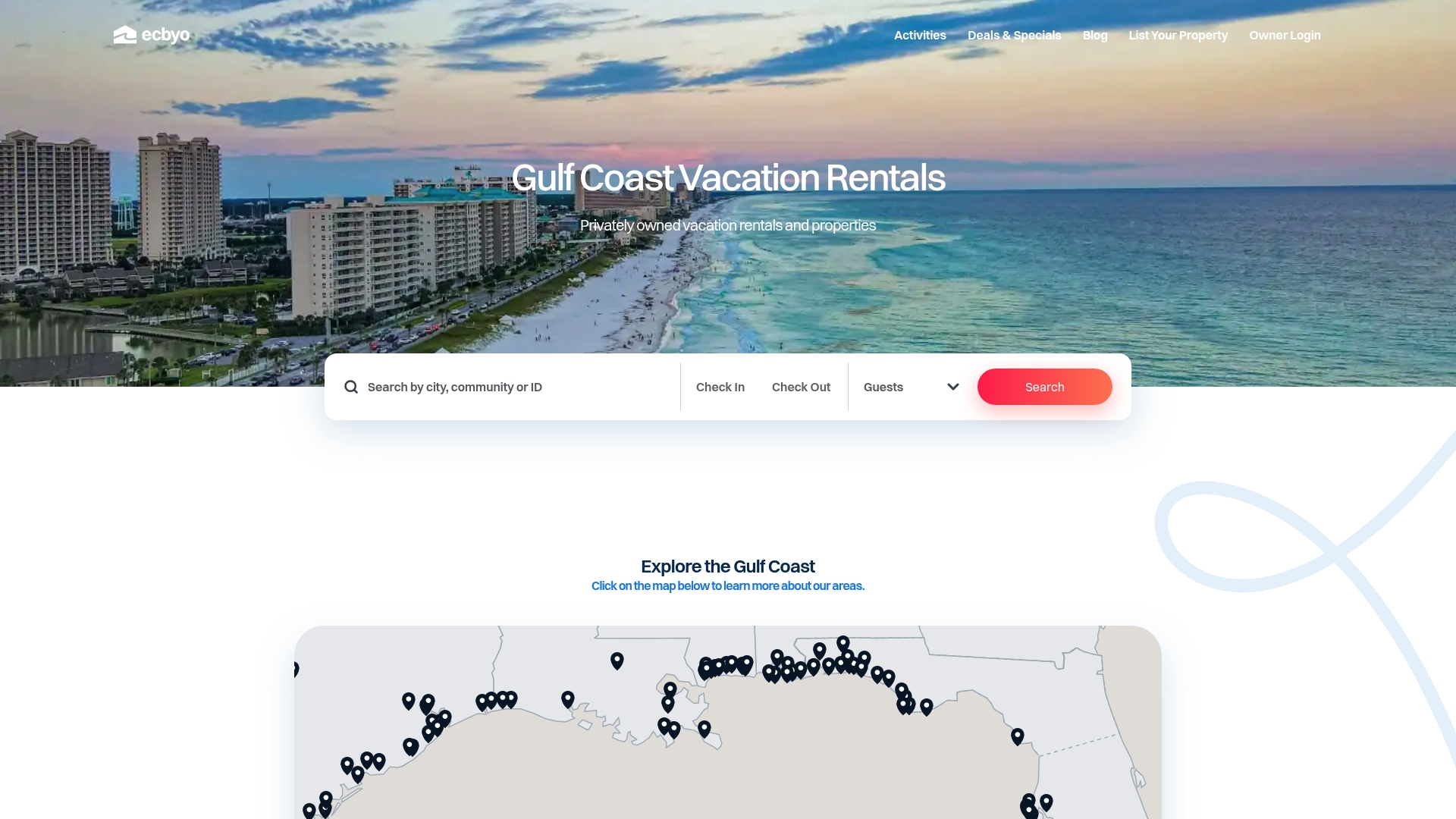
Start by browsing Florida Vacation Rentals or Alabama Vacation Rentals for the cart-friendly towns covered above, then message the owner before booking to confirm three things: whether the community allows rental carts, where the nearest cart parking is, and whether a provider delivers directly to the property. If you own a cart-friendly property yourself, you can list it through the ECBYO subscription and reach vacationers searching specifically for this kind of stay. Check current promotions on the deals page before you book.
FAQ
What beaches in Florida allow golf carts?
Florida beach towns known for cart access include 30A communities like Rosemary Beach and Seaside, Panama City Beach, Destin’s canal neighborhoods, and Amelia Island’s Fernandina Beach area. Rules vary by neighborhood, and Panama City’s ordinance specifically lists which streets are approved and which remain prohibited.
Can you take a golf cart on the beach?
Driving a cart onto the sand itself is only legal where the town already permits motor vehicle beach access, such as designated ramps in parts of the Outer Banks or specific zones in Galveston. Most beaches remain pedestrian-only, so a cart gets you to the parking area or access point, not onto the sand itself, per Galveston’s golf cart guidance.
What island in Florida only allows golf carts?
Florida does not have a major island with a blanket golf-cart-only rule, though Bald Head Island in North Carolina fits that description exactly, since regular cars are banned and carts or LSVs are the only way to get around. Several Florida communities, like parts of Seaside, restrict car traffic heavily but still allow limited vehicle access for residents and deliveries.
What are some good golf cart communities near the beach in Florida?
Rosemary Beach and Seaside along 30A, Panama City Beach’s approved neighborhoods, and Amelia Island’s historic district all support regular cart use on local streets. Each sets its own permit or HOA rules, so confirm details with the property owner or the city’s golf cart ordinance before you rely on a cart for your trip.
How much does it typically cost to rent a golf cart at the beach?
Rental pricing varies widely by town, fleet type, and season, and rental companies typically quote daily and weekly rates directly rather than publishing a fixed national price. Ask the rental company for its current rate sheet and confirm what is included, such as delivery, parking passes, and insurance, before you commit.
Sources
- Golf cart law — South Carolina Department of Public Safety
- Golf carts & low-speed vehicles — Dare County (Outer Banks)
- Golf cart registration — City of Gulf Shores
- Golf cart operations — City of Panama City
- Golf carts and beach access — City of Galveston FAQ
Recommended
- Golf Cart Rules 30A: What Renters Need to Know
- Beachfront Access Rentals: What Vacationers Should Know
- The Best 30A Beaches for Every Kind of Traveler
- 16 30A Beach Towns: Where to Stay by Traveler Type, Owner Direct Tips

About the Author
Tayler Jaeger of the Emerald Coast by Owner Editorial Team creates destination guides, vacation-planning resources, and local travel content focused exclusively on Gulf Coast vacation rentals.
Our team researches beach communities, vacation rental trends, family travel planning, local attractions, and direct-booking best practices across Florida, Alabama, Mississippi, Louisiana, and Texas. Every guide is written to help travelers make more informed booking decisions while avoiding unnecessary third-party guest service fees.
Since launching in 2016, Emerald Coast by Owner has helped connect travelers directly with verified vacation rental hosts across the Gulf Coast.
This article was reviewed for accuracy and updated using local destination research and current vacation rental market insights.


