


The fastest way to get more direct bookings is to remove friction from your booking flow, capture guest emails at every touchpoint, and offer a modest direct-only incentive that beats OTA pricing without undercutting your rates elsewhere. Prioritize those three moves first: a cleaner booking path, an email list you actually own, and a reason to book direct that guests can see immediately. Expect small wins within days, like fewer abandoned carts, and measurable shifts in your channel mix within 60 to 90 days as repeat and referral traffic starts converting on your own site rather than through Lodgify’s tracked OTA channels.
TL;DR:
- Adding a persistent “Book Direct” button on every webpage and highlighting direct perks at the top of booking pages can significantly reduce cart abandonment and increase direct bookings quickly.
- Optimizing mobile website speed, showing all-in total prices upfront, and providing trust signals like reviews and SSL certificates are crucial for boosting mobile conversion rates.
- Offering low-cost, clear incentives such as free breakfast, parking, or small discounts can attract guests to book directly without risking rate parity violations.
- Building a regular email sequence for post-stay engagement and loyalty offers can turn one-time guests into repeat customers over time.
- Listing on a targeted direct-booking marketplace can supplement your own site traffic and expand regional visibility without high upfront costs.
Table of Contents
- Quick Wins: Low-Cost Tactics You Can Start This Week
- Optimize Your Website and Booking Flow for Mobile Conversion
- Pricing and Incentives That Beat OTAs Without a Price War
- Building an Email and Repeat-Guest Booking Habit
- Content, Social Proof, and Reviews That Build Discovery
- Measuring Direct Bookings: KPIs and a Simple Tech Stack
- What the Data Actually Tells Owners About Direct Bookings
- An Adjacent Option: Listing on a Direct-Booking Marketplace
- Sources
- FAQ
Quick Wins: Low-Cost Tactics You Can Start This Week
You don’t need a new website or a marketing budget to move the needle this month. Most owners lose direct bookings to friction they’ve never actually tested themselves, so start by booking a room on your own site from your phone. If you hesitate, hunt for the total price, or get confused about next steps, your guests are doing the same thing right before they close the tab and open Booking.com instead.
Here are the tactics that produce results fastest, roughly in order of effort versus payoff:
- Add a sticky “Book Direct” button to every page of your website, including blog posts and photo galleries, not just the homepage.
- Display your direct-only perk right at the top of the booking page rather than burying it in a policies tab. A simple banner like “Book direct and save 8%, plus late checkout” works better than a discount code guests have to hunt for.
- Set up Wi-Fi email capture using a captive portal tool like StayFi, which collects a guest’s email the moment they connect during their stay, whether they booked direct or through an OTA.
- Put a physical reminder card in the room pointing guests to your direct booking site for their next stay, with a QR code that lands on a pre-filled rebooking page.
- Send a short post-stay message through the OTA’s own messaging system thanking the guest and mentioning that repeat stays booked directly get a small perk, since OTAs generally allow this kind of soft, policy-compliant outreach after checkout.
Each of these can go live in under a week, and none require a developer. Watch your booking-page bounce rate and your Wi-Fi email capture count as your first two short-term signals. If bounce rate drops and your email list grows by even 5 to 10 addresses a week for a small property, the tactics are working.
Pro Tip: Test your own booking flow on a slow hotel Wi-Fi connection, not your office broadband. A three-second load time on your phone at home can turn into eight seconds on a hotel guest network, and that gap is exactly where direct bookings die.
Optimize Your Website and Booking Flow for Mobile Conversion
Most direct-booking losses happen in the booking flow itself, not in marketing. Amadeus’ hospitality guide points to website optimization, mobile experience, and streamlined booking flows as the core levers for growing direct bookings, and that ordering matters: fix the flow before you spend a dollar on ads.
Direct-booking websites for vacation rentals typically convert 3 to 5% of visitors into bookings, which gives you a benchmark to test against once your own flow is live.
If your site converts well below that range, the problem is almost always one of these:
- Page speed on mobile. Google’s Core Web Vitals flag slow loading, layout shifts, and delayed interactivity, and a hotel booking page failing these checks loses guests before they see your rates at all.
- Hidden total price. Guests comparing your site against an OTA tab will bail the moment they suspect a resort fee or cleaning charge is waiting at checkout. Show the all-in total on the search results page, not just at final confirmation.
- Weak trust signals. A visible SSL padlock, real guest reviews on the booking page itself, and a recognizable payment processor logo all reduce the hesitation that sends someone back to a familiar OTA brand.
- Confusing calendar logic. If your booking engine shows a date as available and then rejects it at checkout, that guest is gone, often permanently.
- No instant confirmation. A “we’ll email you within 24 hours” message is a direct invitation to book elsewhere immediately.
Your booking engine itself needs a few non-negotiable features: calendar clarity that matches your actual inventory in real time, instant confirmation emails, the option to save a card for faster rebooking, and fee transparency before the final click. A channel manager ties your booking engine to your OTA listings so a reservation made on one platform blocks that date everywhere else automatically. Skip this piece and you will eventually double-book a unit during a holiday weekend, which costs far more in refunds and reputation than the software subscription would have.
On the discovery side, basic SEO structured data, specifically schema markup for lodging, hotel amenities, and pricing, helps search engines understand your listings well enough to surface them in rich results and in Google Vacation Rentals, which can display your availability for free when your channel manager connection is set up correctly. That’s a direct booking path that costs you nothing per click, unlike paid search.
For a deeper walkthrough of the SEO side specifically, including how to target destination and neighborhood searches that OTAs rank for constantly, see Emeraldcoastbyowner’s direct-booking SEO playbook.
Pricing and Incentives That Beat OTAs Without a Price War
Undercutting your OTA rate is the least sustainable way to win a direct booking, and it can also violate the rate parity clauses in most OTA contracts. The smarter play is value-adds: perks that cost you little relative to their perceived worth but that no OTA listing can replicate at the point of comparison.
Consider these examples, all pulled from what NetSuite’s strategy guide identifies as common, effective direct-booking incentives:
- Free breakfast or a welcome amenity that shows up as a line-item value on your booking page (“$25 value, included free”).
- Complimentary parking, especially valuable in dense coastal towns where daily parking fees can run $15 to $30.
- Early check-in or late checkout, which costs you nothing on most days and feels like a genuine upgrade to the guest.
- A small direct-only discount, typically 5 to 10%, framed as savings rather than as a lower price. “Save 8% booking direct” reads differently than “$183 instead of $199,” even though the math is identical.
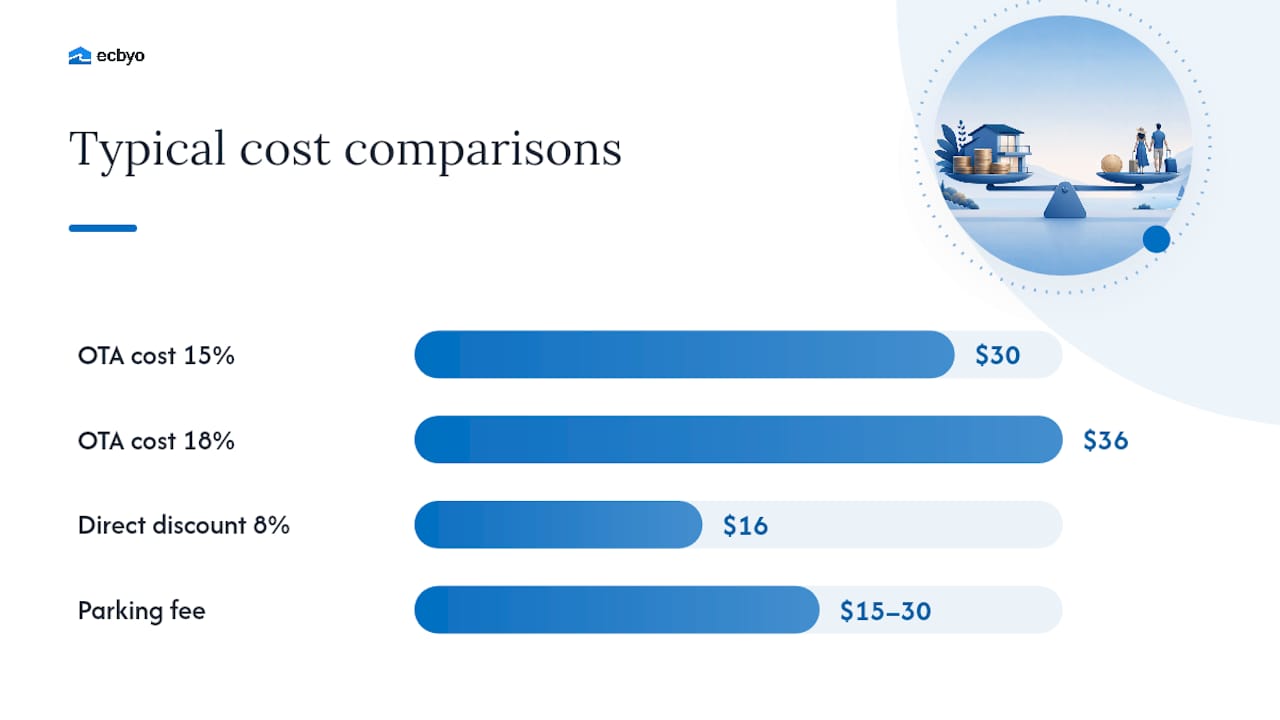
Run the numbers before you commit to a discount. If a $200 nightly rate costs you roughly $30 to $36 in a typical 15 to 18% OTA commission, an 8% direct discount of $16 still nets you more revenue per booking than the OTA channel would, while giving the guest a visible reason to skip the middleman. That math holds up as long as you’re comparing it against your actual commission structure, not against an assumed one.
Test incentives one at a time rather than stacking three new offers simultaneously. Change your direct-only perk, leave everything else static for two to three weeks, and track the shift in your direct booking share before adding a second variable. This keeps you from triggering OTA rate-parity flags, since your public rate stays untouched. Only your owned-channel perks change.
Pro Tip: Write two versions of your direct-offer announcement, one emphasizing savings and one emphasizing exclusivity (“this perk is only available when you book with us directly”), and send each to half your email list to see which framing pulls a higher click-through rate.
For inspiration on how other hospitality operators frame short-stay deals to compete against aggregator pricing, Wild Foodz’s breakdown of weekend booking strategy is worth a look, and Emeraldcoastbyowner’s own deals and specials page shows a working example of how direct-only offers can be displayed clearly to shoppers.
Building an Email and Repeat-Guest Booking Habit
Every guest who stays with you once and never hears from you again is a guest you’ll probably lose back to an OTA search next time. Repeat guests are the cheapest booking channel you have, since you already paid to acquire them once.
Start with consent-based capture at three points: the Wi-Fi captive portal on arrival, an opt-in checkbox at checkout on your booking engine, and a simple in-stay ask, like a note card offering a small perk for joining your guest list. Keep the ask low-friction. Nobody wants to fill out a form on vacation.
From there, a basic three-stage email cadence does most of the work:
- Days 0 to 7 after checkout: A short thank-you note, maybe with a request for a review. No sales pitch yet.
- Days 7 to 30 after checkout: A rebooking offer with a specific direct-only perk and a clear expiration date to create urgency.
- Seasonal touchpoints going forward: Two to four emails a year timed to your property’s peak booking windows, highlighting availability and any new amenities.
A simple loyalty structure works well for small operators: a flat perk for a second stay (say, a free night’s parking or a $25 credit) rather than a complex points system nobody tracks. Segment your list by whether a guest booked direct or through an OTA the first time, since the messaging for each group differs. First-time OTA guests need to be introduced to your direct site; repeat direct guests just need a reason to come back.
You don’t need enterprise software to run this. A basic email tool paired with your booking engine’s guest database covers most small properties. Track two KPIs specifically: your repeat booking rate and the percentage of total bookings that originate from email clicks. If you want a structured framework for testing this over a defined window, Emeraldcoastbyowner’s 90-day book-direct diagnostic walks through exactly this kind of past-guest reactivation sequence.
Content, Social Proof, and Reviews That Build Discovery
Guests searching “things to do near [your town]” or “best neighborhoods for a beach vacation” are further from booking than someone searching your property name directly, but they’re also the audience OTAs can’t fully claim, because that search intent rewards genuinely useful local content, not marketplace listings.
Build a handful of pages around real visitor questions: a local attractions guide, a sample weekend itinerary, and an events calendar for your area’s high season. Each should link clearly to your booking page, not just sit as isolated blog content. Good photography matters here too. A property that photographs well converts better once a visitor lands on the listing, and Emeraldcoastbyowner’s photography guide covers the specific shots that tend to increase click-through from a search result to a booking page.
A few additional tactics worth testing on a small budget:
- Short-form video showing a 15 to 30 second walkthrough of your best room or view, ending with a text overlay directing viewers to “book direct” rather than to a generic bio link.
- Timed review requests sent two to three days after checkout, when the stay is still fresh but the guest isn’t mid-travel and distracted.
- Displaying reviews directly on your booking page, not just linking out to a third-party review site, since guests rarely leave your site to verify trust signals once they’re close to booking.
- Small paid social boosts, $20 to $50 targeted at past website visitors, tend to outperform broad awareness spending for a direct-booking goal specifically.
Track social-to-direct conversion with a dedicated link or promo code in your bio and video captions so you can see which platform is actually sending bookers, not just traffic.
Measuring Direct Bookings: KPIs and a Simple Tech Stack
You can’t improve your direct-booking share if you’re not tracking channel source accurately. Most owners undercount their direct bookings simply because phone and walk-in reservations never get tagged the same way as an online form submission.
Tag every booking channel with UTM parameters on your links and a mandatory “how did you find us” field in your booking engine or reservation notes. The common pitfall is letting “direct” become a catch-all bucket that actually includes phone calls, referrals, and repeat bookings with no real attribution, which makes your data look better than it is without telling you what’s actually working.
Four KPIs matter most for this work:
| KPI | What it tells you |
|---|---|
| Percent of bookings that are direct | Your core progress metric against OTA dependence |
| Booking window length | Direct bookings run 51.3% longer booking windows than OTA bookings, so a widening window signals healthier direct demand |
| Repeat booking rate | Shows whether your email and loyalty tactics are converting past guests |
| Customer acquisition cost for direct channels | Compares your email and content spend against the commission you’re avoiding |
Your minimal tech stack needs four categories: a booking engine, a basic CRM or email tool, a channel manager to sync availability, and a Wi-Fi capture tool if you operate an on-property network. None of these need to be expensive individually, and most integrate with each other now.
Run a 90-day experiment: pick one tactic from each section above, hold everything else steady, and compare your direct booking percentage at day 90 against your baseline. Industry data shows most operators still generate less than 25% of bookings directly even after building a direct site, and shifting that mix meaningfully tends to take months rather than weeks, so set your decision rules with that timeline in mind rather than expecting an overnight flip.
What the Data Actually Tells Owners About Direct Bookings
Here’s the uncomfortable truth about most direct-booking advice: it treats OTA guests and direct guests as competing populations, when the smarter operators treat OTAs as the top of a funnel they’ll convert later. The Lodgify performance data showing 45.2% longer stays and 51.3% longer booking windows for direct guests isn’t just a vanity stat. It tells you direct guests plan further ahead and commit to longer visits, which means your marketing should target people already planning a trip, not just people mid-search on an OTA.
Emerald Coast By Owner built its entire model around this idea since 2016: connect travelers directly with Gulf Coast property owners and cut the guest fees that push people toward faster, less committed OTA bookings. That focus on the Gulf Coast specifically, rather than trying to be everything everywhere, is what most single-property owners get wrong when they try to compete broadly instead of owning their regional niche.
— Gail
An Adjacent Option: Listing on a Direct-Booking Marketplace
Building your own site from scratch works, but it takes time, and traffic doesn’t show up the day you launch. If you want direct-channel exposure while your own SEO and email list mature, listing on a marketplace built specifically for direct bookings is worth testing for a season.
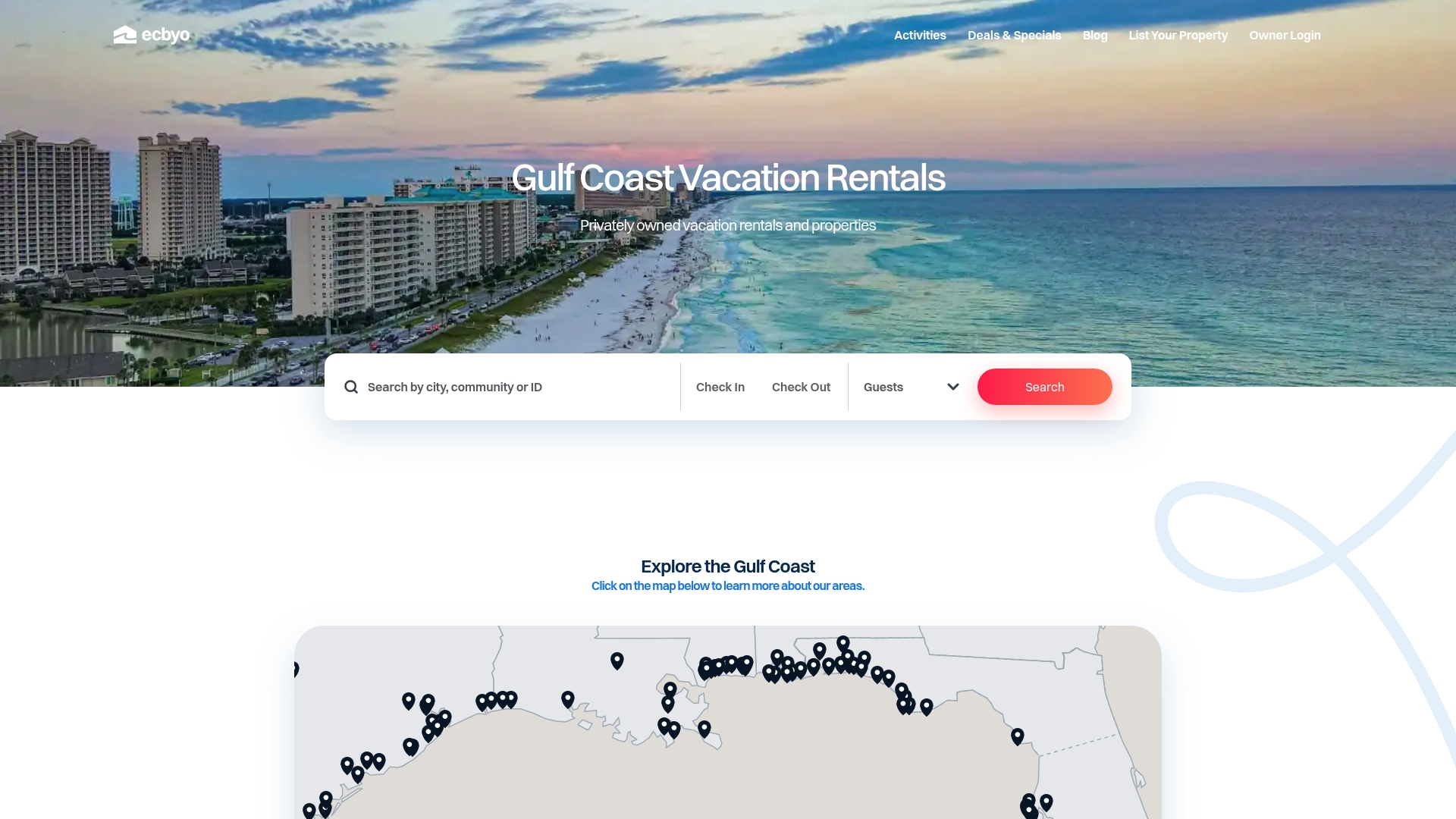
A direct-booking marketplace puts your property in front of travelers who are already searching for vacation rentals by owner and looking to skip guest fees, without you having to build an audience first. Such marketplaces typically charge owners a listing fee rather than a per-booking commission, so once a guest finds your property and books, you keep that revenue instead of splitting it with an OTA on every reservation.
This approach makes the most sense for owners who already have a booking engine and channel manager set up but want an additional discovery channel that specifically attracts guests searching for direct-from-owner stays across Gulf Coast destinations. Evaluate it the same way you’d evaluate any new channel: list for one season, track how many inquiries convert, and compare that cost against what an equivalent OTA commission would have run you.
To get started, list your property and browse regional pages like Florida vacation rentals, Texas vacation rentals, and Louisiana vacation rentals to see how properties similar to yours are presented to travelers browsing by owner.
Sources
Claims in this article draw on Lodgify’s direct-booking performance report, Amadeus’ hospitality direct-booking guide, and NetSuite’s 13-strategy breakdown, along with StayFi’s 2026 vacation rental statistics and Emeraldcoastbyowner’s own resource pages on SEO and 90-day diagnostics.
- Ultimate Guide To Growing Hotel Direct Bookings
- How to Increase Direct Hotel Bookings: 13 Strategies
FAQ
What does “direct booking” mean?
A direct booking is a reservation made straight through a property’s own website or booking engine, with no OTA acting as an intermediary or charging a guest service fee.
Is it better to book on Booking.com or direct?
For guests, booking direct often means lower total cost since no service fee is added, and for owners, it means avoiding the 15 to 18% commission most OTAs charge per reservation.
How do I get more bookings overall?
Combine booking-flow optimization, a direct-only incentive, email capture at every guest touchpoint, and consistent review management, since Amadeus’ guide and NetSuite’s strategy list both point to this multi-pronged approach over any single tactic.
What is a direct booking website?
It’s a booking engine you own and control, separate from any OTA listing, where guests can search availability and reserve a stay without a third-party fee added at checkout. Marketplaces like Emeraldcoastbyowner offer a similar direct-from-owner path without requiring you to build that infrastructure yourself.
How long does it take to see results from these tactics?
Booking-flow fixes and email capture can show early signals within days, but shifting your overall direct-booking percentage meaningfully typically takes 60 to 90 days, and industry data suggests a fuller mix shift can take six months to two years for many operators.
Recommended
- Vacation Rental Owners: 90 Day Book Direct Diagnostic, Use Past Guests
- Vacation Rental SEO: The Direct-Booking Playbook for Owners
- Vacation Rental Photography Tips That Increase Bookings
 |
About the AuthorGail Greiner of the Emerald Coast by Owner Editorial Team creates destination guides, vacation-planning resources, and local travel content focused exclusively on Gulf Coast vacation rentals. Our team researches beach communities, vacation rental trends, family travel planning, local attractions, and direct-booking best practices across Florida, Alabama, Mississippi, Louisiana, and Texas. Every guide is written to help travelers make more informed booking decisions while avoiding unnecessary third-party guest service fees. Since launching in 2016, Emerald Coast by Owner has helped connect travelers directly with verified vacation rental hosts across the Gulf Coast. This article was reviewed for accuracy and updated using local destination research and current vacation rental market insights. |


