


Accessible beach vacation rentals are properties specifically designed to support travelers with mobility challenges, offering features like step-free entrances, roll-in showers, and verified beach access routes. Finding accessible beach vacation rentals on the Gulf Coast requires more than searching for the word “accessible” in a listing title. The term is loosely applied across platforms like Airbnb, Vacasa, and Vrbo, so knowing exactly which features to verify, and how to confirm them before you book, makes the difference between a relaxing trip and a frustrating one.
What accessibility features should you look for in beach vacation rentals?
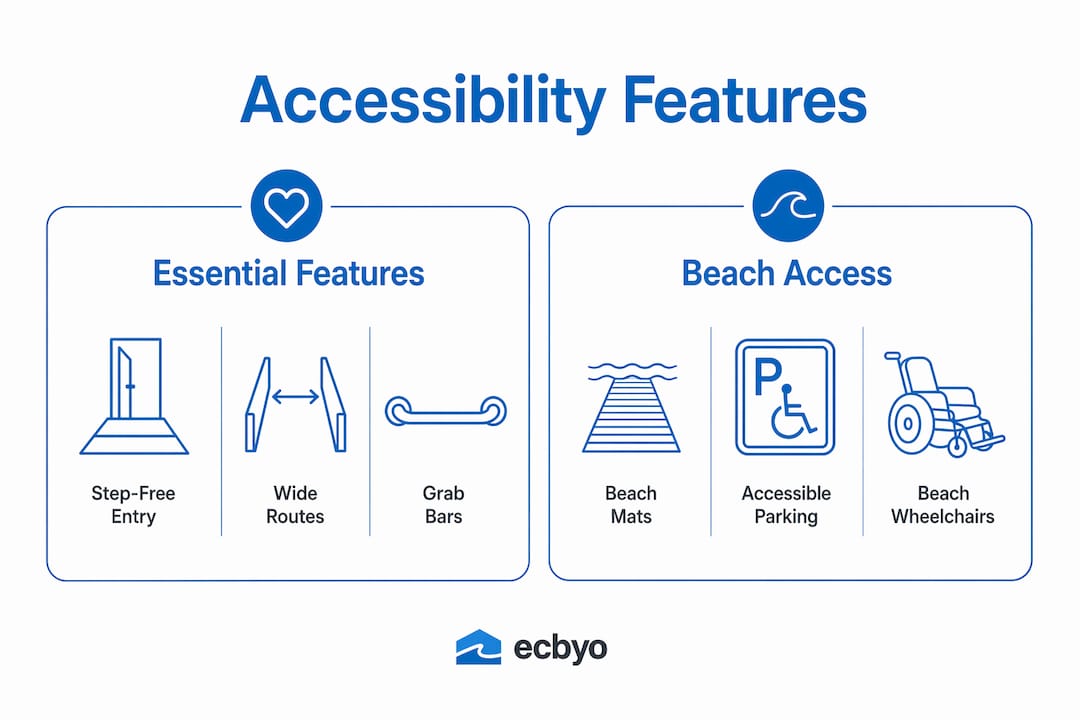
The Americans with Disabilities Act (ADA) sets measurable standards that give travelers a concrete checklist for evaluating any rental. Accessible routes must be at least 3 feet wide, with firm, slip-resistant surfaces and slopes no steeper than 1:12. These numbers matter because a route that looks flat in listing photos can still be too steep for a manual wheelchair user traveling alone.
Parking is the first test. Van-accessible spaces require a 96-inch access aisle and at least 98 inches of vertical clearance for lift-equipped vehicles. A rental with a standard accessible space but no van clearance can strand travelers before they even reach the front door.
Inside the property, two features separate genuinely accessible rentals from ones that simply claim the label:
- Roll-in showers: A true roll-in shower has no threshold and a slip-resistant floor. Products like those from Ella’s Bubbles offer barrier-free shower bases with no lip to navigate, which is the standard worth asking about by name.
- Pool access: ADA standards require at least one accessible pool entry, either a pool lift or a sloped entry. A pool described as “accessible” without specifying one of these two options does not meet the standard.
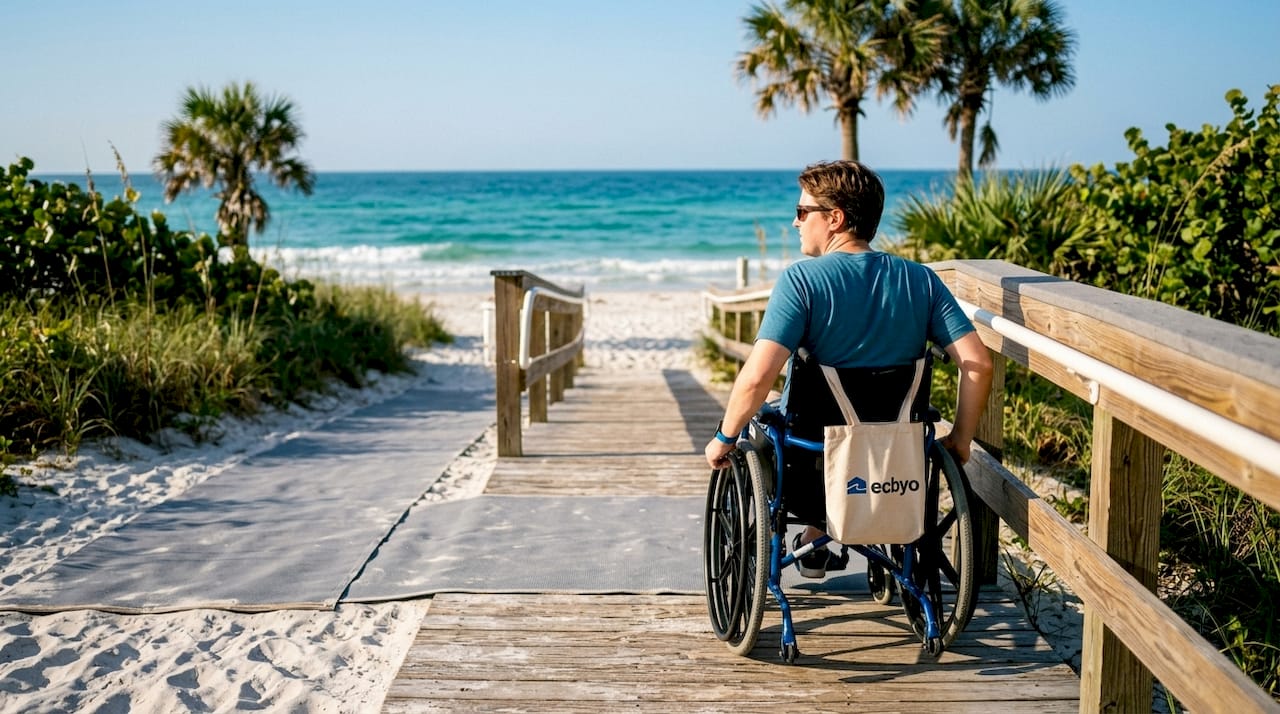
Beach access adds a third layer of requirements specific to coastal properties. Sand is not a firm surface, so the accessible route from the building to the water requires an accessibility mat. Ocean House II in Gulf Shores is a well-documented example of a beachfront property that provides a direct beach access mat, allowing wheelchair users to travel over sand without sinking.
Pro Tip: Ask every host specifically: “Does the accessible route from the parking area to the beach entry point remain continuous, with no steps, gaps, or loose surfaces?” A yes or no answer to that precise question tells you far more than a general “accessible” label.
How do you use online platforms to find accessible beach rentals?
Major rental platforms have improved their search tools for travelers with mobility needs. Here is how to use them effectively:
-
Apply accessibility filters first. Airbnb offers tags like “step-free guest entrance” and “wide doorways.” Vacasa and Vrbo include similar filters. These tags improve search precision, but they are self-reported by hosts, so they are a starting point, not a guarantee.
-
Study listing photos with a critical eye. Look for the entrance threshold, the shower floor, the parking area, and the path to the beach. A photo of a beautiful ocean view tells you nothing about whether a wheelchair can reach it.
-
Read guest reviews for accessibility language. Reviews often reveal candid details that listings omit. Search the review text for words like “steps,” “ramp,” “shower,” “sand,” and “parking.” One honest review from a wheelchair user is worth more than ten five-star ratings from able-bodied guests.
-
Contact the host with specific questions. Vague questions get vague answers. Instead of “Is the property accessible?”, ask: “Is there a roll-in shower with no threshold?” and “Is there a pool lift or sloped pool entry?” Specific questions signal that you know what you need and make it harder for a host to give a non-answer.
-
Request photos or a short video of the route. Ask the host to walk the path from the parking space to the front door and then to the beach access point on camera. Proactively requesting host-provided videos of parking, pathways, and beach entry routes is one of the most effective ways to verify continuous accessible routes before arrival.
Properties along the Gulf Coast, from Navarre Beach in Florida to Orange Beach in Alabama, vary widely in their actual accessibility. Filtering by location and then verifying by direct communication gives you the most reliable result.
What common accessibility challenges arise at beach rentals?
Beach vacations present a specific set of obstacles that inland accessible rentals do not. Understanding them in advance prevents the most common disappointments.
The last-mile sand problem is the most frequent barrier. A rental can have a fully ADA-compliant interior and still leave a wheelchair user stranded at the edge of the boardwalk. Beach wheelchairs alone do not solve sand access. Soft sand requires a stable pathway, typically an accessibility mat, combined with a mobility device designed for sand. Without both elements working together, reaching the water remains difficult.
Common challenges and their solutions:
- Loose sand between the mat and the water’s edge: Confirm with the host or local beach services whether the mat extends close to the waterline, or whether a beach wheelchair rental service operates nearby.
- Gaps in listing information: Many hosts list a property as accessible based on one feature, like a grab bar in the bathroom, while the entrance has a step. Requesting detailed descriptions of every transition point, from car to door to beach, closes these gaps.
- Assuming beach wheelchairs solve everything: A beach wheelchair improves mobility on sand, but effective beach access requires both a stable mat and a compatible mobility device. Ask whether the property or a nearby service provides both.
- Unverified pool lift status: Pool lifts require ongoing maintenance. A lift listed in a property description may be broken or removed. Ask the host to confirm the lift is currently operational before you book.
Pro Tip: When you contact a host, ask them to describe the “last transfer point,” meaning the last place where a wheelchair user must move from a paved or matted surface onto an unassisted surface. That single question reveals more about real beach access than any listing description.
Comparing accessible beach rental options: features and locations
Not all accessible beach rentals offer the same level of support. The table below summarizes the key features to compare when evaluating properties across Gulf Coast destinations.
| Feature | What to look for | Why it matters |
|---|---|---|
| Entrance route | Step-free, 3-foot-wide path with max 1:12 slope | ADA minimum for safe wheelchair travel |
| Parking | Van-accessible space with 96-inch aisle and 98-inch clearance | Required for lift-equipped vehicles |
| Bathroom | Roll-in shower with no threshold, slip-resistant floor | Standard for independent bathing |
| Pool access | Pool lift or sloped entry confirmed operational | ADA requirement for public accommodations |
| Beach access | Accessibility mat extending onto sand, beach wheelchair available | Solves the last-mile sand problem |
| Location | Proximity to accessible beach access points | Reduces travel distance over difficult terrain |
Location affects accessibility as much as the property itself. A rental one block from a beach access point with a paved path is far more practical than a beachfront unit with no mat. Gulf Coast destinations like 30A in South Walton, Florida and St. Pete Beach, Florida have invested in accessible beach infrastructure, making them strong choices for travelers with mobility needs.
Additional services worth researching before you book include local beach wheelchair rental programs, which several Gulf Coast municipalities and nonprofits operate at no charge. Confirm availability and reservation requirements in advance, since demand is high during summer months.
Key Takeaways
Finding accessible beach vacation rentals requires verifying specific ADA criteria, confirming beach access solutions, and communicating directly with hosts before booking.
| Point | Details |
|---|---|
| Use ADA standards as your checklist | Ask about route width, slope, van parking, roll-in showers, and pool lifts by name. |
| Verify beach access specifically | Confirm an accessibility mat and compatible beach wheelchair are both available. |
| Go beyond platform filters | Filters are self-reported; direct host communication and video requests are more reliable. |
| Read reviews for accessibility language | Search guest reviews for words like “steps,” “ramp,” and “shower” to find candid details. |
| Location affects access as much as the property | Choose rentals near established accessible beach access points to reduce last-mile challenges. |
What I’ve learned from years of Gulf Coast accessibility planning
The biggest mistake travelers make is treating “accessible” as a binary. A property either has the label or it does not, and they book accordingly. Real accessibility is a chain of connected decisions, and one broken link, a step at the entrance, a pool lift that has not worked in six months, a beach mat that ends 50 feet from the water, ruins the whole trip.
The travelers who have the best experiences are the ones who ask uncomfortable, specific questions before they book. Hosts who genuinely have accessible properties are not offended by detailed questions. They answer them quickly and confidently. Hosts who give vague reassurances are telling you something important.
I have also noticed that the Gulf Coast has some of the most genuinely accessible beachfront options in the country, particularly in Florida and Alabama, where local governments have invested in beach mat programs and accessible boardwalks. But even in those areas, the gap between a listing’s claims and the actual experience can be wide. The only way to close that gap is to verify every link in the chain yourself, before you arrive.
Advocate clearly for your needs. Platforms like Airbnb and Vacasa respond to specific, documented accessibility requests. Hosts who want your business will meet you where you are.
— Joe
Accessible Gulf Coast rentals through Emeraldcoastbyowner
Emeraldcoastbyowner connects travelers directly with Gulf Coast property owners, which means you can ask detailed accessibility questions and get answers from the person who actually knows the property.
The platform lists vacation rentals across Florida, Alabama, Mississippi, Louisiana, and Texas, with properties ranging from beachfront condos to private homes. Because Emeraldcoastbyowner operates without traveler fees, more of your budget goes toward the stay itself. Browse the full Gulf Coast rental catalog and use the direct messaging feature to ask hosts your specific accessibility questions before you commit to a booking.
FAQ
What is an accessible beach rental on the Gulf Coast?
An accessible beach rental on the Gulf Coast is a property that meets ADA-aligned standards for mobility access, including step-free entrances, roll-in showers, accessible parking, and a verified route to the beach.
How do I verify a rental is truly wheelchair friendly?
Ask the host specific questions about route width, shower threshold, pool lift status, and beach mat availability. Request a short video of the path from parking to beach entry to confirm the route is continuous.
Do beach wheelchairs solve all sand access problems?
No. Beach wheelchairs require a stable mat or pathway to be effective. Soft sand without a firm surface still prevents independent movement, even with a specialized mobility device.
What ADA parking standards apply to vacation rentals?
Van-accessible spaces must have a 96-inch access aisle and 98 inches of vertical clearance. Confirm these dimensions with the host if you travel with a lift-equipped vehicle.
Which Gulf Coast destinations have the best beach accessibility infrastructure?
Florida and Alabama have invested significantly in accessible beach access points, including boardwalks and beach mat programs. Destinations like Navarre Beach and Orange Beach are well-regarded for their accessible seaside accommodation options.
Recommended
- Beach Time! An ECBYO blog about all things Gulf Coast
- Gulf Coast Vacation Rentals | Book Direct Vacation Rental by Owner
- Deals & Specials | Emerald Coast By Owner
- Gulfport Mississippi Vacation Rentals | ECBYO
About the Author
The Emerald Coast by Owner Editorial Team creates destination guides, vacation planning resources, and local travel content focused exclusively on Gulf Coast vacation rentals.
Our team researches beach communities, vacation rental trends, family travel planning, local attractions, and direct-booking best practices across Florida, Alabama, Mississippi, Louisiana, Texas, and Southwest Florida. Every guide is written to help travelers make more informed booking decisions while avoiding unnecessary third-party guest service fees.
Since launching in 2016, ECBYO has helped connect travelers directly with verified vacation rental hosts across the Gulf Coast.
This article was reviewed for accuracy and updated using local destination research and current vacation rental market insights.


