


Breed restrictions in vacation rentals usually come from an owner’s insurance policy or an association’s rules, not from the owner’s opinion of your dog. That is good news for travelers. When you book directly with the owner, you can ask exactly which rule applies and get the answer in writing before you pay. On Emerald Coast By Owner, guests contact owners directly and pay no traveler service fees, so the conversation about your dog happens with the person who makes the decision.
TL;DR
- Most breed limits trace back to insurance policies, which tend to react to the size of a possible claim, not how often bites happen.
- Pit bull-type dogs are the breed most often restricted, and some policies cover mixes too, so state your dog’s breed and size honestly.
- Read the listing’s pet policy, then confirm in writing with the owner. A listing that says nothing about dogs has not said yes.
- Assistance animals are not pets under federal housing guidance, so breed rules and pet fees generally do not apply to them.
- Browse pet-friendly Gulf Coast rentals and message owners directly.
Table of Contents
- Why vacation rentals restrict dog breeds
- Which breeds are usually restricted
- How to check before you book
- Pet fees and other dog rules to compare
- Assistance animals are different
- What Florida law does and doesn’t do
- If your dog is restricted
- Why booking direct helps dog owners
- Our perspective
- FAQ
- Sources
Why vacation rentals restrict dog breeds
Breed rules in rental housing took hold in the 1990s and 2000s, when insurers began denying coverage or adding surcharges for properties with dogs of breeds they considered dangerous, according to Advocate Avenue. Pit bulls are the breed most commonly restricted across the country, and restrictions typically target larger breeds and can cover mixes.
A 2026 study from the Michelson Found Animals Pet-Inclusive Housing Initiative interviewed 14 insurance carriers and 4 brokers. It found that nearly all carriers impose pet-related restrictions, such as breed limits, size limits, pet-count limits and exotic-animal exclusions. Dog incidents are uncommon, but they can produce large claims, especially involving children, and that severity is what makes carriers cautious.
The same study found that large landlords often negotiate exceptions, while small providers face rigid rules. Many vacation rental owners are individuals with one or two properties, so the rule on the listing may be the insurer’s rule, not theirs.
Some insurers won’t cover owners of breeds they categorize as dangerous. Others decide case by case or charge more for certain breeds, according to a Florida pet-travel guide. Condo associations can add their own rules on top.
What this means for you
A restriction is rarely a judgment of your dog. It is the owner staying inside the terms of a policy. Hosts are advised to enforce insurance or association limits regardless of personal feelings, and to word them as facts, for example that the insurance policy does not cover certain breeds. Knowing that helps you ask the right question: which breeds or sizes does the policy name, and does it cover mixes?
Which breeds are usually restricted
Lists differ by property, but the pattern is consistent. The table shows how to read common wording.
| What the listing says | What it usually means | What to ask the owner |
|---|---|---|
| “No restricted breeds” | A named list applies, often pit bull-type dogs and other large breeds | Can you send the list? |
| “Dogs under 50 lbs” | A weight cap, regardless of breed | Is the limit based on adult weight? |
| “Two pets maximum” | A count limit, not a breed limit | Does the cap include puppies? |
| “Pets considered” | Case-by-case approval | What do you need from me, such as vaccination records? |
| No mention of pets | No answer yet | Do you allow dogs, and which ones? |
Breed mixes are where most confusion happens. If your dog is a rescue of unknown parentage, describe the dog plainly: weight, age, temperament, training and any vet records. A written reply from the owner protects you both.
How to check before you book
Pet policies are not uniform. One host may welcome animals while a neighbor on the same street allows none, and a photo of a dog bowl or fenced yard is not a promise. The listing’s own text and the host’s written answers are what count.
- Filter for pets first. Start with listings that state they accept dogs, then read the full policy, not just the badge.
- Read the rules section. Look for breed lists, weight limits, number of pets, and whether dogs may be left alone.
- Message the owner with specifics. Give breed or mix, weight, age and whether the dog is spayed or neutered and vaccinated.
- Ask about money. Confirm any pet fee, deposit and whether either is per pet or per stay.
- Get it in writing. Keep the reply in the message thread before you pay.
- Ask about the property. Fenced yard, carpeted rooms, balcony access and beach rules for dogs all affect your stay.
On Emerald Coast By Owner, you can search by map and see owner profiles, then communicate with the owner directly. That makes steps 3 to 5 a single conversation, not a relay through a middle layer.
Pet fees and other dog rules to compare
Breed is only one filter. These are the items to compare across listings.
| Rule | Why it matters | Question to ask |
|---|---|---|
| Pet fee | Can be per stay or per night | Is it per dog and per stay? |
| Pet deposit | Refundable or not | When is it returned? |
| Size or weight limit | Can exclude dogs a breed list would allow | What is the cutoff? |
| Number of dogs | Often capped at one or two | Is a third dog ever allowed? |
| Vaccination proof | Some owners require current records | What documents do you need? |
| Unattended dogs | Crating or no-alone rules | Can the dog stay alone briefly? |
Pet fees are set by each owner, so the way to compare them is to ask, not to assume. If you want to keep costs down, choose a listing whose stated policy already fits your dog. Pushing against a stated policy is not a good plan, and owners can enforce it.
Assistance animals are different
If your dog is a service animal or an assistance animal for a disability, the rules change. Under HUD’s FHEO-2020-01 notice, as summarized by the North Carolina Real Estate Commission, pet deposits, fees and breed restrictions do not apply to assistance animals, because they are not considered pets. A housing provider must make reasonable exceptions for a person with a disability who needs the animal to use and enjoy the home.
The Arizona Civil Rights Advisory Board’s guide says the federal Fair Housing Act covers temporary housing such as short-term rentals, and that a provider may not deny an assistance animal because of breed stereotypes. A provider can still deny a request for reasons such as undue burden, a direct threat that cannot be reduced, or significant physical damage.
Courts look at the individual animal. One federal case in Florida held that a condo violated the Fair Housing Act by excluding a pit bull assistance animal under a county breed ban, while a Vermont decision upheld excluding a particular dog based on credible evidence of hostility, as a legal guide describes. If this applies to you, tell the owner early, in writing, and be ready to share the documentation they ask for. For a specific situation, an attorney or your local fair housing agency is the right person to ask.
What Florida law does and doesn’t do
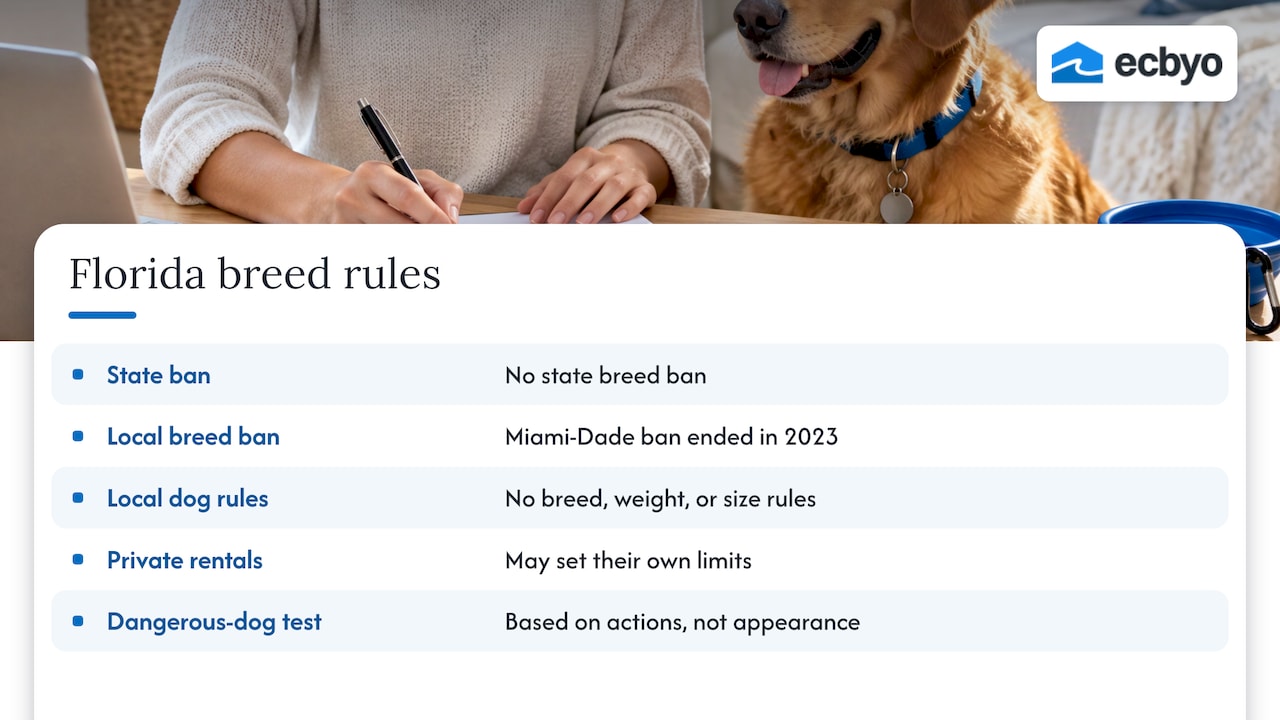
Many Gulf Coast trips start in Florida, so the state rules matter. Florida has no state breed ban. A 2023 amendment to section 767.14 ended the last local breed ban, in Miami-Dade County, and since October 1, 2023, local dangerous-dog rules cannot be specific to breed, weight or size. That law does not reach private businesses, condo associations or insurers, so a private rental can still set its own limits. Florida defines a dangerous dog by what a particular dog has done, not by what it looks like.
For more on rules that affect guests, see our guide to Florida vacation rental laws.
If your dog is restricted
A no is not always the end of the search.
- Ask whether the rule is the owner’s or the insurer’s. If a policy names breeds, the owner usually cannot waive it.
- Offer information. Vaccination records, training history and a short description of your dog’s behavior help an owner who has discretion.
- Search a different property. Policies differ from one owner to the next, so a restriction at one condo says nothing about the next listing.
- Widen the map. Gulf Coast towns from Orange Beach to Galveston have owners with different insurers and rules.
Our guides to pet-friendly rentals in the Gulf Coast and Orange Beach pet-friendly rentals show what to expect on cost and amenities.
Why booking direct helps dog owners
Breed rules are specific to each property, and the person who knows them is the owner. With a direct booking you can ask about your dog’s breed, size and habits, and get a written answer from the person who can approve it. Emerald Coast By Owner focuses only on Gulf Coast rentals across Florida, Alabama, Mississippi, Louisiana and Texas, so you can compare pet-friendly options along the same stretch of coast. You can also see owner profiles and detailed listings before you reach out.
Start with Florida vacation rentals, or browse Alabama, Mississippi, Louisiana and Texas. Choose a beachfront, budget or luxury stay, then message the owner about your dog.
Our perspective
We built Emerald Coast By Owner so guests and owners talk to each other directly, with no traveler booking or service fees. For dog owners that matters more than almost anything else. Breed rules are not abstract: they live in one owner’s insurance policy or one association’s bylaws, and the fastest way to learn them is to ask the owner.
Our advice is simple. Pick listings that state their pet policy, tell the owner honestly about your dog, and keep the answer in writing. Owners tend to respond well to a traveler who gives clear details.
If you are an owner, a clear pet policy helps you too. Our pet policy template gives you a place to start, and you can list your property for 499 USD per year through our subscription page.
Joe
FAQ
Why do rentals have breed restrictions?
Mostly because of insurance. Carriers that cover rental properties often limit breeds or sizes because dog incidents, while uncommon, can lead to very large claims. Some owners also follow condo or HOA rules.
Do breed restrictions cover mixed-breed dogs?
They can. Restrictions often target larger breeds and may include mixes, so ask the owner how the policy treats your dog. Share weight, age and temperament so the owner can decide with real information.
Can a rental refuse my service or assistance animal because of its breed?
Generally not on breed alone. Federal housing guidance treats assistance animals as not being pets, so breed rules and pet fees do not apply. A provider can still make an individualized assessment of the specific animal, so talk to the owner early.
Does Florida ban certain dog breeds?
No. Florida has no state breed ban, and local breed-specific dangerous-dog rules have been prohibited since October 1, 2023. Private rentals, condo associations and insurers can still set their own limits.
How do I find a rental that accepts my dog?
Start with our pet-friendly vacation rentals, read each pet policy, and message the owner with your dog’s breed, weight and age. Get the reply in writing before you book.
Sources
- PIHI Pets, Properties, and Policies Report
- Breed Restrictions in Rental Properties
- Breed Restrictions in Florida: Law, Hotels, Rentals
- Vacation Rental Pet Policy Guide for Hosts
- Airbnb hidden fees: 10 ways to avoid surprise charges
- Fair Housing (NCREC)
- Civil Rights Guide (Arizona Civil Rights Advisory Board)
- Service Animals, Emotional Support Animals and Pets (Fisher & Phillips)
Recommended
- Pet Policy Template for Vacation Rentals
- Pet-Friendly Beach Rentals for Dog Owners
- Florida Vacation Rental Laws: What Guests and Owners Should Know
- HOA Vacation Rental Rules: 5 Checks Gulf Coast Hosts Need

About the Author
Joe Godar of the Emerald Coast by Owner Editorial Team creates destination guides, vacation-planning resources, and local travel content focused exclusively on Gulf Coast vacation rentals.
Our team researches beach communities, vacation rental trends, family travel planning, local attractions, and direct-booking best practices across Florida, Alabama, Mississippi, Louisiana, and Texas. Every guide is written to help travelers make more informed booking decisions while avoiding unnecessary third-party guest service fees.
Since launching in 2016, Emerald Coast by Owner has helped connect travelers directly with verified vacation rental hosts across the Gulf Coast.
This article was reviewed for accuracy and updated using local destination research and current vacation rental market insights.


