


Yes, booking directly with an owner or verified host usually saves you money compared with going through an OTA, and it can be done safely if you follow a few non-negotiable steps. Verify the host’s identity and contact details before you send a dollar, and always pay through a traceable method like a credit card or a reputable processor. If either step fails, or you’re renting a high-value property for the first time, book through a platform instead.
TL;DR:
- Booking directly with an owner can save you between 12 and 18 percent on total trip costs, primarily by avoiding guest service fees charged by OTAs.
- Always verify the host’s identity with a real phone number, business address, and consistent property records before sending any payment.
- Use traceable payment methods like credit cards or PayPal, and avoid irreversible options such as wire transfers, cryptocurrency, or gift cards.
- Search on regional direct-booking sites and cross-reference listings on major platforms to find legitimate owner-operated rentals with clear availability and contact info.
- Book through a platform if verification is impossible or if the property involves a high-value commitment, to benefit from dispute resolution and chargeback protections.
Table of Contents
- Why Booking Direct Vacation Rentals Saves You Money
- How Do You Find Legitimate Direct Vacation Rental Listings?
- How Do You Verify a Host Before You Pay?
- What Payment Methods Protect You If Something Goes Wrong?
- When Should You Book Through a Platform Instead?
- A Gulf Coast Resource Built Around Direct Booking
- How Do You Communicate With Owners to Lock in the Right Terms?
- Building Trust and Rapport With Hosts for Smoother Bookings
- Handling Contracts and Rental Agreements When Booking Direct
- What the Data Actually Tells You About Booking Direct
- Start Your Direct Booking Search on the Gulf Coast
- Primary Sources and Official Guidance
- Sources
- FAQ
Why Booking Direct Vacation Rentals Saves You Money
The math behind guest service fees is simple, and it’s almost always working against you on a big booking platform. Online travel agencies charge a service fee on top of the nightly rate, often layered with a separate host commission baked into the listed price. Neither charge shows up as a single line item; instead, both get folded into “taxes and fees” at checkout, which makes the true markup hard to see until you compare it against what an owner charges directly for the same week.
Travel-industry cost comparisons put the total savings from booking direct at roughly 12 to 18 percent of the total trip cost when you skip the OTA guest fee entirely. On a $3,000 week at the beach, that’s between $360 and $540 back in your pocket, enough to cover a night’s stay, a week of groceries, or the charter fishing trip you were on the fence about.
By the numbers: A $3,000 weeklong rental booked through a major platform can carry $360 to $540 in guest service fees that simply don’t exist when you book directly with the owner.
Beyond the sticker price, direct relationships open doors that platforms close off:
- Owners can negotiate rate reductions for extended stays, off-season weeks, or last-minute vacancies they’d rather fill than leave empty.
- Cleaning fees are usually itemized clearly upfront instead of buried in a bundled total.
- Repeat guests often get loyalty discounts or first access to peak-season dates, something no algorithm on a platform will ever offer you.
How Do You Find Legitimate Direct Vacation Rental Listings?
Finding a real owner-direct listing takes a little more legwork than typing a destination into a search bar, but the process is fast once you know the pattern.
- Start on an OTA to identify the property, then search for it elsewhere. This “search-then-book” approach is standard advice from owner-direct booking guides: find a listing you like on a major platform, note the property name or manager, then search for that same property’s direct booking page.
- Look for a professional reservation system. A legitimate direct-booking marketplace or owner site should have a working search-and-availability calendar, secure checkout, and valid contact information, not just a contact form that vanishes into a void.
- Use targeted search phrases. Queries like “[destination] vacation rental owner direct” or “[property name] direct booking” surface manager websites that don’t rank well for generic vacation-rental searches but exist specifically to cut out the middleman.
- Check verified direct-booking marketplaces built for this purpose. Sites like Emeraldcoastbyowner exist specifically to connect travelers with Gulf Coast owners who list without charging guest service fees, which removes a lot of the guesswork from step one and two.
Pro Tip: Bookmark the direct site once you find it. Owners who see repeat direct traffic are far more likely to offer you a returning-guest discount on your next trip.
Guides focused on regional bookings, like this breakdown of owner direct beach rentals on the Gulf Coast, walk through exactly what a legitimate direct listing should include before you ever reach out.
How Do You Verify a Host Before You Pay?
A few minutes of verification work eliminates most of the risk in booking direct, and skipping it is where nearly every horror story begins.
Start with contact information tips. A host who provides a real phone number, a business address, and a name that matches property records is behaving like someone with a legitimate operation to protect. Vague replies, generic email addresses, or a refusal to get on a phone call are red flags worth taking seriously.
Next, run a reverse image search on the listing photos. Security researchers who study rental fraud note that scammers routinely copy photos from legitimate listings and republish them under a different property name or address, sometimes on multiple sites at once. If the same photos turn up attached to a different address or a different host name, walk away.
Before you commit, run through this checklist:
- Confirm the property address matches what’s listed on the county property record or a map search.
- Search the host’s name and property address together, looking for independent reviews or complaints outside the listing itself.
- Ask a specific question about the property, like parking availability or a neighborhood detail, and judge the response for accuracy and speed.
- Cross-check reviews across more than one platform, since a host who deletes negative reviews on their own site may still have them elsewhere.
Pro Tip: Ask for a quick video call showing the property’s exterior and street sign. A legitimate owner will do this without hesitation; a scammer almost never will.
What Payment Methods Protect You If Something Goes Wrong?
The payment method you choose determines whether you have any recourse if a booking falls apart. Credit cards and reputable processors like Stripe or PayPal for Business give you chargeback rights and dispute processes that simply don’t exist with other payment types.
Financial-sector fraud advisories are blunt about this: wire transfers, cryptocurrency, and gift card payments are the preferred tools of rental scammers precisely because they’re irreversible. If a host insists on one of these methods, or pushes to move communication off any platform where a paper trail exists, treat it as a serious warning sign rather than a quirky preference.
Fraud signal to remember: Off-platform payment requests, especially for wires or crypto, are a more reliable red flag than a suspiciously low price, according to banking-sector guidance on rental scams.
Protect yourself further with a short list of habits:
- Keep every email, text, and payment confirmation related to the booking in one folder.
- Request a written receipt that itemizes the nightly rate, cleaning fee, and any taxes.
- Report suspected fraud immediately to your card issuer and file a complaint with the Federal Trade Commission, which tracks patterns across scam reports to help shut down repeat offenders.
When Should You Book Through a Platform Instead?
Booking direct isn’t the right call for every trip, and pretending otherwise does readers a disservice. The decision usually comes down to how much verification you can actually complete and how much is riding on getting it right.
- Book direct when you’re working with a property manager who has a professional website, a track record of reviews across multiple sources, and responsive communication. Longer stays and repeat visits to the same destination make direct booking even more worthwhile since the savings compound.
- Choose a platform when it’s your first time renting from a given owner, the property represents a significant financial commitment, or you can’t independently verify the host’s identity and address.
- Default to a platform when verification fails at any step. If photos don’t reverse-search cleanly, contact information is vague, or the host pressures you toward an untraceable payment method, the platform’s dispute resolution and chargeback support is worth the fee you’d otherwise save.
A Gulf Coast Resource Built Around Direct Booking
A Gulf Coast marketplace was launched in November 2016 with a goal: build a platform where Gulf Coast travelers book directly from owners without paying traveler fees tacked onto every reservation. What started as a few hundred listings has grown into thousands of properties spanning Florida, Alabama, Mississippi, Louisiana, and Texas.
Using the site follows the same logic covered above, just with the verification work already partly done for you:
- Search by destination page, whether that’s Florida, Texas, or Louisiana, to browse owner listings in one region at a time.
- Read owner profiles directly on each listing to check for the contact detail and communication history that a legitimate host should provide.
- Check the Deals & Specials page for current promotions before locking in dates.
- Message owners directly through the platform to ask the verification questions covered earlier, from parking to exact property location.
For a deeper walkthrough of the process, the guide on renting a Gulf cottage without a travel agent covers owner communication in more detail.
How Do You Communicate With Owners to Lock in the Right Terms?
Good communication with a host does two things at once: it clarifies exactly what you’re paying for, and it signals to the owner that you’re a serious, low-hassle guest worth accommodating.
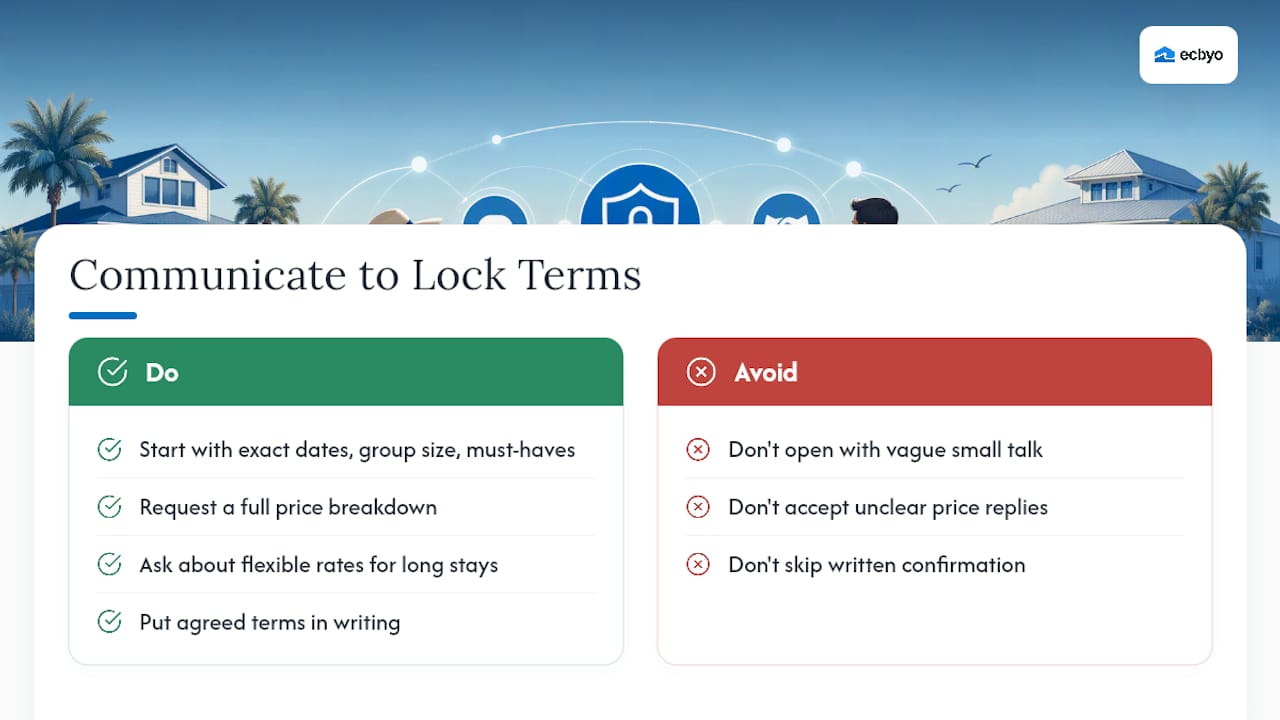
Start your first message with specifics, not small talk. State your exact dates, group size, and any must-haves like pet accommodations or ground-floor access. Vague inquiries get vague replies, and vague replies waste both sides’ time.
Ask directly for a full price breakdown before you commit to anything: nightly rate, cleaning fee, any local taxes, and the total due at booking versus the balance due before arrival. A host who answers this clearly and quickly is demonstrating exactly the kind of transparency you want in a direct transaction.
Negotiation is fair game in direct communication in a way it never is on a platform. If you’re booking a shoulder-season week or a stay longer than five nights, ask whether the rate is flexible. Many owners would rather fill a week at 90 percent of asking price than leave it vacant. Put every agreed term in writing over email or text, even after a phone call, so there’s a record matching what you eventually pay.
Building Trust and Rapport With Hosts for Smoother Bookings
Trust in a direct booking runs both directions, and treating it that way tends to produce a better experience on both ends. Owners renting their own property are often more invested in guest satisfaction than a corporate property manager juggling hundreds of units, but that also means they’re evaluating you as a guest before they hand over the keys.
Respond to messages promptly and answer questions about your group directly. If an owner asks about your travel plans or the occasion for your trip, a genuine answer builds rapport faster than a one-line reply.
Mention specifics that show you’ve actually read the listing. Referencing the screened porch or the walk to the beach access point tells a host you’re a thoughtful renter, not someone mass-messaging fifteen listings at once.
Once you’ve stayed somewhere and had a good experience, say so directly to the owner and ask about returning next year. Hosts frequently extend better rates and priority access to guests they remember fondly, and that relationship is one of the real, lasting advantages of booking direct that a platform booking simply can’t replicate.
Handling Contracts and Rental Agreements When Booking Direct
A direct booking still needs a written agreement, even though there’s no platform terms-of-service standing in for one. At minimum, get the dates, total price breakdown, security deposit amount and refund conditions, cancellation policy, and house rules in writing before you pay anything.
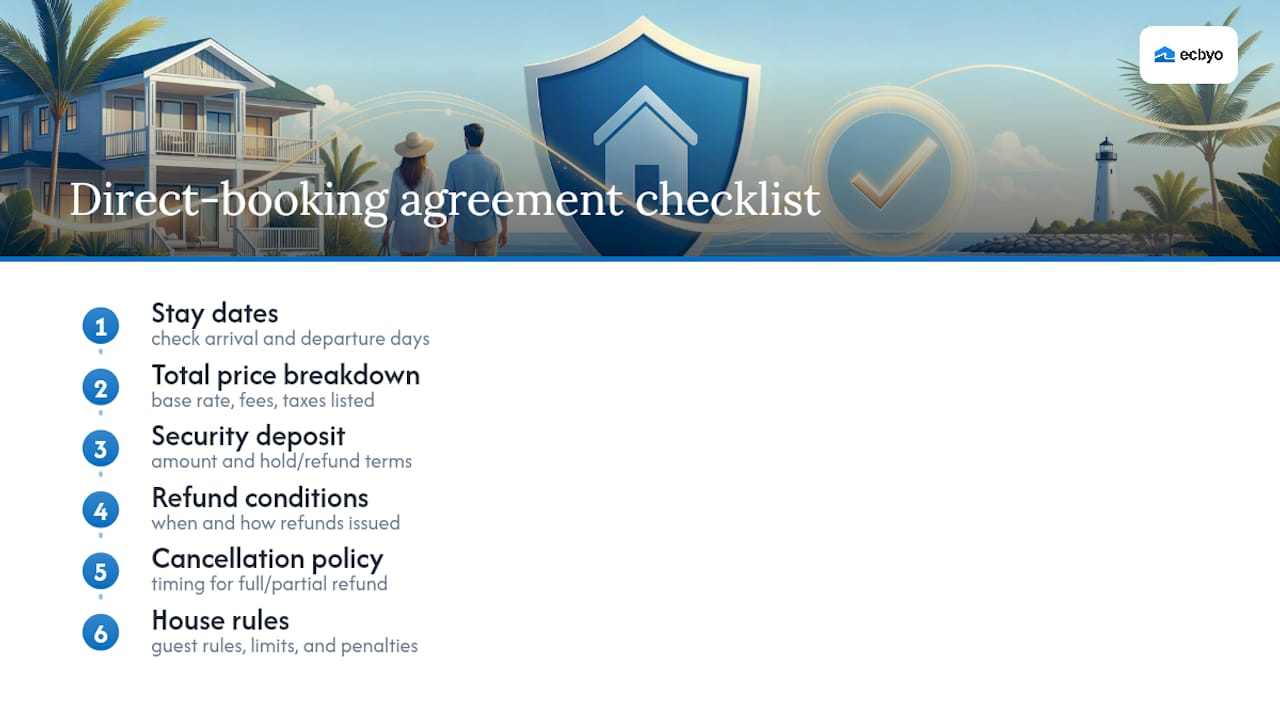
Read the cancellation policy closely, since direct-booking agreements vary far more than platform policies do. Some owners offer full refunds up to 60 days out; others keep the deposit non-refundable regardless of timing. Neither is wrong, but you need to know which one you’re agreeing to.
Save the signed agreement or the email chain confirming these terms in the same folder as your payment receipts. If a dispute arises over a deposit or a cancellation, this documentation is what you’ll lean on when contacting your card issuer or filing a complaint.
What the Data Actually Tells You About Booking Direct
The evidence here points to a clear, if slightly unglamorous, conclusion: booking direct rewards preparation more than optimism. The 12 to 18 percent savings figure is real, but it’s not automatic. It’s the payoff for doing verification work most travelers skip because platforms have trained everyone to assume the guardrails are automatic.
Where conventional advice falls short is in treating “book direct” and “book on a platform” as a moral choice rather than a risk calculation. The right answer changes with the property value, your relationship with the host, and how much verification you’re willing to do. A first-time $8,000 beach house rental deserves more scrutiny than a $150-a-night return visit to a manager you’ve booked with twice before.
If you take one thing from this guide, make it this: verify before you negotiate, and never let a good price rush you past the checklist. The savings will still be there once you’ve confirmed the host is real.
— Tayler
Start Your Direct Booking Search on the Gulf Coast
Certain direct-booking platforms are built for exactly the approach this guide recommends: search by owner, verify directly, and avoid paying guest service fees. Unlike a big booking platform where fees get layered on at checkout, many listings on such sites connect you straight to the property owner, so the price you see reflects what actually goes toward your stay.
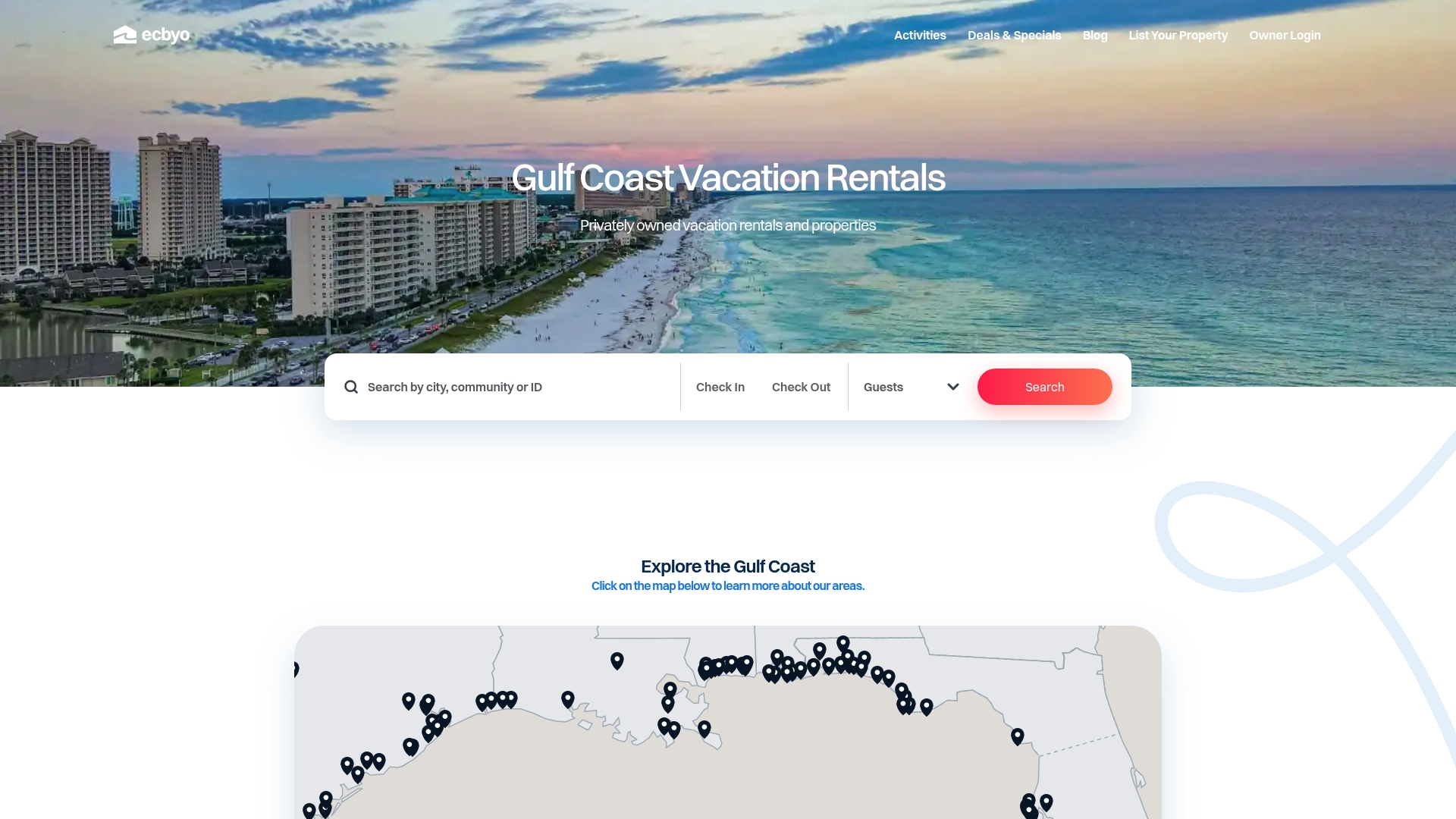
Start your search on the Gulf Coast Vacation Rentals home page, or jump straight to a regional landing page for Florida, Texas, or Louisiana listings. Before you send your first message to an owner, confirm four things: your exact travel dates, the full price breakdown including cleaning fees and taxes, the accepted payment method, and the cancellation policy in writing. Check the Deals & Specials page for current promotions on beachfront and pet-friendly properties before you lock in your dates.
Primary Sources and Official Guidance
For further reading on scam prevention and consumer protection, the Federal Trade Commission’s consumer information hub covers how to spot and report fraud. The Federal Reserve’s guidance on property rental scams details common fraud tactics, and Making Sense Of Security’s rental scam playbook breaks down how to spot fake listings before you pay.
Sources
- Federal Trade Commission — Consumer information
- Federal Reserve (FRB Services) — Risk management: property rental scams
- Making Sense Of Security — The Vacation Rental Scam Playbook
- Vacation Rental Planners — Booking direct vs Airbnb/VRBO cost comparison
- My Kauai Vacation Rental — How to book owner direct condo stays safely
FAQ
What is the best site to book vacation rentals?
The best choice depends on your priorities: platforms like major OTAs offer built-in dispute protection, while direct-booking marketplaces such as Emeraldcoastbyowner connect you straight to Gulf Coast owners without charging guest service fees.
Is it better to book through Vrbo or direct?
Booking direct typically saves 12 to 18 percent on total trip cost by avoiding guest service fees, but Vrbo offers stronger built-in dispute protection for first-time or high-value bookings where host verification is harder to complete.
What is a good direct booking website for short-term rentals?
Look for a site with owner profiles, secure checkout, and no guest service fees, especially for Gulf Coast destinations across Florida, Alabama, Mississippi, Louisiana, and Texas.
Which vacation rental site has the lowest fees?
Direct-booking marketplaces that don’t charge guest service fees generally carry lower total costs than major OTAs that add service fees and host commissions at checkout.
Recommended
- Key Largo Vacation Rentals on the Gulf Coast: 2026 Guide
- How to Rent a Gulf Cottage Without a Travel Agent
- How to Find Owner Direct Beach Rentals on the Gulf Coast

About the Author
Tayler Jaeger of the Emerald Coast by Owner Editorial Team creates destination guides, vacation-planning resources, and local travel content focused exclusively on Gulf Coast vacation rentals.
Our team researches beach communities, vacation rental trends, family travel planning, local attractions, and direct-booking best practices across Florida, Alabama, Mississippi, Louisiana, and Texas. Every guide is written to help travelers make more informed booking decisions while avoiding unnecessary third-party guest service fees.
Since launching in 2016, Emerald Coast by Owner has helped connect travelers directly with verified vacation rental hosts across the Gulf Coast.
This article was reviewed for accuracy and updated using local destination research and current vacation rental market insights.


