



A condo rental is a privately owned residential unit within a multi-unit complex, leased directly by the individual owner rather than a property management company. This ownership structure sets condo rentals apart from standard apartment leases in ways that affect everything from your lease terms to the rules you live by. The United States has over 7.4 million condos, each governed by a Homeowners Association (HOA) that manages shared spaces and enforces community rules. Whether you are planning a Gulf Coast vacation or searching for a long-term home, understanding what is a condo rental gives you a real advantage before you sign anything.
What is a condo rental, exactly?
A condo rental, formally called a condominium lease, is an agreement where you rent a unit that someone privately owns inside a larger building or community. The owner holds the title to that specific unit and rents it to you directly. The HOA owns and manages everything outside the unit walls: hallways, pools, gyms, parking areas, and landscaping.
This matters because you are dealing with two separate authorities at once. Your landlord sets the rent and lease terms. The HOA sets the rules for how you use the property. Both have real power over your experience as a renter. Understanding the condo rental definition from the start prevents surprises later.

The HOA collects dues from unit owners and uses that money to maintain common areas and enforce community standards. As a renter, you do not pay HOA dues directly, but your landlord’s costs often factor into the rent price. Some HOAs also require renters to register, attend orientation, or receive formal approval before moving in.
How does renting a condo differ from renting an apartment?
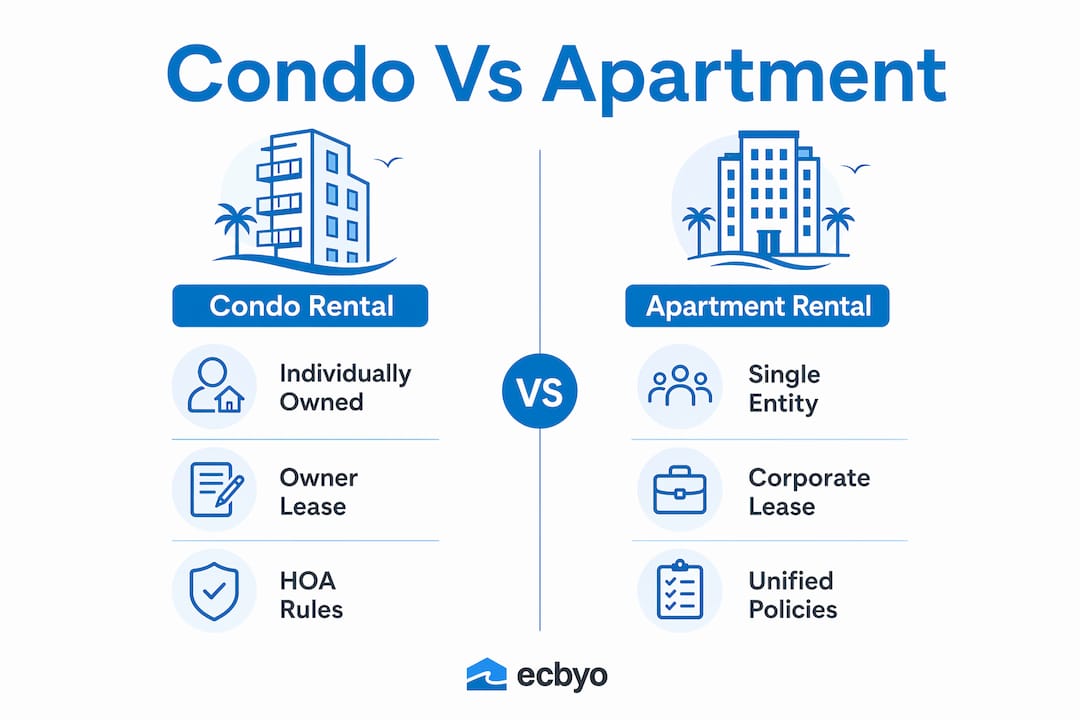
The core difference is ownership. Apartments are owned by a single entity, typically a corporation or real estate investment firm, while condos are owned by individual people. That single fact changes nearly every part of the rental experience.
With an apartment, one management company handles maintenance requests, lease renewals, and community rules uniformly across every unit. With a condo, your landlord is a private person who may live in another state, own multiple properties, or be renting out their unit for the first time. That variability creates both opportunity and risk.
The table below shows the key differences renters encounter most often:
| Factor | Condo Rental | Apartment Rental |
|---|---|---|
| Ownership | Individual private owner | Single company or corporation |
| Lease flexibility | Often negotiable with owner | Standardized corporate terms |
| Maintenance response | Depends on owner engagement | Managed by on-site staff |
| Community rules | HOA bylaws apply | Building management policies |
| Amenities | Often upgraded, owner-selected | Standardized across units |
| Pet and renovation rules | HOA restrictions vary | Uniform building policy |
Lease flexibility with individual owners is a genuine advantage, but HOA restrictions on pets or renovations can offset that freedom. Knowing both sides before you commit is the smartest move you can make.
What is the typical process for renting a condo?
Renting a condo involves more steps than a standard apartment application. Here is what to expect from start to finish:
-
Find a listing. Search platforms that specialize in owner-direct rentals or work with a local real estate agent familiar with condo inventory in your target area.
-
Contact the owner directly. Unlike apartment complexes, you negotiate rent, lease length, and move-in dates one-on-one with the owner.
-
Submit a rental application. Expect a credit check, background check, employment verification, and references. In cities like New York, some buildings require a detailed board package that includes bank statements, tax returns, and personal references. Approval can take 1–6 weeks.
-
Receive HOA approval if required. Some associations require renters to submit paperwork separately and may conduct their own screening.
-
Pay deposits and upfront costs. Standard practice is 1–2 months’ rent as a security deposit plus the first month’s rent at signing. Some buildings add a separate HOA move-in deposit.
-
Sign the lease. Review every clause carefully, especially sections covering maintenance responsibilities, subletting, and early termination.
-
Register with the HOA. Many associations require renters to register and receive a copy of the community rules before receiving access to amenities.
Pro Tip: Ask the owner for a copy of the HOA bylaws before signing the lease. Reviewing HOA meeting minutes from the past year reveals any upcoming rule changes or fee increases that could affect your stay.
Vacation condo rentals follow a shorter version of this process, but HOA short-term rental policies deserve extra attention. Many associations require minimum stays of 30 days or more, which directly limits your options as a short-term guest.
What are the benefits and challenges of renting a condo?
Condo rentals offer a distinct living experience compared to standard apartments. The benefits are real, and so are the trade-offs.
Benefits worth knowing
-
Upgraded amenities. Condos often feature high-end appliances, hardwood floors, and access to shared pools or gyms that most apartment complexes do not match at the same price point.
-
More space. On average, condos have larger floor plans than comparable apartment units. That extra square footage matters on a long vacation or a year-long lease.
-
Direct owner relationship. Negotiating directly with the owner means you can sometimes secure a longer lease at a lower rate, add a pet clause, or arrange flexible move-in dates.
-
Community environment. HOA-managed properties tend to be well-maintained, with consistent landscaping, clean common areas, and enforced noise standards.
-
Privacy. Many condo buildings have fewer units per floor than large apartment complexes, which translates to quieter hallways and less foot traffic.
Challenges to prepare for
-
HOA rule restrictions. HOA boards increasingly enforce rental caps and bans on short-term rentals. Rules on pets, parking, and renovations vary widely and are non-negotiable.
-
Inconsistent landlord responsiveness. Maintenance speed depends entirely on owner involvement. An engaged owner fixes a broken AC within hours. A disengaged one may take days.
-
Unexpected utility costs. Electricity billing is an often-overlooked expense. Some landlords charge above regulated rates, adding an unexpected $50–$150 per month to your costs depending on usage.
-
Approval delays. Buildings with strict HOA screening can delay your move-in by weeks, which is a serious problem if you are on a tight timeline.
Pro Tip: Test landlord responsiveness before signing. Send a question about the unit and note how quickly and clearly the owner responds. That communication style is exactly what you will get when the dishwasher breaks at 9 p.m.
How to find and secure a condo rental that fits your needs
Finding the right condo rental takes more than a quick search. These steps help you evaluate options and avoid common mistakes:
-
Use owner-direct platforms. Sites that connect renters directly with owners cut out middlemen and often provide more accurate listing details. For Gulf Coast vacations, Emeraldcoastbyowner lists beachfront condos in Gulf Shores and properties along 30A in South Walton with direct owner contact.
-
Verify rental legality. Before falling in love with a listing, confirm the owner has the legal right to rent the unit. Verifying short-term rental allowances is critical because HOA enforcement can void your lease mid-stay.
-
Ask the right questions upfront. Confirm who pays for utilities, how maintenance requests are handled, whether parking is included, and what the guest policy is for visitors.
-
Review the HOA rules in full. Request the complete rulebook, not just a summary. Pay attention to noise curfews, pool hours, move-in procedures, and any restrictions on decorating or furniture placement.
-
Inspect the unit in person or via video. Photos rarely show the full picture. A live walkthrough or detailed video call with the owner reveals the actual condition of appliances, flooring, and common areas.
-
Understand the lease terms completely. Look for clauses on early termination penalties, renewal options, and what happens if the owner decides to sell the unit during your lease.
For vacation travelers heading to destinations like Panama City Beach or Marco Island, checking the minimum stay requirements early saves a lot of back-and-forth. Many popular Gulf Coast condos have 7-night minimums during peak season.
Key takeaways
A condo rental gives you access to privately owned, amenity-rich housing, but HOA rules and owner variability require more due diligence than a standard apartment lease.
| Point | Details |
|---|---|
| Ownership structure matters | Condos are individually owned; this affects lease flexibility and maintenance response. |
| HOA rules govern your stay | Review bylaws before signing to avoid surprises on pets, parking, or short-term stays. |
| Upfront costs are higher | Budget for 1–2 months’ security deposit plus first month’s rent and possible HOA fees. |
| Landlord responsiveness varies | Test owner communication before committing to avoid slow maintenance responses. |
| Vacation condos need extra checks | Verify short-term rental legality and minimum stay requirements before booking. |
What I have learned after years of watching renters get caught off guard
The single biggest mistake I see renters make is treating a condo rental like an apartment rental. They focus entirely on the unit itself and completely ignore the HOA layer sitting above the whole arrangement. Then they sign a lease, move in, and discover the pool is off-limits for the first two weeks of their stay because of a scheduled renovation, or that their dog is technically in violation of a 25-pound weight limit buried on page 14 of the bylaws.
The ownership structure is what makes condo rentals genuinely appealing. You are renting from a person, not a corporation. That means real negotiation is possible. I have seen renters lock in 14-month leases at below-market rates simply because the owner wanted a reliable long-term tenant and was willing to deal. That kind of flexibility does not exist with a corporate apartment management company.
The flip side is real too. Individual owners range from highly attentive to completely absent. I always recommend sending a test message before signing anything. If the owner takes three days to respond to a simple question about parking, that is your preview of what happens when the water heater fails on a Saturday.
For vacation renters specifically, the short-term rental restriction issue is more common than most people realize. Reviewing HOA meeting minutes from the past year is the single most underused tactic in condo rental research. Those minutes tell you exactly what the board is focused on enforcing right now.
— Joe
Find your perfect Gulf Coast condo rental with Emeraldcoastbyowner
Emeraldcoastbyowner connects travelers directly with Gulf Coast condo owners across Florida, Alabama, Mississippi, Louisiana, and Texas. No middleman fees. No inflated booking costs. Just straightforward access to thousands of vacation rentals listed by the owners themselves.
Whether you are looking for a laid-back week on the white-sand beaches of Florida or a longer stay along the Gulf Coast, Emeraldcoastbyowner makes it easy to find and book the right property. Browse Gulf Coast vacation rentals by destination, filter by amenities, and contact owners directly to ask every question on your list. Check the current deals and specials page for discounted rates on available condos. For Florida-specific options, the Florida vacation rentals page is the best starting point.
FAQ
What is the condo rental definition in simple terms?
A condo rental is a lease agreement for a privately owned unit inside a multi-unit building or complex. The owner rents the unit directly to you, while the HOA manages shared spaces and enforces community rules.
How much does it cost to rent a condo upfront?
Standard upfront costs include a security deposit of 1–2 months’ rent plus the first month’s rent at signing. Some buildings also charge a separate HOA move-in deposit.
Can you rent a condo for a short vacation stay?
Many condos allow short-term vacation rentals, but HOA bylaws often require minimum stays of 30 days or more. Always confirm the minimum stay policy and the owner’s legal right to rent before booking.
What is the difference between a condo rental and an apartment rental?
The key difference is ownership. Apartments are owned by a single company, while condos are owned by individual people. This affects lease flexibility, maintenance response times, and the rules that govern your stay.
What should you check before signing a condo lease?
Review the full HOA rulebook, confirm utility billing arrangements, verify the owner’s right to rent the unit, and test the owner’s communication responsiveness before committing to any lease.
Recommended
About the Author
The Emerald Coast by Owner Editorial Team creates destination guides, vacation planning resources, and local travel content focused exclusively on Gulf Coast vacation rentals.
Our team researches beach communities, vacation rental trends, family travel planning, local attractions, and direct-booking best practices across Florida, Alabama, Mississippi, Louisiana, Texas, and Southwest Florida. Every guide is written to help travelers make more informed booking decisions while avoiding unnecessary third-party guest service fees.
Since launching in 2016, ECBYO has helped connect travelers directly with verified vacation rental hosts across the Gulf Coast.
This article was reviewed for accuracy and updated using local destination research and current vacation rental market insights.


